For years, the artificial intelligence community has lived with a frustrating dichotomy known as the two-language problem. Data scientists prototype their ideas in the flexible, intuitive embrace of Python, only to hit a performance wall that forces them to hand the code over to systems engineers. These engineers then rewrite the core logic in C++ or CUDA to squeeze every drop of power from the hardware. This friction creates a massive bottleneck in the AI development cycle, where the distance between a conceptual breakthrough and a production-ready model is measured in weeks of tedious rewriting and debugging. This week, the developer community is buzzing with a potential solution as the 1.0.0b1 beta of Mojo arrives to challenge this status quo.
The Architecture of Mojo 1.0.0b1
Released on May 7, Mojo 1.0.0b1 is not merely a version increment but a strategic roadmap for high-performance AI systems. At its core, Mojo is designed as a statically typed language that maintains the aesthetic and syntactic familiarity of Python while delivering the raw execution speed of C++. To achieve this, the development team at Modular drew inspiration from three distinct pillars of modern programming. It adopts the intuitive syntax of Python for accessibility, the memory safety guarantees of Rust to prevent the common pitfalls of systems programming, and the compile-time metaprogramming capabilities of Zig.
This hybrid approach allows Mojo to implement a gradual complexity model. A developer can start writing code that looks and feels like a standard Python script, but as the need for performance increases, they can introduce strict typing and low-level memory controls. The 1.0.0b1 release focuses heavily on hardware abstraction, aiming to provide a vendor-neutral environment where code can run efficiently across CPUs and GPUs without being locked into a specific hardware ecosystem. By leveraging compile-time metaprogramming, Mojo removes the runtime overhead typically associated with high-level abstractions, ensuring that the final binary is as lean as possible.
Breaking the CUDA Dependency
The true shift in the Mojo 1.0.0b1 update lies in how it handles the transition from high-level logic to hardware-level execution. Historically, if a developer wanted to optimize a specific function for a GPU, they had to leave the Python ecosystem entirely and dive into CUDA or OpenCL. Mojo eliminates this hard boundary by allowing the same language to be used for both the general application logic and the specialized GPU kernels.
This interoperability is the most critical feature for existing AI pipelines. Instead of a total system rewrite, teams can now employ a surgical approach to optimization. They can keep the vast majority of their codebase in Python and migrate only the performance-critical bottlenecks to Mojo. Because Mojo is designed to be compatible with the Python ecosystem, Mojo code can be imported into Python as a distribution package, and conversely, Mojo can natively call existing Python libraries. This creates a fluid pipeline where performance is an opt-in feature rather than a structural requirement.
Consider the implementation of a SIMD-vectorized kernel. In a traditional setup, this would require a separate C++ file and a complex binding layer. In Mojo, it is handled within the language itself:
python
SIMD-vectorized kernel squaring array elements in place.
def mojo_square_array(array_obj: PythonObject) raises:
comptime simd_width = simd_width_of[DType.int64]()
ptr = array_obj.ctypes.data.unsafe_get_as_pointer[DType.int64]()
def pow[width: Int](i: Int) unified {mut ptr}:
elem = ptr.load[width=width](i)
ptr.store[width=width](i, elem * elem)
vectorize[simd_width](len(array_obj), pow)
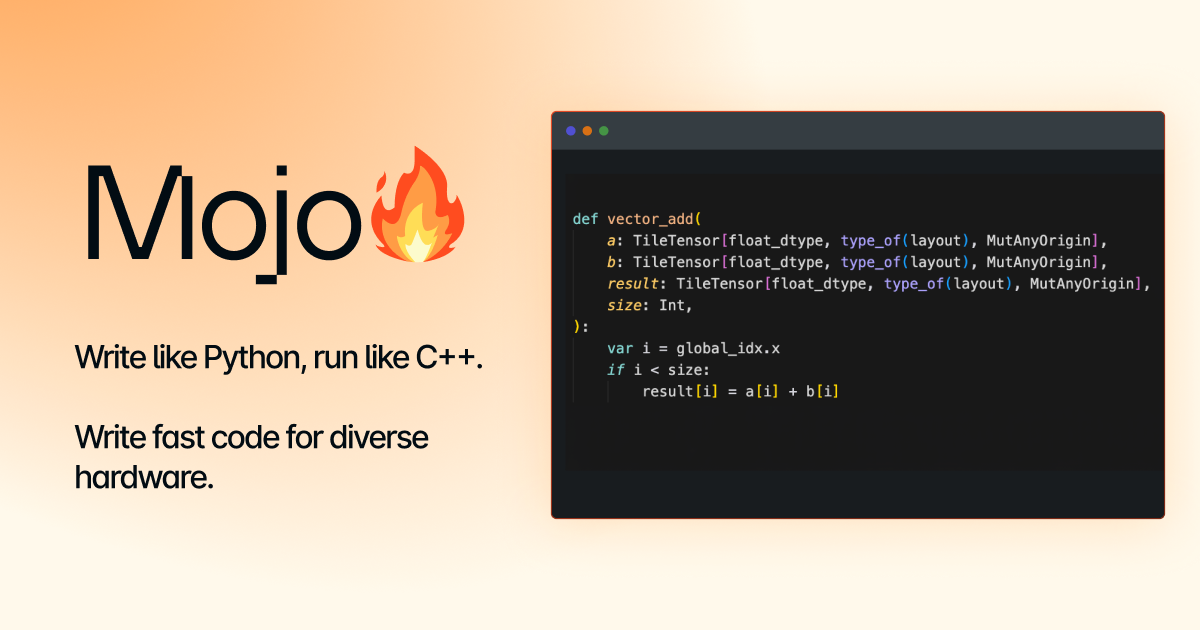
This capability extends directly to the GPU. The ability to write GPU kernels without relying on vendor-specific libraries means that the AI stack becomes more portable and less dependent on the dominance of a single hardware provider. The following example demonstrates how a vector addition kernel is written directly in Mojo, treating the GPU as a first-class citizen of the language:
def vector_add(
 a: TileTensor[float_dtype, type_of(layout), element_size=1, ...],
 b: TileTensor[float_dtype, type_of(layout), element_size=1, ...],
 result: TileTensor[
 mut=True, float_dtype, type_of(layout), element_size=1, ...
 ],
):
 var i = global_idx.x
 if i < layout.size():
 result[i] = a[i] + b[i]
By unifying the CPU and GPU programming models, Mojo transforms the optimization process from a translation task into a refinement task. The developer no longer asks how to translate Python to CUDA, but rather how to refine a Mojo function to better utilize the available hardware. This removes the cognitive load of switching languages and the operational risk of maintaining two separate versions of the same logic.
Modular is pursuing a phased rollout to ensure the ecosystem matures alongside the language. While the compiler remains proprietary for now, the company has set a clear goal to open-source the Mojo compiler by 2026. To facilitate early adoption and community growth, the standard library is already available on GitHub, where developers can contribute to its evolution. For those looking to dive into the technical specifics, the official documentation provides a comprehensive guide, and the GPU puzzles repository offers a hands-on way to master kernel writing.
The industry is moving toward a future where the distinction between a research language and a production language disappears entirely. As more developers replace their performance bottlenecks with Mojo while staying within the Python environment, the barrier to deploying hyper-optimized AI models will continue to collapse.