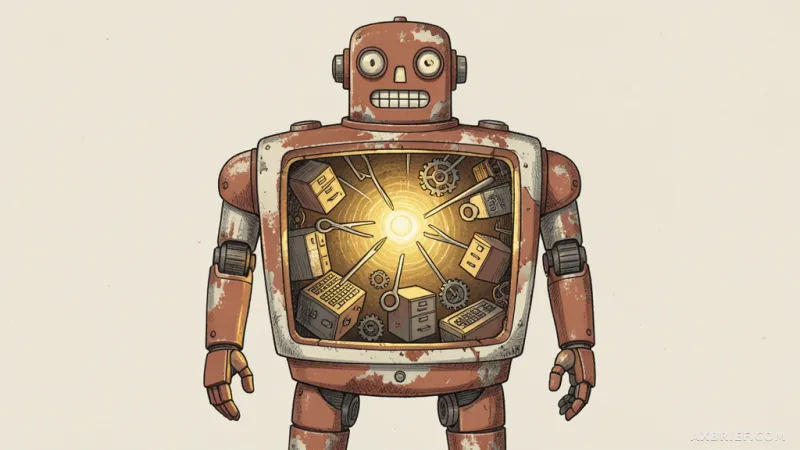
The modern developer often finds themselves trapped in a paradox of digital hoarding. We accumulate thousands of Markdown files, snippets, and research notes across various local folders, yet the act of retrieving a specific insight often feels like searching for a needle in a haystack of plain text. While the industry has pivoted toward cloud-based AI assistants that promise to organize our lives, these tools often require us to surrender our most private thoughts to a remote server or force us into a rigid, proprietary database structure. The tension between the desire for AI-powered synthesis and the need for absolute data sovereignty has left a gap in the market for a tool that treats the local file system as the ultimate source of truth.
The Architecture of a Local-First AI Agent
Kuku enters this space not as a traditional note-taking app, but as an intelligent layer that sits atop existing local Markdown directories. The technical foundation of the application is built for performance and safety, utilizing a sophisticated stack that combines Tauri for the desktop framework, SolidJS for the reactive user interface, and a backend powered by Rust and Go. This combination allows Kuku to handle heavy file system operations and search indexing with the efficiency of system-level languages while maintaining a fluid, modern web-based frontend. By leveraging Rust and Go, the application ensures that the overhead of managing a large vault of documents remains minimal, even as the knowledge base grows into the thousands of files.
At its core, Kuku implements the essential features of a professional knowledge management system. It provides full-text search, graph views for visualizing connections, and support for wikilinks and backlinks. These features allow users to create a non-linear web of information, mirroring the way the human brain associates ideas. However, the true innovation lies in how Kuku integrates artificial intelligence. Rather than building a proprietary cloud AI, Kuku adopts a Bring Your Own (BYO) model, requiring users to provide their own Gemini API keys from Google. This architectural choice ensures that the application remains a lean client, while the user retains control over their API usage and data flow.
Shifting from AI Chatbots to AI Agents
Most AI integrations in productivity software follow a predictable pattern: a sidebar chat window where the user asks a question and the AI provides an answer. This creates a fragmented workflow where the AI is a consultant existing outside the document, and the user must manually copy and paste insights back into their notes. Kuku disrupts this pattern by reimagining the AI as an agent capable of proposing direct modifications to the knowledge base. Instead of a separate conversation, the AI analyzes the vault and suggests specific changes to the text.
The critical distinction here is the implementation of a diff-based review system. When the AI suggests an edit or a new connection between notes, Kuku does not simply overwrite the file. Instead, it presents the change in a format identical to a code editor's diff view, highlighting exactly what is being added or removed. This creates a necessary friction point that prevents AI hallucinations from silently corrupting a user's personal knowledge base. The user acts as the final editor, reviewing the proposed changes and deciding whether to commit them to the local disk. This transforms the AI from a potential source of error into a collaborative editor that enhances the user's existing thoughts without stripping them of agency.
This approach solves the problem of volatility inherent in AI chats. In a standard LLM interface, an insight generated during a session is often lost once the window is closed unless the user proactively saves it. In Kuku, the AI's output is designed to become a permanent part of the local Markdown asset. By focusing on the modification of the source file rather than the generation of a chat response, Kuku ensures that the AI contributes to the long-term growth of the user's second brain rather than creating a separate, ephemeral stream of data.
Currently, Kuku is available as a public beta for macOS and is distributed as an open-source project under the MIT license. This transparency allows the developer community to audit the data handling processes and contribute to the tool's evolution. The project is hosted on GitHub, where users can explore the source code or contribute to the development of new features. The current roadmap emphasizes two primary goals: the implementation of self-hosting synchronization methods to allow users to sync their vaults across devices without relying on third-party clouds, and deep compatibility with Obsidian, the industry standard for local Markdown notes, to facilitate seamless migration.
Developers interested in testing the application or contributing to its growth can set up the environment using the following commands:
git clone https://github.com/kuku-app/kuku
cd kuku
npm install
npm run tauri dev
The project can be accessed directly through its GitHub repository.
The shift toward diff-based AI editing marks the beginning of a new era where humans act as curators rather than just prompt engineers.