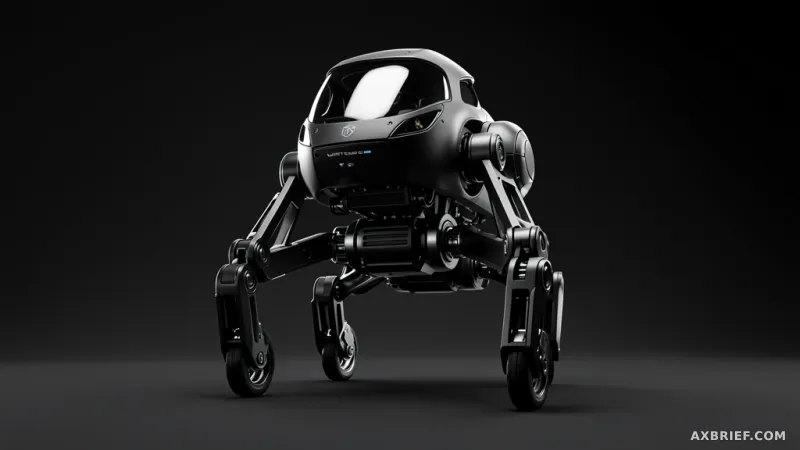
The image of a human-piloted mecha crashing through a brick wall is no longer confined to cinematic concept art or high-budget sci-fi. On Weibo, the dominant social media platform in China, a video recently surfaced showing Unitree CEO Wang Xingxing operating a massive, metallic frame that pulverizes a wall with calculated force. This demonstration was not merely a stunt for viral engagement but a calculated signal to the global robotics community. It marks the moment when the industry shifts from creating autonomous assistants to building rideable, heavy-duty platforms capable of physical dominance.
The Hardware of the GD01
Unitree has officially unveiled the GD01, a transformable robot designed for human occupancy. According to recent Shanghai IPO filing documents, the starting price for the unit is 3.9 million yuan, which converts to approximately $537,000. This figure represents a correction from earlier market rumors that had pegged the price at $650,000. When a pilot is seated within the chassis, the total weight of the machine reaches roughly 500kg. In its fully upright bipedal stance, the GD01 towers over its operator, reaching a height more than double that of an average adult human.
The engineering core of the GD01 lies in its versatile locomotion system. The robot is capable of switching between a bipedal mode, which mimics human walking patterns, and a quadrupedal mode designed for maximum stability on irregular or unstable terrain. To further enhance its ability to navigate treacherous environments, the GD01 features a frame that can tilt from a vertical to a horizontal orientation. This mechanical flexibility allows the machine to maintain balance and traction where traditional wheeled or strictly bipedal vehicles would fail.
From Robot Dogs to Capital Showcases
For years, Unitree built its reputation by aggressively pursuing the low-cost robot dog market, positioning itself as a disruptive alternative to the high-end engineering of Boston Dynamics. However, the GD01 signals a fundamental pivot in corporate strategy. By scaling up from small, autonomous pets to a massive, rideable platform, Unitree is moving away from the consumer electronics trajectory and toward the realm of specialized heavy machinery. The GD01 is less of a humanoid robot in the traditional sense and more of a walking transport vehicle.
The $537,000 price point confirms that the GD01 is not intended for the general public. Instead, Unitree is positioning the platform for a niche intersection of industrial operators, theme park developers, and ultra-high-net-worth individuals. The demonstration of the robot destroying a brick wall was a deliberate attempt to prove structural rigidity and physical power, suggesting that the machine is intended for environments where raw force and stability are more valuable than delicate dexterity.
This product launch coincides with a massive financial play. Unitree is currently pursuing an IPO on the Shanghai A-share market with a valuation target of $610 million. This would make it the first humanoid-focused robotics company to go public in China. The timing suggests that the GD01 serves as a physical manifestation of the company's technical maturity, designed to instill confidence in investors rather than to capture immediate mass-market share. While the robot is currently limited to the Chinese market, the company faces significant hurdles before it can expand into the West.
Regulatory barriers in Europe and North America are far more daunting than the technical challenge of bipedal movement. The European Union's Machinery Regulation, set for full implementation in 2027, imposes rigorous safety standards on any industrial machine that physically interacts with humans in a commercial setting. The GD01, with its 500kg mass and capacity for physical destruction, would require exhaustive safety certifications that Unitree has not yet begun to address. Furthermore, critical performance data—such as battery endurance, autonomous navigation range, and the maximum load capacity per leg—remain undisclosed, leaving a gap in the technical understanding of the machine's actual utility.
The mass production of a rideable robot is less an evolution of utility and more a high-stakes showcase for the capital markets.