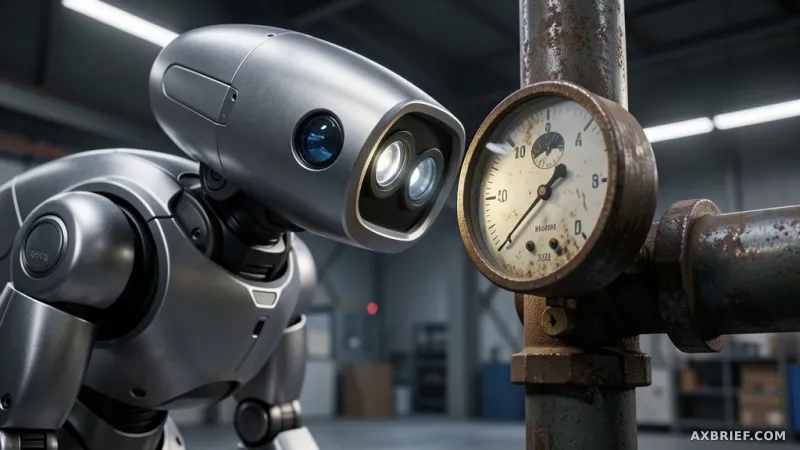
A technician stands before a sight glass, squinting at a thin column of liquid to determine if a tank is reaching its critical fill level. For decades, this has been the reality of industrial maintenance: a human operator manually counting tick marks on a glass tube or interpreting the needle of a vibrating analog pressure gauge. It is a process prone to fatigue and human error, yet it remains the gold standard for safety in high-stakes environments. This week, the boundary between human observation and machine perception shifted as the industry moved toward a model where AI does not just see the gauge, but understands the measurement.

The Integration of Gemini Robotics ER 1.6 into Orbit

Boston Dynamics, the creator of the Spot robot and the Orbit automation platform, has partnered with Google Cloud and Google DeepMind to integrate Gemini and Gemini Robotics ER 1.6 into Orbit AIVI-Learning. This visual inspection and learning tool received a comprehensive update on April 8, 2026, making the new capabilities available to all AIVI-Learning users. The system is designed to handle a sophisticated array of industrial tasks, including 5S compliance audits, pallet quantity calculations, and the detection of liquid puddles on factory floors. Most notably, the update introduces the ability to read analog gauges that track pressure and temperature, effectively digitizing legacy hardware without requiring physical sensor upgrades.

To accommodate various industrial security and infrastructure needs, the deployment environment is flexible. Users can access the system via a Site Hub for local on-site data management, through a Virtual Machine (VM), or via cloud hosting. This flexibility ensures that the high-compute requirements of the Gemini Robotics ER 1.6 model can be managed according to the specific latency and privacy requirements of the facility.

From Object Detection to Industrial Reasoning

The fundamental shift in this update is the transition from simple object recognition to high-level cognitive reasoning. Previous iterations of industrial AI were largely binary; they could identify whether a specific object was present or absent in a frame. Orbit AIVI-Learning now moves beyond this by interpreting the state of an object. Instead of merely identifying a digital display, the AI reads the specific numerical value; instead of spotting a gauge, it analyzes the needle's position to determine the current pressure level. This capability indicates that Gemini Robotics ER 1.6 is beginning to grasp the physical context of the environment, treating a gauge not as a shape, but as a source of critical data.

This evolution extends to the operational lifecycle of the software. The traditional model of updating industrial software involved scheduled downtime or manual patches that risked interrupting 24/7 production cycles. The new system implements Zero-Downtime Upgrades, allowing models to be refined and updated in the cloud without halting the robot's operation. This ensures that inspection accuracy improves continuously without incurring maintenance costs or production losses.

Furthermore, Boston Dynamics has addressed the black-box problem inherent in deep learning. In an industrial setting, an AI's misinterpretation of a gauge could lead to a catastrophic safety failure. To mitigate this, the system now utilizes AIVI prompts that allow operators to examine the logical steps the model took to reach its conclusion. By making the reasoning process transparent, the system provides a layer of verification that is essential for safety-critical audits. Looking forward, the addition of Site View will expand these capabilities into real-time alerting for unauthorized personnel or hazardous spills. However, this leap in intelligence comes with a specific requirement: users must share their data with Boston Dynamics to leverage these advanced models.

Industrial AI has moved past the era of simple vision and entered the era of logical interpretation.