Systems programmers often find themselves in a frustrating paradox when building user interfaces. While languages like Zig offer unparalleled control over memory and hardware, the ecosystem for UI frameworks often forces a choice between bloated C++ wrappers that complicate the build pipeline or slow, interpreted layers that negate the performance benefits of the language. This friction creates a significant barrier for developers who want to build high-performance desktop or web applications without inheriting a massive tree of external dependencies.
The Architecture of Hardware-Accelerated Rendering
Gooey emerges as a specialized solution designed specifically for the Zig ecosystem, focusing on GPU acceleration to handle the heavy lifting of UI rendering. Rather than relying on a single abstraction layer that might introduce overhead, Gooey targets platform-specific APIs directly. It supports Metal for macOS, Vulkan and Wayland for Linux, and leverages WebAssembly (WASM) alongside WebGPU for browser-based deployments. By interfacing directly with these hardware-acceleration layers, the framework ensures that the UI remains fluid even when the application is under significant load.
One of the primary challenges in any UI framework is the efficient rendering of massive datasets. Gooey addresses this through a sophisticated virtualization system. The VirtualizedList component is engineered to handle both fixed and variable height elements, but its core strength lies in its rendering logic. Instead of attempting to instantiate every item in a dataset, the framework calculates the visible viewport and renders only the elements currently seen by the user. This approach ensures that memory consumption remains constant regardless of whether the list contains ten items or ten thousand.
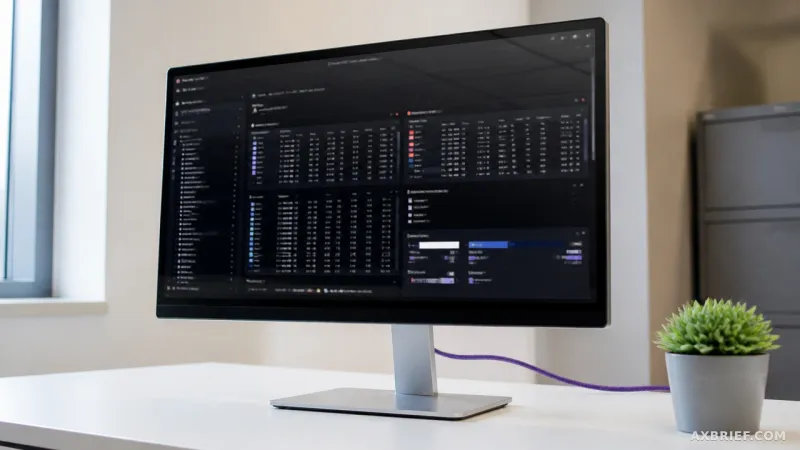
This virtualization philosophy extends to the 2D Table component. The table supports simultaneous horizontal and vertical virtualization, allowing developers to present vast grids of data without crashing the GPU or stalling the main thread. To maintain usability, the table includes native support for column resizing, data sorting, and item selection, providing a professional-grade data management interface that operates with minimal resource overhead.
The Zero-Allocation Strategy and Asynchronous State
While rendering efficiency is critical, the real technical friction in UI development occurs at the intersection of the UI thread and asynchronous background tasks. In traditional frameworks, executing a network request or a heavy file I/O operation on the main thread leads to the dreaded frozen screen. Gooey solves this by leveraging the capabilities of Zig 0.16, specifically utilizing `std.Io` to decouple asynchronous work from the rendering loop.
Developers can spawn background tasks using `cx.io().async(...)`, which offloads the computation to a separate thread. The results of these operations are not pushed directly into the UI state—which would create dangerous race conditions and require complex locking mechanisms—but are instead placed into a finite queue known as `std.Io.Queue(T)`. The render loop polls this queue at the start of every frame, draining the results and updating the UI state in a single-threaded, deterministic manner. This architecture eliminates lock contention and ensures that the UI remains responsive regardless of the complexity of the background processing.
To further optimize performance, Gooey implements a strict zero-allocation strategy for data passing. The framework imposes a rigid 8-byte limit on handler arguments. Functions such as `updateWith`, `commandWith`, and `deferWith` facilitate this by packing arguments internally into a `u64` type. If a developer attempts to pass data exceeding this 8-byte threshold, the framework triggers a compile-time error. By shifting this constraint to the build phase, Gooey removes the need for dynamic memory allocation during runtime, effectively eliminating heap fragmentation and reducing the overhead of the garbage collector or manual memory management in the hot path of the UI loop.
This lean approach extends to the framework's dependency model. Most modern frameworks rely on a complex web of packages defined in files like `build.zig.zon`, which often leads to version conflicts and bloated build times. Gooey intentionally removes all external Zig package dependencies. It links directly to the platform's system frameworks and libraries, ensuring that the build pipeline remains simple and the runtime remains lightweight. This design choice means that the framework is not subject to the volatility of third-party library updates, providing a more stable foundation for long-term project maintenance.
Visual consistency is handled through a semantic role-based theme system rather than hard-coded color values. By integrating the Catppuccin Latte and Catppuccin Macchiato palettes, Gooey allows components to determine their own colors based on their assigned role. This means a button or a text field knows how to style itself based on the active theme, allowing for an instantaneous global switch between light and dark modes. Furthermore, the framework simplifies typography through a single source of truth: the `font_size_base` field. With a default value of 14, this single variable controls the scaling of all text across the entire interface, ensuring a consistent visual hierarchy without requiring manual adjustments to individual components.
By combining a zero-dependency philosophy with a strict zero-allocation memory model, Gooey transforms the way Zig developers approach UI construction. It proves that high-level interface capabilities can be achieved without sacrificing the low-level efficiency that makes systems programming attractive.