For years, the gold standard for autonomous robot navigation has been a costly array of sensors. To move through a complex office or a crowded warehouse without crashing, developers have relied on LiDAR for precise distance mapping and depth sensors to perceive the three-dimensional world. This hardware-heavy approach creates a high bill of materials and a nightmare of sensor calibration, where a slight misalignment in a depth camera can lead to a total system failure. The industry has long sought a way to achieve high-fidelity navigation using only the visual data a human uses: a simple camera feed.
The 8B Parameter Leap in Visual Navigation
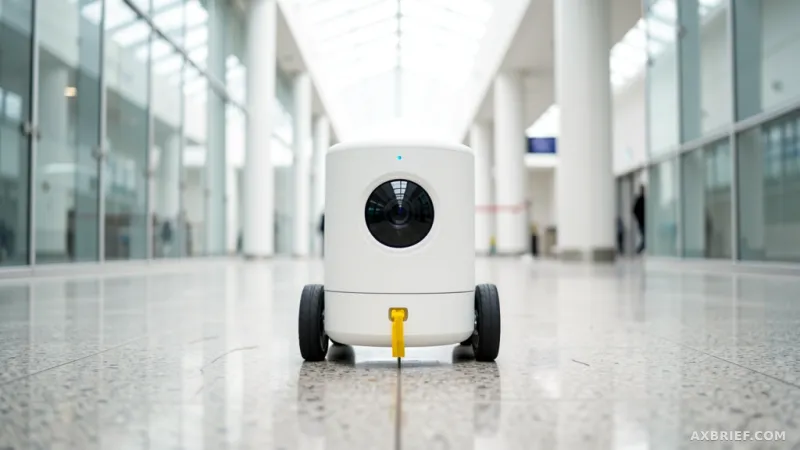
Mistral has entered this arena with Robostral Navigate, an 8B parameter model designed to steer robots using nothing more than a single RGB camera and natural language instructions. Rather than relying on specialized hardware to calculate distance, the model processes raw images and text to determine the optimal path to a destination. The performance metrics suggest a significant shift in what is possible with vision-only systems. In the R2R-CE (Room-to-Room in Continuous Environments) benchmark, Robostral Navigate achieved a 76.6% success rate in validation unseen environments—areas the model had never encountered during training. In validation seen environments, that success rate climbed to 79.4%.
These numbers are not just incremental improvements; they represent a reversal of the traditional hardware hierarchy. Robostral Navigate outperformed existing single-camera approaches by 9.7 percentage points. More strikingly, it surpassed top-tier systems that utilize depth sensors or multi-camera arrays by 4.5 percentage points. This suggests that the intelligence of the model is now compensating for the lack of raw sensor data. The model is designed for extreme versatility, operating across wheeled, legged, and flying hardware. Because it does not rely on specific camera intrinsics or the physical dimensions of the robot, it maintains generalized performance across various platforms in offices, residential homes, commercial buildings, and outdoor spaces.
From Metric Displacement to Visual Pointing
The core innovation of Robostral Navigate lies in how it perceives movement. Traditional navigation models often attempt to predict metric displacements—calculating exactly how many meters a robot should move forward or turn. This approach is fragile because it depends heavily on the scale of the world and the specific calibration of the camera. Mistral instead implemented a pointing-based prediction system. The model infers the image coordinates of the target location and the required orientation within the current camera view to decide the next move. By predicting coordinates directly on the image plane, the system becomes agnostic to the world scale and camera settings.
When a target falls outside the current field of view, the model dynamically switches to displacement commands based on the robot's local coordinate frame. This hybrid logic is built upon a Vision-Language Model (VLM) specialized in grounding tasks such as pointing, counting, and object localization. Essentially, Mistral took a model that already understood where objects were in a picture and extended that spatial intelligence into a navigation capability. To fuel this, they utilized a massive simulation pipeline that generated approximately 400,000 trajectories across 6,000 distinct scenes.
Training a model of this scale usually requires months of compute, but Mistral introduced a prefix-caching algorithm to break this bottleneck. By employing a tree-based attention-masking strategy, the team compressed entire episodes into a single sequence. This allows the model to train all time-steps in a single forward pass while preventing information leakage between steps. The result was a 22-fold reduction in training tokens, slashing the development timeline from several months down to just a few days.
To solve the distribution shift problem—where a model performs well in simulation but fails in the real world due to slight differences in data—Mistral applied CISPO, an online reinforcement learning algorithm. By conducting post-training via CISPO after the initial supervised learning phase, the model learned to recover from failures through trial and error. This refinement alone provided a 3.2% boost in overall success rates.
This shift moves the burden of robot performance from the hardware engineer to the AI researcher. By proving that a single RGB camera can outperform a LiDAR-equipped system, Mistral is signaling a future where the complexity of a robot is defined by its data and token management strategies rather than the cost of its sensor suite.