
For the past two years, the enterprise AI narrative has been dominated by the cloud. The promise was simple: outsource the massive compute requirements to a handful of hyperscalers and pay for what you use. But in the boardrooms of global financial institutions and government agencies, a quiet anxiety has been building. The convenience of the cloud is increasingly clashing with the rigid realities of data sovereignty and the spiraling costs of token-based subscriptions. The industry is realizing that while renting intelligence is a great way to start, owning the infrastructure is the only way to scale securely.
The Capital Surge and the Intel Alliance
SambaNova Systems has positioned itself as the primary alternative to the cloud-centric status quo, a bet that has recently paid off with a massive infusion of capital. The company has secured a $1 billion Series F funding round, propelling its corporate valuation to $11 billion. Led by General Atlantic, this round represents a primary closing phase, with additional investors expected to join shortly. The velocity of this funding is particularly striking; it comes only five months after a $350 million Series E round closed in February, signaling an aggressive acceleration in investor confidence.
This financial momentum is underpinned by a strategic technical alliance with Intel. Rather than competing in a vacuum, SambaNova has entered a multi-year partnership to optimize AI inference specifically for Intel Xeon processors. This is not a mere vendor relationship but a deep integration where both companies co-develop products and execute joint go-to-market strategies. Intel, which has been a consistent investor since the Series C stage, participated in the Series F round, effectively doubling down on a hardware stack designed to move AI out of the public cloud and into the private data center.
The Architecture of AI Sovereignty
To understand why a bank like JPMorganChase would pivot toward SambaNova, one must look at the physical constraints of modern AI. Most frontier models—those with trillions of parameters—are so massive that they must be distributed across multiple server racks. This distribution creates a physical bottleneck; data must travel across cables and switches, introducing latency and increasing the risk of failure. SambaNova has solved this by engineering a system capable of hosting these trillion-parameter models within a single rack. By collapsing the physical distance the data must travel, they have fundamentally optimized the speed and efficiency of inference.
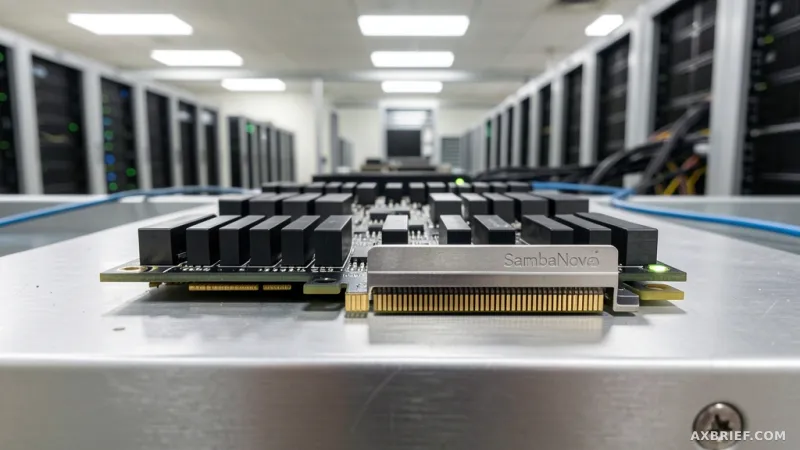
This shift transforms the economic model of AI. Cloud subscriptions are essentially rent payments for someone else's data center, where costs scale linearly—or even exponentially—with usage. By moving to an on-premises model, enterprises transition from tenants to homeowners. The hardware roadmap supports this transition: the SN40L was released in a cloud version in September 2023 and an on-premises version in November 2023. The next leap, the SN50 chip, was unveiled in February 2026 and is scheduled for customer delivery in the second half of 2026. SoftBank has already signed on as the first deployment partner to validate this next-generation infrastructure in a live environment.
This technical capability is the catalyst for the rise of Sovereign AI. For entities like Saudi Aramco or national governments, the goal is not just performance, but control. Sovereign clouds allow nations to keep their data within their own borders, free from the jurisdiction or outages of foreign tech giants. JPMorganChase is applying this same logic to finance, utilizing SN40L and SN50 systems to ensure that sensitive financial inference happens entirely within its own walls. By building a heterogeneous infrastructure that mixes different chip architectures, the bank is reducing its dependency on any single provider while maximizing security.
As the honeymoon phase of public cloud AI ends, the focus is shifting toward the tangible control of the hardware stack. The ability to run a trillion-parameter model on a single rack means that the most powerful AI in the world no longer requires a lease from a hyperscaler.



