Every time a user prompts a large language model for a complex piece of code or a nuanced strategic analysis, a silent, massive industrial operation springs into action. Thousands of GPUs and TPUs synchronize across sprawling server farms, consuming megawatts of power to predict the next token in a sequence. For the end user, the experience is a seamless chat interface, but for the providers, it is a brutal war of attrition fought with silicon and electricity. The industry has reached a tipping point where the elegance of an algorithm is secondary to the sheer volume of compute available to run it.
The $80 Billion Infrastructure Blueprint
Alphabet has officially entered this hardware arms race with a massive financial maneuver, announcing a plan to raise $80 billion in capital to expand its AI infrastructure and computing capabilities. This capital raising effort, primarily executed through the issuance of shares, represents one of the most aggressive infrastructure bets in the history of the computing era. The objective is clear: Alphabet intends to secure a dominant lead in the physical layer of artificial intelligence.
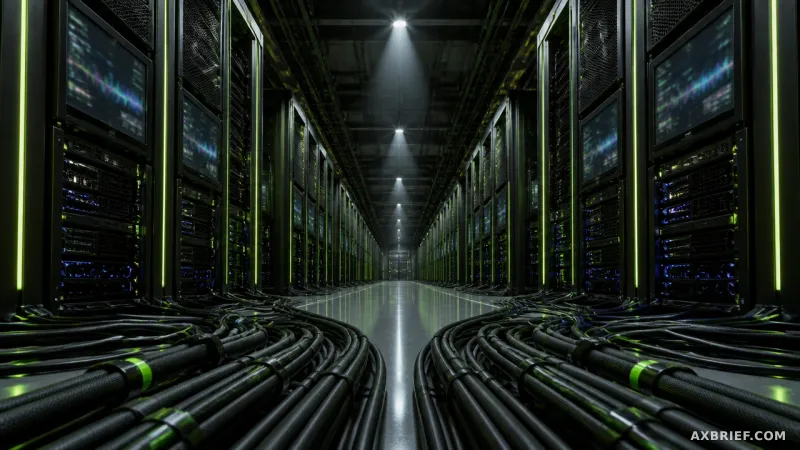
The allocated funds are earmarked for two primary pillars of AI production. First, the company is aggressively scaling its procurement of AI accelerators. While Google has long relied on its proprietary Tensor Processing Units (TPUs), the current demand for high-performance compute requires a broader and deeper inventory of chips to support the next generation of multimodal models. Second, Alphabet is investing heavily in the construction and expansion of hyperscale data centers. These are not traditional server rooms but massive industrial complexes designed specifically to handle the thermal and power demands of AI workloads, which far exceed those of standard cloud computing.
By securing $80 billion, Alphabet is not merely updating its hardware cycle; it is building a dedicated factory for intelligence. The scale of this investment ensures that the company can maintain its internal research velocity without being throttled by hardware shortages or the volatility of the global chip supply chain.
From Algorithmic Superiority to Compute Moats
For the first several years of the generative AI boom, the primary metric of success was the architecture of the model. The industry obsessed over parameter counts, attention mechanisms, and training datasets. The prevailing belief was that a more efficient architecture could outcompete a larger, clumsier one. However, the current trajectory of the industry suggests a reversal of this logic. We are moving from an era of algorithmic competition to an era of infrastructure dominance.
This shift occurs because the ceiling for model performance is currently tied to the amount of compute available during both the training and inference phases. When a company like Alphabet commits $80 billion to hardware, they are creating a compute moat. A competitor might develop a model that is 10 percent more efficient, but that advantage is instantly negated if Alphabet can deploy 100 times more computing power to process data or serve users. The bottleneck has shifted from the software engineer's desk to the electrical grid and the semiconductor fabrication plant.
This transition transforms AI from a pure software play into a capital-intensive industrial operation. The ability to iterate on a model is now directly proportional to the amount of hardware a company can keep running in parallel. By investing in the physical layer, Alphabet is ensuring that it can experiment faster, train larger models, and offer lower latency than any player lacking similar capital reserves. The tension is no longer about who has the best idea, but who has the most silicon.
This strategic pivot indicates that the winners of the AI era will not necessarily be those who write the best code, but those who can manage the most complex supply chains and the largest energy footprints. The intelligence of the AI is now a function of the scale of the infrastructure supporting it.
This massive capital injection effectively raises the barrier to entry for the entire industry, turning the AI race into a game of financial and physical endurance.