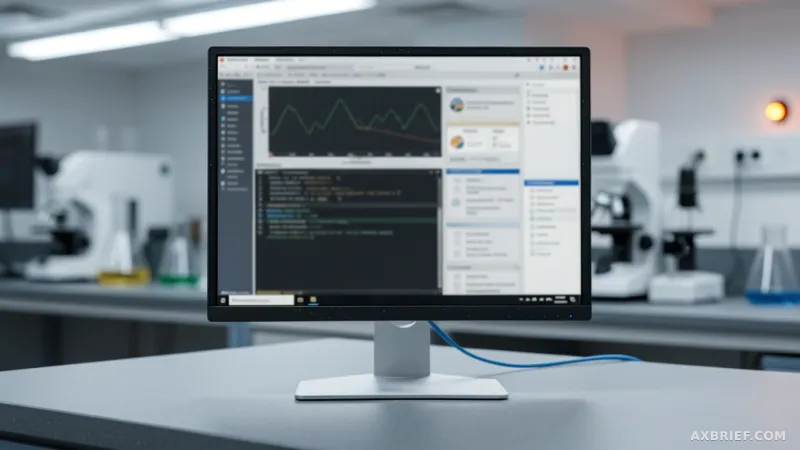
The modern biological researcher lives in a state of constant cognitive friction. On one screen, a large language model generates a sophisticated Python script for genomic analysis or a complex bash script for a protein folding simulation. On the other, a terminal window remains open to a remote High-Performance Computing (HPC) cluster, where the researcher must manually SSH into a node, struggle with conflicting Conda environments, and painstakingly track which version of a script produced which specific figure in a draft manuscript. This disconnected workflow—the gap between AI-assisted ideation and actual execution—is where scientific reproducibility often goes to die. The act of copying and pasting code from a chat interface into a terminal is not just a nuisance; it is a break in the chain of provenance that makes auditing scientific results a manual nightmare.
The Integrated Architecture of Claude Science
Claude Science emerges as a dedicated scientific computing environment designed to collapse this gap, transforming the AI from a side-car assistant into the central nervous system of the research workbench. Operating on macOS and Linux, the platform moves beyond the chatbot paradigm to provide a native environment where data processing, execution, and publication are unified. At its core, the system integrates natively with the infrastructure researchers already rely on, allowing for the direct control of local notebooks, Linux workstations, and HPC login nodes. By automating the submission of batch scripts via SSH and supporting serverless GPU management through Modal, Claude Science removes the manual overhead of infrastructure orchestration.
The technical backbone of this integration relies heavily on the Model Context Protocol (MCP), which allows the AI to interface directly with external specialized tools and datasets. Claude Science connects to over 60 scientific databases, enabling researchers to extract data without mastering the idiosyncratic query languages of every individual repository. This is exemplified by its integration with LatchBio, a bioinformatics tool platform, and Helix, a genomic data platform. Through these MCP servers, the AI can directly control validated bioinformatics pipelines and manage massive clinical-genomic datasets. Furthermore, the environment incorporates the NVIDIA BioNeMo toolkit, providing the computational muscle required for state-of-the-art generative AI in drug discovery and protein design.
Beyond connectivity, the platform treats scientific visualization as a first-class citizen. Rather than outputting static images that must be saved and renamed manually, Claude Science natively visualizes protein and molecular structures. This integration ensures that the visual representation of a molecule is tied directly to the data and code that generated it, creating a seamless transition from raw data to visual insight.
Solving the Reproducibility Crisis Through Provenance
While the ability to execute code on an HPC cluster is a significant convenience, the true shift offered by Claude Science is the institutionalization of provenance. In traditional research, a figure in a paper is often the result of a long, undocumented trail of trial-and-error scripts and environment tweaks. Claude Science solves this by automatically archiving the exact state of the world for every output. Every plot, table, and notebook is stored alongside the precise code used to generate it, the specific software environment configuration, and the full history of the AI conversation that led to the analysis. This means a researcher can return to a result months later and reproduce it with a single click, or provide a transparent audit trail during the peer-review process to defend the validity of their findings.
This commitment to reliability extends to the verification of the AI's own output. To combat the risk of hallucinations in high-stakes scientific data, the platform implements an agent-based fact-checking system. Background reviewer agents operate in parallel with the primary analysis, scanning outputs for inconsistencies. These agents are designed to flag untraceable numbers, incorrect citations, or figures that deviate from the underlying source code. By automating the cross-referencing process that researchers previously performed manually, the system builds a layer of trust into the generative process, ensuring that the speed of AI does not come at the cost of scientific accuracy.
The most profound impact of this shift is the democratization of computational biology. For years, a divide has existed between the biological hypothesis-drivers and the computational specialists who execute the analysis. Researchers without deep expertise in Linux administration or Python optimization often found their progress throttled by the technical barrier of the HPC. Claude Science effectively lowers this barrier, allowing non-computational biologists to execute complex data pipelines directly. This is already being put into practice by the drug discovery firm Xaira, which uses the tool to compress the timeline from hypothesis generation to empirical validation. By removing the need for researchers to become infrastructure experts, the platform shifts the value proposition of the scientist from their ability to manage a server to their ability to design a rigorous analysis.
The transition from manual deployment to an integrated AI workbench marks a fundamental change in how scientific discovery is conducted. When the friction of infrastructure is removed and the chain of provenance is automated, the bottleneck of research shifts from technical execution to intellectual design.