The modern developer's workflow is currently defined by a fragmented loop of cognitive friction. A programmer writes a prompt in a chat window, waits for a response, copies a block of code, and pastes it into an IDE, only to realize a small error requires another trip back to the browser. This constant oscillation between the creative space of the editor and the conversational space of the AI creates a hidden tax on focus, where the act of managing the tool becomes as demanding as the act of coding itself. The industry has long sought a way to bridge this gap, moving beyond the keyboard and mouse to something that feels less like a conversation and more like a cockpit.
The Architecture of the kbd-1.0-codex-micro
To solve this interface crisis, OpenAI has partnered with Work Louder to design the Codex Micro, a dedicated physical controller for AI agents. Released under the model name `kbd-1.0-codex-micro`, the device is priced at $230 and is currently available for pre-order, with an expected shipping date of July 24. The hardware is designed to move the most frequent AI agent interactions out of the software layer and into the physical realm, placing tactile controls directly under the user's fingertips to eliminate the need for repetitive tab-switching.
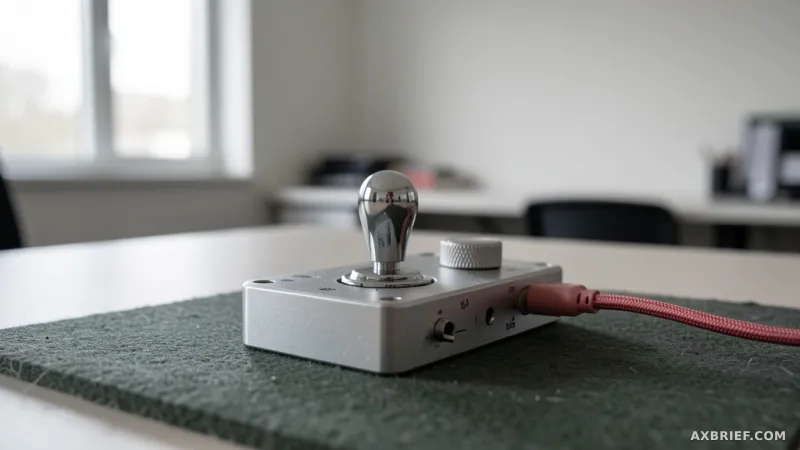
The device is built for professional durability and precision, featuring a body CNC machined from PC and aluminum. The bottom plate undergoes a sandblasted anodized treatment to ensure a premium finish and long-term wear resistance. In terms of raw input capabilities, the Codex Micro integrates 13 mechanical switches, one touch sensor, one rotary encoder, and a planar joystick. Users can choose between Clicky switches for tactile feedback or Silent switches for quieter office environments. The package includes the Creator Micro main unit, a USB-C to USB-C cable, and the Codex Icon Keyset, which provides visual identifiers for the specific agent functions assigned to each key.
Connectivity is handled via Bluetooth and USB-C, ensuring the device is compatible with both Mac and Windows environments. By providing a dedicated hardware layer for agent control, OpenAI is attempting to standardize the way developers interact with autonomous systems, moving the interaction model from a generic text box to a specialized toolset.
Shifting from Prompting to Piloting
While the specifications describe a high-end peripheral, the actual shift occurs in how the developer perceives the AI's role. The inclusion of a planar joystick transforms the act of code review from a linguistic task into a spatial one. Instead of typing commands to navigate a Pull Request (PR), developers can use the joystick to trigger common Codex workflows, such as reviewing code changes, debugging errors, or initiating refactoring sequences. This replaces the high-cost action of menu navigation with a low-cost physical gesture.
This philosophy extends to the dedicated Command keys. Frequent actions—such as accepting or rejecting an AI suggestion, using push-to-talk, or starting a new chat session—are mapped to physical buttons. This removes the need to hunt for a specific button in a UI or type a confirmation command, effectively collapsing a multi-step software process into a single keystroke. The tension between the human's intent and the AI's execution is reduced when the confirmation happens via a physical switch rather than a mouse click.
Perhaps the most significant departure from traditional interfaces is the rotary dial used to adjust the Reasoning Level. In the current AI paradigm, the depth of a model's thought process is often hidden or managed through complex system prompts. The Codex Micro brings this into the physical world, allowing users to dial up the reasoning intensity for complex architectural logic or dial it down for simple typo fixes to get faster responses. This turns the AI's cognitive depth into a variable that can be tuned in real-time, much like a photographer adjusts the aperture on a lens to change the depth of field.
Beyond the controls, the device addresses the anxiety of the waiting period. The Agent Key utilizes integrated RGB lighting to communicate the internal state of the Codex system. Rather than staring at a blinking cursor in a chat window, the developer can glance at the key to see if the agent is thinking, executing, waiting, or has completed its task. This visual telemetry allows the developer to maintain their flow state in the IDE, only switching back to the chat interface once the hardware signals that the result is ready.
The transition from a software-only interface to a tactile one suggests that the future of AI productivity is not found in better prompts, but in shorter distances. By reducing the physical and cognitive gap between the developer's hand and the agent's execution, the Codex Micro treats the AI not as a chatbot to be questioned, but as a sophisticated instrument to be played.