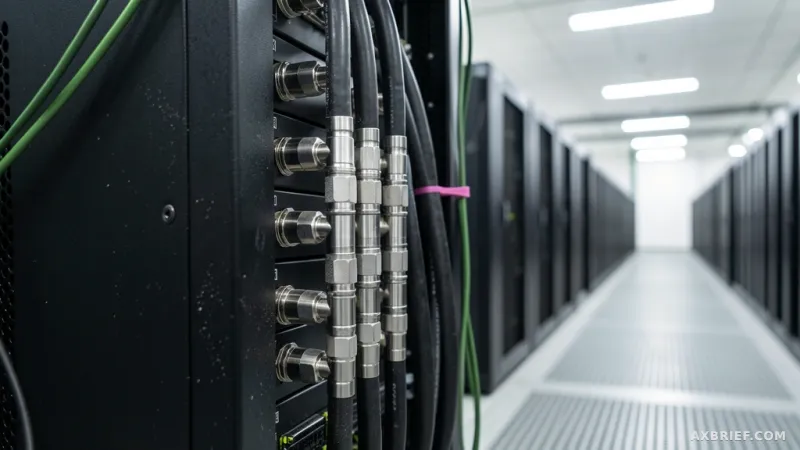
Walking into a modern high-density data center is often an assault on the senses, specifically the ears. The roar is industrial and oppressive, a constant wall of sound generated by tens of thousands of high-RPM cooling fans fighting a losing battle against the heat of thousands of GPUs. For engineers and technicians, ear protection is not a suggestion but a requirement for survival in the aisles. This noise is the audible symptom of a fundamental inefficiency in AI infrastructure: the reliance on air to move heat. As chip TDPs climb, the volume of air required to prevent thermal throttling has reached a physical limit, turning server racks into glorified wind tunnels.
The Architecture of the Fanless AI Factory
NVIDIA is attempting to silence this roar entirely with the Rubin generation of AI infrastructure. The core of this shift is the implementation of 100% liquid cooling, a design philosophy where every single chip and networking component is cooled by liquid, allowing for the complete removal of physical cooling fans from the system. This is not a peripheral upgrade but a foundational change integrated into the NVIDIA DSX (Data Center System) AI Factory reference design, which serves as the blueprint for the next generation of AI industrial stacks.
By extending liquid cooling beyond the GPU to include the networking fabric, NVIDIA has eliminated the primary source of acoustic pollution and mechanical failure in the rack. This transition has immediate physical implications for data center density. In traditional air-cooled setups, the sheer volume of space required for airflow and massive heat sinks often forced systems to occupy 6U of rack space. With the Rubin architecture, this footprint is collapsed to 2U. This three-fold increase in density allows operators to pack significantly more compute power into the same square footage, fundamentally altering the economics of floor space in the data center.
The visual identity of the server has changed as a result. Traditional servers are characterized by perforated bezels—essentially giant grills designed to suck in massive quantities of air. The Rubin server replaces these with clean, sealed front panels. Because there is no longer a need to manage airflow paths or prevent dust ingress from high-velocity fans, the chassis can be fully enclosed, maximizing internal space for power delivery and interconnects while streamlining the overall aesthetic of the AI factory.
Redefining the Thermal Ceiling and Water Economics
The true innovation of the Rubin system, however, lies not in the removal of fans, but in the thermodynamics of the coolant loop. Traditionally, liquid cooling required chilled water to be effective, meaning data centers had to run energy-intensive mechanical chillers to keep the coolant at low temperatures. NVIDIA has broken this dependency by raising the operational temperature of the cooling liquid to a maximum of 45°C (113°F).
When this 45°C coolant enters the cold plates sitting directly atop the processors, it absorbs the concentrated heat of the AI workloads and exits the system at approximately 55°C. Because this temperature range falls within verified operational limits, the system can maintain peak performance without the need for aggressive refrigeration. In many global climates, this allows the facility to bypass mechanical chillers entirely, relying instead on simple facility loops to reject heat into the environment.
This is made possible by a specific chemical composition: a mixture of 75% water and 25% propylene glycol. This fluid travels through cold plates to absorb heat at the source, is managed by a Coolant Distribution Unit (CDU), and is finally pumped to dry coolers—essentially massive radiator coils—where the heat is dissipated into the outside air.
This closed-loop design solves the most pressing environmental critique of the AI era: water consumption. Conventional cooling towers rely on evaporative cooling, where millions of gallons of water are evaporated into the atmosphere to carry away heat. By switching to a dry-cooler-based closed loop, NVIDIA Rubin can reduce water consumption by up to 100%. In favorable climates, this eliminates the consumption of approximately 2.6 million gallons of water per megawatt per year. For a modern AI cluster, this transforms the data center from a water-intensive utility into a water-neutral operation.
The financial incentives are as compelling as the environmental ones. For a hyperscale facility operating at 50MW, the transition to this liquid-cooled architecture can slash annual energy and water costs by more than 4 million dollars. The efficiency gains are linear and predictable; industry estimates suggest that for every 1°C increase in the chiller plant temperature, cooling energy costs drop by approximately 4%. By pushing the coolant temperature to 45°C, NVIDIA is effectively turning thermal management from a sunk cost into a profit lever.
The era of the deafening server room is ending. By replacing the brute force of air with the precision of a closed-loop liquid system, NVIDIA has decoupled AI scaling from water scarcity and acoustic pollution. The viability of the next generation of AI factories will no longer be measured by how much air they can move, but by how efficiently they can move heat.