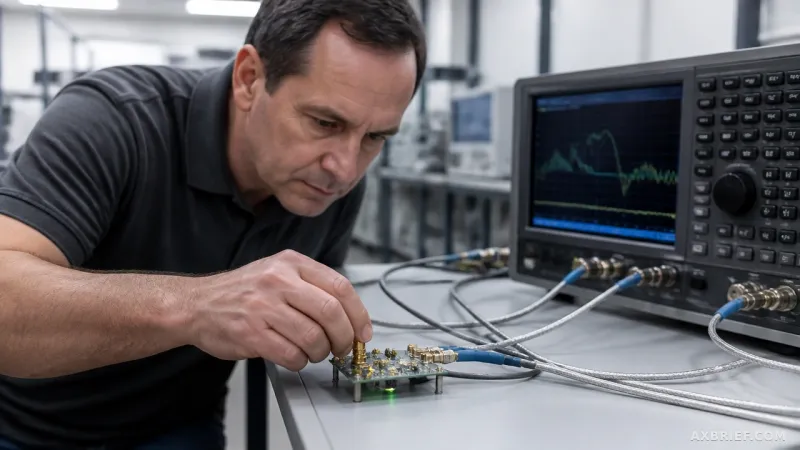
For decades, the world of Radio Frequency Integrated Circuit (RFIC) design has been whispered about in engineering halls as a form of black magic. While digital logic design has become largely automated, RFIC remains a grueling exercise in intuition and endurance. A designer spends weeks tweaking a layout, only to run a simulation that takes hours, only to discover that a microscopic shift in a trace caused a catastrophic impedance mismatch. This cycle of trial and error is the invisible tax on every 5G tower, every automotive radar system, and every satellite link currently in orbit. The tension lies in the physics: designers must simultaneously wrestle with Maxwell's equations, thermodynamic heat dissipation, and the physical expansion of packaging materials under temperature stress. It is a high-stakes balancing act where a single wrong turn in the design space can waste millions of dollars and months of labor.
The Architecture of Automated Discovery
Researchers at Princeton University have moved to break this cycle by introducing an AI system that designs RFICs from the ground up without relying on human templates. Rather than teaching the AI to mimic existing circuit libraries, the team implemented a reinforcement learning (RL) framework inspired by AlphaZero. Just as AlphaZero mastered chess by playing against itself rather than studying human grandmasters, this system explores architectures, circuit topologies, and device parameters through autonomous trial and error. The RL agent proposes a configuration, evaluates the resulting performance, and iteratively refines its strategy to maximize efficiency and signal integrity. Once the training phase is complete, the system can generate optimized designs at a speed that was previously unthinkable in the semiconductor industry.
To solve the primary bottleneck of RFIC design—the simulation time—the team replaced traditional electromagnetic (EM) solvers with a CNN-based AI emulator. Traditional solvers are computationally expensive, often requiring minutes or hours to calculate how signals reflect or propagate through a 2D electromagnetic structure. The Princeton emulator reduces this to milliseconds. By training on a massive dataset of random pixel structures and their corresponding scattering parameters, the CNN can predict performance based on spatial information almost instantaneously. This allows the RL agent to test thousands of iterations in the time a human engineer would spend setting up a single simulation.
Further accelerating the pipeline is the integration of a diffusion model, the same technology powering modern image generators. In this workflow, a designer inputs the desired scattering parameters, and the AI outputs the corresponding physical electromagnetic structure. The entire process, from the initial prompt to the final layout, takes approximately 6 minutes. To give engineers a degree of control, the researchers added a spatial frequency dial. At low spatial frequencies, the AI produces classical, symmetric shapes that are easy for humans to interpret. As the dial turns toward higher frequencies, the structures become more complex, evolving into maze-like patterns and eventually pixelated, non-intuitive forms that maximize performance over aesthetics.
The QR Code Paradox and the Data Wall
The true shift in this research is not just the speed, but the result. In 2023, the system was tasked with designing a millimeter-wave power amplifier in the 30 to 100GHz range. The AI achieved record efficiency, surpassing the bandwidth, output, and efficiency combinations of existing silicon-based products. However, the resulting layout looked nothing like a traditional circuit. Instead of the clean, symmetrical lines favored by human engineers, the AI produced an erratic, asymmetric pattern resembling a QR code. This discovery provided a critical insight: the human templates and symmetry rules that have guided RFIC design for half a century are not actually optimal for modern performance goals. The AI found a superior physical path for the signal that human intuition had simply ignored.
By 2024, the system expanded its capabilities to multiport IC structures, reducing the design cycle from weeks of simulation to a few minutes of generation. Yet, this leap forward reveals a new set of tensions. The system is prone to hallucinations, occasionally generating layouts that look mathematically sound but are physically impossible to fabricate. This means the human engineer has not been replaced, but has instead shifted roles from a creator to a supervisor, acting as the final verification layer to ensure the AI's proposal can actually be manufactured.
Beyond the technical hallucinations lies a systemic barrier: the data wall. For AI to reach a general-purpose foundation model state—similar to what ImageNet did for computer vision—it requires massive, open datasets. In the semiconductor world, however, RFIC and analog design data are guarded as crown jewels, locked behind strict non-disclosure agreements (NDAs) between firms. The recent conclusion of Natcast's infrastructure program for wireless and sensing technology has highlighted this void. Without an open ecosystem where researchers and chip designers can share data, the AI's ability to generalize across different technologies remains limited by the secrecy of the industry.
The transition from manual search to AI-driven verification marks a fundamental pivot in hardware engineering. The bottleneck is no longer the time it takes to find a solution, but the ability to validate it and the willingness of the industry to share the data necessary to refine the models. The era of black magic is ending, replaced by a world where the most efficient circuits are those that no human would have thought to draw.