The local LLM community has long been trapped in a frustrating hardware dichotomy. Developers typically face a choice between the raw compute power of NVIDIA GPUs, which are often crippled by limited VRAM, or the massive unified memory pools of Apple's Mac Studio, which come with a closed ecosystem and a steep price premium. This VRAM wall has forced many to compromise on model size or spend exorbitant sums on multi-GPU arrays that consume massive amounts of power. The tension between the need for high-capacity memory and the desire for an open, flexible development environment has created a gap in the market that professional AI engineers have been desperate to fill.
The Architecture of the Ryzen AI Halo
AMD is attempting to shatter this dichotomy with the release of the Ryzen AI Halo, an AI development kit priced at $3,999.99. At the heart of this machine is the AMD Ryzen AI Max+ 395 processor, built on the latest Zen 5 architecture. This chip is a powerhouse, featuring 16 cores and 32 threads designed to handle the heavy lifting of data preprocessing and model orchestration. However, the real strength lies in its integrated graphics. The system utilizes the AMD Radeon 8060S, which packs 40 RDNA 3.5 Compute Units. By physically integrating the compute units and the processor, AMD has significantly shortened the data processing path, reducing latency and increasing overall throughput for AI workloads.
The most critical specification for any LLM developer is the memory subsystem, and the Ryzen AI Halo delivers a massive 128GB of unified LPDDR5x-8000 memory. This configuration provides a memory bandwidth of 256 GB/s, allowing the system to load multiple large-scale models simultaneously without the typical bottlenecks associated with swapping data between system RAM and discrete GPU memory. To complement this, AMD has included a 2TB M.2 SSD that is fully removable, ensuring that developers can easily scale their storage or migrate datasets between machines. This hardware combination is specifically engineered to move the bottleneck away from memory capacity and toward raw compute efficiency.
Bridging the Gap Between Hardware and Ecosystem
While the raw specs are impressive, the Ryzen AI Halo is positioned not as a consumer mini-PC, but as a dedicated AI Dev Kit. The primary value proposition here is the integration with ROCm, AMD's open software platform for GPU computing. By packaging this hardware into a single, fixed-specification unit, AMD is attempting to remove the friction of component selection and compatibility testing that usually plagues the assembly of AI workstations. The goal is to provide a standardized baseline that allows developers to move from unboxing to experimentation in the shortest time possible.
However, there is a distinct philosophical shift in how this kit is delivered. Unlike a consumer product, the Ryzen AI Halo does not come as a turn-key solution with pre-installed models or optimized driver stacks. Instead, it offers a choice of foundations: Windows 11 Pro or a custom AMD Linux distribution based on Debian 13.4. While the OS is pre-installed, the responsibility of configuring the driver stack, installing specific AI frameworks, and optimizing model weights falls entirely on the developer. This design choice transforms the device from a simple appliance into a flexible sandbox, catering to those who require granular control over their environment rather than a curated, locked-down experience.
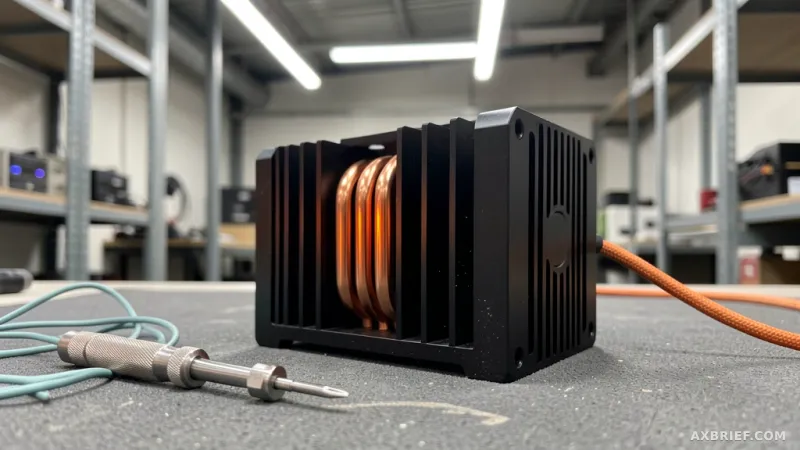
This flexibility extends to the physical design. The entire system is housed in a compact 15cm x 15cm square chassis, with a height of less than 5cm and a total weight of 1.2kg. Despite its small footprint, the machine is built for sustained high-performance inference. It employs two internal blower fans that pull air from the top and sides, pushing it across the heatsinks and out through the rear. With a Thermal Design Power (TDP) of 120W and a 240W power adapter, the system is designed to maintain stability during long inference runs that would typically cause smaller mini-PCs to thermal throttle. Connectivity is equally robust, featuring four USB 3.2 Type-C ports, an HDMI 2.1 port, Wi-Fi 7, Bluetooth 5.4, and a 10GbE Ethernet port for high-speed data transfer across local networks.
The emergence of the Ryzen AI Halo shifts the conversation from simple TFLOPS to the more critical metric of memory efficiency. For the developer, the decision to adopt this platform over a Mac Studio or a custom NVIDIA build now rests on the specific relationship between model parameter size and memory bandwidth. The real-world utility of the 256 GB/s bandwidth will determine the token generation speed for the specific models a team is deploying, making the economic justification a matter of measured inference latency versus hardware cost.