An engineer sits in a semiconductor design office in Pangyo, staring at a screen filled with thousands of intersecting circuit lines. The task is simple in theory: arrange these paths so they never overlap while minimizing the total distance. Yet, as the complexity of the chip grows, the engineer reaches a standstill. Even the most advanced AI models, capable of writing poetry or piloting drones, fail here. The screen freezes or returns a suboptimal guess because the AI has hit a wall known as combinatorial explosion. When the number of possible arrangements grows exponentially, the sheer volume of calculations required to find the absolute best solution exceeds the capacity of any existing silicon processor.
The FPGA Architecture and the Nature Communications Breakthrough
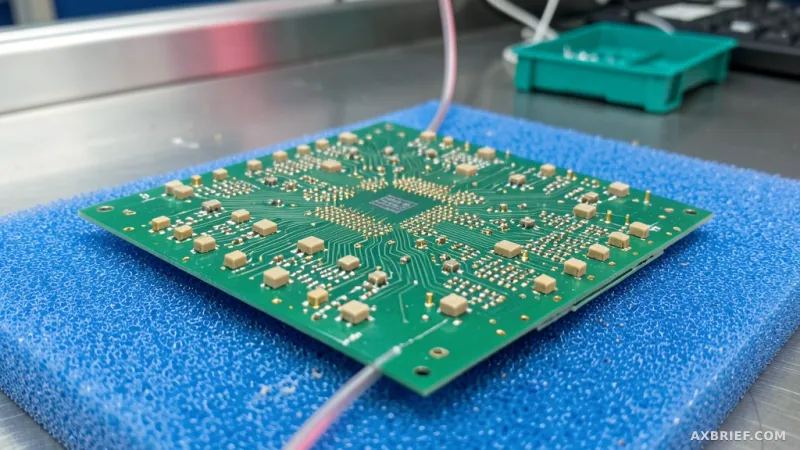
This computational deadlock is not a failure of software, but a limitation of the underlying hardware. Traditional CPUs and GPUs process data in a linear, step-by-step fashion that struggles with the multi-dimensional search spaces of combinatorial optimization. To break this cycle, a multinational research team led by Professor Shantanu Chakrabarty of the University of Washington has developed a new type of computer: a neuromorphic Ising machine implemented on Field-Programmable Gate Array (FPGA) boards. Their findings, recently published in Nature Communications, propose a fundamental shift in how machines arrive at an answer.
The device integrates two critical components: a Fowler-Nordheim annealer and a neuromorphic autoencoder. The autoencoder acts as a brain-inspired neural network that extracts and reconstructs the core features of the input data, while the Fowler-Nordheim annealer utilizes quantum tunneling—a phenomenon where particles pass through energy barriers that would be impassable in classical physics. By combining these, the machine does not simply calculate a result; it simulates a physical process to find the most stable state of a system. This architecture is specifically designed for problems like protein folding and logistics network optimization, where the goal is to select the single most efficient configuration from a nearly infinite pool of candidates.
The research was a global effort, involving collaborations with the Bengaluru Neuromorphic Engineering Workshop (BNEW) at the Indian Institute of Science (IISc) and the Telluride Neuromorphic Engineering Workshop in the United States. The team also drew expertise from Heidelberg University, Johns Hopkins University, and UC Santa Cruz. By leveraging standard CMOS (Complementary Metal-Oxide-Semiconductor) processes, the researchers ensured that this quantum-inspired computing approach remains compatible with existing semiconductor fabrication techniques. Detailed research data and technical specifications are available through the Neuronics Lab page.
Navigating Energy Landscapes via Natural Mimicry
To understand why this matters, one must consider the nature of the Traveling Salesperson Problem. Finding the fastest route between a few dozen cities is manageable, but adding just a few more destinations increases the number of possible paths exponentially. Current AI models attempt to solve this by iterating through candidates or using heuristics that often get stuck in local minima—solutions that look like the best option in a small neighborhood but are far from the global optimum. This is why an AI that can simulate the universe still struggles with a complex puzzle; it is trying to find a needle in a haystack by looking at every single piece of straw.
Nature, however, does not use brute force. Protein folding provides the perfect example: a long chain of amino acids does not test every possible shape. Instead, it passes through a molten globule state and naturally collapses into the structure with the lowest possible energy. The neuromorphic Ising machine mimics this biological efficiency. Rather than treating the problem as a mathematical equation to be solved, it treats the problem as an energy landscape. The solution is the lowest valley in a rugged mountain range of possibilities.
While classical computers must climb over every mountain to see what is on the other side, the Fowler-Nordheim annealer allows the system to tunnel through the mountains. This ability to bypass energy barriers allows the machine to converge on the global optimum with asymptotic convergence, meaning the error margin shrinks toward zero as the system stabilizes. This represents a departure from Moore's Law. For decades, the industry focused on making transistors smaller and clocks faster to increase performance. This research suggests that for the hardest problems in computer science, the answer is not faster hardware, but different hardware. By shifting the burden of optimization from software algorithms to the physical properties of the hardware itself, the neuromorphic Ising machine transforms a computational nightmare into a physical convergence.
The era of relying solely on raw processing power to solve combinatorial problems is ending, giving way to an era where the architecture of the machine is the solution itself.