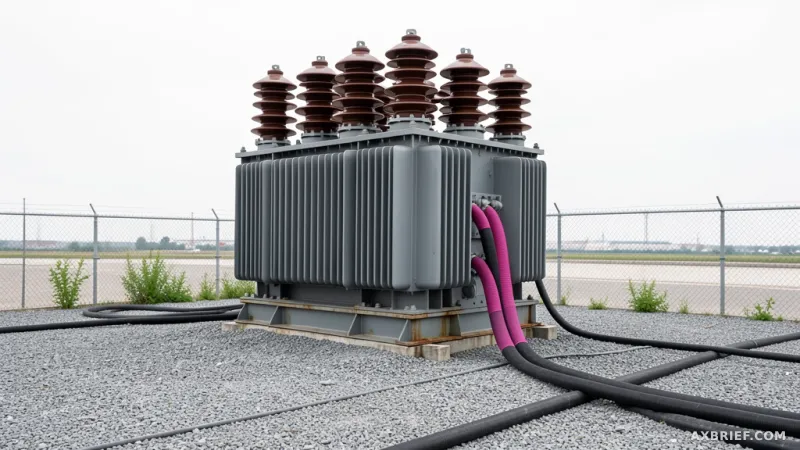
The modern professional experience is now defined by a screen-bound intelligence. Whether it is drafting a complex quarterly report or debugging a Python script, the ability of a Large Language Model to process information has become a baseline utility. Yet, for all the brilliance of these digital brains, they remain trapped in a vacuum of pixels and tokens. The current tension in the industry is no longer about whether a model can reason, but whether that reasoning can translate into a physical change in the real world. For AI to move from a productivity tool to a physical agent, it requires a convergence of massive energy reserves and coordinated physical action.
The Energy Land Grab and the Grid Bottleneck
The race for AI supremacy has moved from the GPU cluster to the power plant. As hyperscalers realize that public energy grids cannot sustain the exponential growth of data centers, they are aggressively securing their own energy supply chains. Microsoft has already moved to secure a deal to restart a reactor at Three Mile Island, while Amazon has entered into direct contracts with nuclear facilities in Pennsylvania. Meta is following a similar trajectory, issuing Requests for Proposals (RFPs) to identify and partner with nuclear developers to diversify its energy sourcing.
This shift represents a move toward energy independence. Beyond traditional nuclear power, the industry is pouring capital into Small Modular Reactors (SMRs), nuclear fusion, and enhanced geothermal systems. SMRs, in particular, offer a compelling alternative to massive traditional plants by reducing size to improve safety and construction efficiency. By investing directly in the production of energy, Big Tech is attempting to engineer its way around the physical limitations of the existing electrical grid.
The scale of the deficit is staggering. The U.S. Department of Energy (DOE) estimates that an additional 100GW of capacity will be required by 2030 to meet the demands of AI data centers. To put that number in perspective, that is the equivalent of powering 16 additional New York Cities. Because the expansion of power infrastructure moves at a glacial pace compared to the rapid iteration of compute power, energy availability has become the primary bottleneck for the next era of AI growth.
The Shift to Vertical AI and Material Sovereignty
If energy is the fuel, then physical infrastructure is the vehicle. The industry is witnessing a pivot from horizontal AI—models that do everything moderately well—to vertical AI strategies that dominate specific physical workflows. Companies like Carbon Robotics, which deploys laser-weeding robots for agriculture, and Dexterity, which focuses on logistics automation, are not just building software. They are employing a full-stack approach, designing specialized hardware and dedicated models tailored to the safety constraints and economic realities of a specific environment.
This transition is supported by a new infrastructure layer designed to bridge the gap between digital simulation and physical reality. Firms such as Human Archive and Antioch are developing synthetic data generation and digital twin tools. These technologies allow robots to undergo billions of iterations in a virtual environment before ever touching a physical object, effectively bypassing the prohibitive cost and time associated with real-world trial and error.
This demand for physical expansion is now rippling backward into the raw materials supply chain. The surge in data center construction is forcing a modernization of the steel industry. Microsoft has already signed contracts in Sweden for green steel, which utilizes carbon-neutral production methods to align with sustainability goals. Similarly, NFX has invested in Bethlehem Steel, an effort to rebuild the American steel industry using the data-driven operational efficiencies typical of a Silicon Valley tech firm. The need for physical AI is not just creating a market for robots, but a market for the very atoms those robots and data centers are made of.
The intelligence demonstrated by OpenAI and its peers has effectively become a commodity. The real competitive moat is no longer the model layer, but the ability to integrate that intelligence with a stable power source and a resilient physical supply chain. The convergence of SMRs, digital twin stacks, and vertical robotics is the only path toward a truly autonomous physical economy.
The ultimate ceiling for artificial intelligence will not be defined by the number of parameters in a model, but by the capacity of the power grid and the resilience of the physical supply chain.