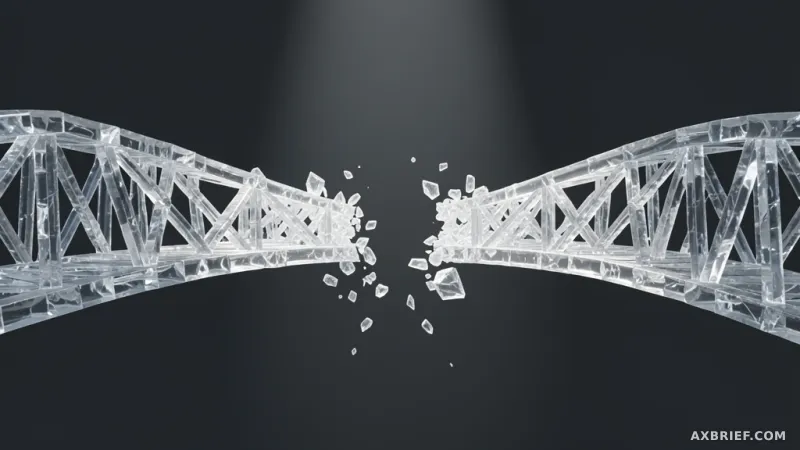
You are standing in front of a boardroom of executives, the air thick with expectation. You have spent weeks preparing the data, and you know the subject matter inside and out. Yet, as the pressure peaks, a sudden, jarring void opens in your mind. You can recall individual facts, but you cannot seem to weave them into a coherent argument. The logical bridge between point A and point B has vanished. This is not a simple case of stage fright or a lapse in concentration. It is a biological shutdown of the brain's most sophisticated filing system.
The Mechanics of Hippocampal Integration
The hippocampus serves as the brain's primary hub for memory and spatial navigation. Its most critical function is not merely the storage of data, but the integration of overlapping events. In a healthy state, the brain does not store every experience as a separate, isolated file. Instead, it identifies commonalities between events and binds them into a single, unified context to maximize efficiency. For instance, if you encounter an old friend at a cafe you visit daily, your hippocampus does not create two distinct memories—one for the cafe and one for the friend. Instead, it merges the spatial information of the environment with the social information of the person, creating a consolidated memory cluster.
This process is akin to plotting multiple data points on a single map. By finding the overlap between different experiences, the brain creates a dense network of associations. This integration allows the brain to conserve storage space and, more importantly, to retrieve information with far greater speed. The more overlap there is between events, the more robust the memory web becomes, turning fragmented observations into a structured narrative of experience.
However, this delicate architectural process is highly sensitive to the body's chemical state. When the brain is flooded with stress hormones, the integration mechanism in the hippocampus effectively freezes. Rather than weaving overlapping events into a shared context, the brain begins to store information as isolated fragments. In the cafe scenario, a stressed brain might store the memory of the location in one mental drawer and the memory of the friend in another. The biological glue that normally binds these elements disappears, leaving the memories as disconnected shards. The brain no longer recognizes that these two events occurred in the same time and space, treating them as entirely unrelated data points.
The Collapse of Memory Inference
The true danger of this fragmentation is not the loss of the memories themselves, but the destruction of memory inference. Inference is the cognitive ability to fill in the gaps between known pieces of information to reach a new conclusion. If the brain has successfully integrated memories, it can use a known point A and a known point C to logically deduce the existence of point B, even if point B was never explicitly recorded. This is the foundation of intuition and complex problem-solving.
When stress fragments the hippocampus, this inferential bridge collapses. The information is still there—the dots are present on the page—but the brain loses the ability to draw the lines between them. If the memory of the cafe and the friend were never integrated, recalling the cafe will not automatically trigger the memory of the friend. The pieces of the puzzle are all on the table, but they no longer fit together. This creates a state of cognitive paralysis where an individual possesses the necessary knowledge but cannot apply it to the current situation.
This failure extends beyond simple recall and impacts how we navigate unfamiliar environments. Human intelligence relies on the ability to take a rule learned in one context and apply it to a similar but new scenario. For example, a person might navigate a strange city by recalling the structural patterns of a similar town they visited years ago. This is memory inference in action: combining fragmented pieces of past experiences to create a predictive map for the present.
Under chronic or acute stress, this adaptive capacity vanishes. The brain shifts from a flexible, integrative processor to a rigid archive of disconnected notes. In a professional setting, this manifests as an inability to handle unexpected variables. While a composed expert can synthesize past failures and successes to pivot their strategy in real-time, a stressed brain sees only a list of unrelated past events. The data remains, but the logic is gone. The brain becomes a warehouse of random memos rather than a functional map, rendering the individual unable to innovate or adapt despite their level of expertise.
Maintaining the integrity of the hippocampus is not merely a matter of psychological comfort. It is a fundamental requirement for the maintenance of human intelligence. When the links between memories are severed, the capacity for reasoning and prediction is compromised, proving that stress management is a critical line of defense for the brain's cognitive architecture.