
The primary barrier to adopting cutting-edge robotics has never been a lack of imagination, but rather the crushing weight of the initial invoice. For most enterprises, the leap from a laboratory pilot to a full-scale deployment involves a financial risk that few CFOs are willing to sanction: the purchase of multi-million dollar hardware that may become obsolete in eighteen months. This week, the conversation shifted from ownership to access as the humanoid robotics sector began treating physical hardware like cloud compute.
The RaaS Strategy and the European Beachhead
On June 30, 2026, Agibot hosted the Agibot Partner Conference (APC) 2026 in London, marking the official European debut of its next-generation humanoid, the Agibot A3. Rather than focusing solely on hardware specifications, the company centered its launch on a Robot-as-a-Service (RaaS) model. By shifting the financial burden from capital expenditure (CapEx) to operational expenditure (OpEx), Agibot is attempting to accelerate the penetration of embodied AI into the European market.
Under this new framework, the cost of entry is strictly tiered by robot capability. Humanoid robot rentals start at £1,999 per day, while quadruped models are available starting at £899 per day. This price gap, roughly a 2.2x difference, reflects the increased hardware complexity and the broader operational scope of the humanoid form factor. The service is not a simple lease; it is a comprehensive package that integrates the local logistics, technical support, and delivery resources of regional partners.
William Shi, President of Agibot's European and US markets, identified the United Kingdom as a strategic hub due to its mature partner networks and innovation ecosystem. The UK serves as the primary launchpad for a wider expansion into Italy, Germany, and Spain. To prove the viability of this model, Agibot has already deployed a fleet in a smart city zone within a retail space in Milton Keynes. This deployment includes the A3, X2, and A2 humanoids, alongside the D1 quadruped, all managed through a partnership with Scancom to handle local channel logistics. In this environment, the robots are tasked with customer engagement, foot-traffic interaction, greeting, guidance, and brand promotion, moving the technology out of the sterile lab and into the chaotic flow of public commerce.
From Industrial Heavyweights to Agile Commercial Assets
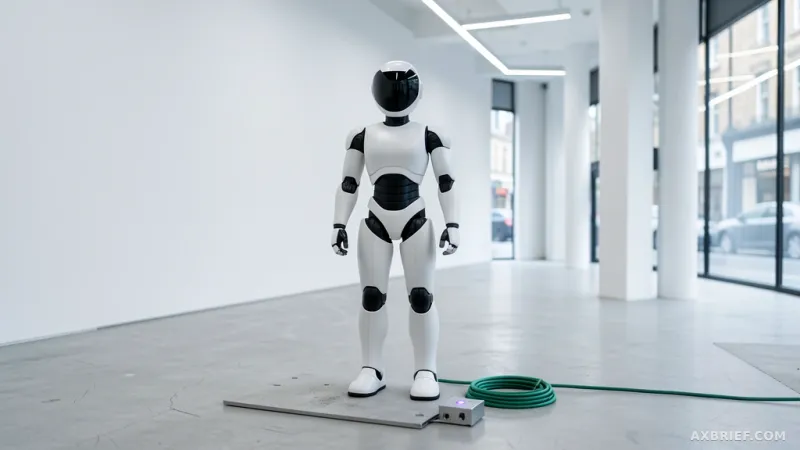
For years, the prevailing wisdom in humanoid robotics was that stability required mass. The industry standard leaned toward heavy, rigid frames to ensure a low center of gravity and structural durability. Agibot A3 represents a fundamental reversal of this philosophy. By utilizing magnesium and titanium alloy reinforcements, Agibot has stripped the A3 down to a total body weight of 55kg. Standing 173cm tall with a meticulously tuned 1:9 head-to-body ratio, the A3 is designed for agility in cramped commercial spaces rather than raw strength in industrial warehouses.
This obsession with agility extends to the logistics of deployment. The A3 is light enough to be transported by a single adult and can be moved in a standard SUV, eliminating the need for specialized freight vehicles. It even features an autonomous unpacking function, allowing it to transition from shipping to operation with minimal human intervention. This makes the A3 uniquely suited for high-turnover environments like pop-up stores, trade shows, and university research exhibitions where rapid deployment and retrieval are critical.
Operational uptime is managed through a dual-battery system that provides up to 10 hours of continuous operation. More importantly, the system allows for a battery swap in just 10 seconds, effectively neutralizing the downtime that typically plagues mobile robotics. To solve the problem of precision movement in crowded areas, Agibot integrated Ultra-Wideband (UWB) technology. This allows for centimeter-level positioning without requiring extensive hardware modifications to the environment. By relying on software and UWB communication, the A3 can maintain complex formations and group coordination, ensuring that multiple robots can navigate a retail floor without colliding or disrupting human traffic.
Physical interaction is handled through a multi-modal sensory array. Beyond vision and hearing, the A3 features touch sensors integrated into its shoulders. This allows the robot to recognize when a human has lightly tapped it, enabling a more intuitive, tactile form of greeting and guidance. When combined with the lightweight frame and UWB precision, the A3 ceases to be a heavy piece of machinery and becomes a fluid service interface.
This shift in design and delivery suggests that the next phase of humanoid adoption will not be driven by the ability to perform heavy lifting, but by the ability to be deployed as easily as a laptop. By treating the robot as a flexible, rentable asset rather than a permanent piece of infrastructure, Agibot is betting that the path to mass adoption lies in lowering the psychological and financial friction of the first encounter.
The era of the humanoid as a laboratory curiosity is ending, replaced by the humanoid as a plug-and-play retail employee.



