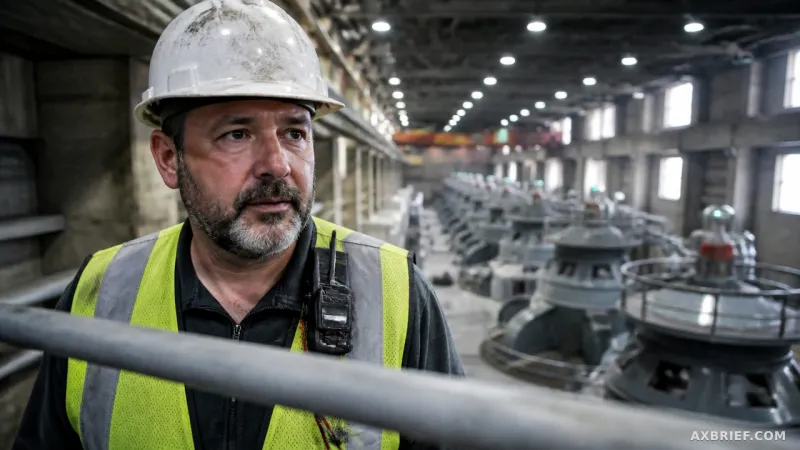
Sarah Chen, a factory manager overseeing 12 assembly lines and 2,000 pieces of equipment, spends her Monday mornings in a state of digital friction. To prepare a production review, she must navigate a fragmented landscape of IoT dashboards to spot temperature spikes, dive into ERP systems for maintenance logs, and scrub through historian databases for uptime records. When she notices that Line 4's utilization has dropped from 94% to 87% while scrap rates climbed by 2.3%, the data is there, but the insight is trapped. She spends the next hour emailing three different supervisors, finally receiving a definitive answer at 11:15 AM.
This is the reality for most enterprise operators. Raj Patel, a floor supervisor, relies on a three-day-old PDF because he lacks dashboard access. Priya Nair, a maintenance technician, waits four hours for a CSV file from an analyst just to check vibration data. In the average corporation, employees juggle five to eight disparate operational systems daily. Because these systems do not talk to one another, the employees themselves become the human integration layer, manually stitching together data points through a series of logins, queries, and spreadsheets. Traditional BI dashboards offer a rearview mirror—visualizing what happened—but they cannot autonomously diagnose why it is happening in real-time across a fragmented tech stack.
The Shift from AI Construction to Configuration
Amazon Bedrock AgentCore fundamentally changes this dynamic by treating orchestration, security, memory, and scaling not as features to be built, but as baseline infrastructure. In a traditional custom multi-agent framework, an engineering team must spend months developing connectors, session isolation, memory management, and scaling logic before the system can answer a single business question. AgentCore collapses this timeline by shifting the developer's role from construction to configuration. Instead of writing the plumbing, engineers now define the data sources and the business rules the agent must follow.
For users like Sarah, Raj, and Priya, this means the technical complexity of the backend disappears. They no longer need to know which database holds the vibration logs or which API provides the scrap rate. They simply ask a natural language question, and the system synthesizes a personalized answer by traversing the entire technical stack. The value proposition here is not just speed, but the elimination of the decision-making lag. When a manager relies on intuition because the data takes four hours to retrieve, the company incurs a hidden cost of inefficiency. AgentCore mitigates this by ensuring the answer is as immediate as the question.
At the heart of this capability is a five-layer architecture that strictly separates the user, orchestration, tool execution, and data access. When a user submits a request, AgentCore handles authentication, policy review, and memory retrieval to analyze the intent. It then routes the request through an MCP server connector to the underlying data infrastructure. This modularity allows enterprises to scale or replace individual layers without rebuilding the entire agentic workflow. The system employs an intent classification process to determine the best path to an answer, utilizing a semantic layer powered by the SageMaker Data Catalog. This catalog acts as a metadata repository, telling the agent where specific data lives and what it means without requiring hard-coded logic for every possible query.
Standardizing Intelligence via the Model Context Protocol
The true technical pivot in AgentCore is the adoption of the Model Context Protocol (MCP). For years, the primary barrier to AI agent adoption has been the diversity of query interfaces; every database and API speaks a different language. MCP standardizes how AI agents discover and call external tools, turning a chaotic ecosystem of proprietary APIs into a uniform interface.
For standard enterprise data, Bedrock AgentCore provides pre-built MCP servers. This allows an agent to execute supply chain inventory and OEE analysis queries in Amazon Redshift, retrieve historical data in Iceberg format from S3 Tables, or process equipment registration and maintenance histories in Amazon Aurora PostgreSQL. The developer no longer writes a unique connector for each of these services; they simply leverage the standard protocol to call structured data.
When an organization uses specialized services that lack pre-built servers, the FastMCP framework combined with the AWS SDK allows for the rapid creation of custom MCP servers. For instance, a server connected to Amazon Timestream can query real-time sensor data for vibration, temperature, and pressure, while a server connected to Amazon OpenSearch Serverless can perform semantic searches across quality inspection documents. The developer does not need to teach the LLM the complex internal syntax of these databases. Instead, they define a tool interface that the MCP server exposes to the agent.
python
FastMCP를 이용한 도구 인터페이스 정의 및 SDK 위임 예시
from fastmcp import FastMCP
import boto3
mcp = FastMCP("TimestreamServer")
client = boto3.client("timestream-query")
@mcp.tool()
def get_sensor_data(sensor_id: str, duration: str):
"""실시간 센서 데이터를 조회합니다."""
query = f"SELECT * FROM sensor_table WHERE id = '{sensor_id}' AND time > ago({duration})"
return client.query(QueryString=query)
By defining the function name and input parameters, the SDK handles the execution and returns the result to the agent. This approach removes the need for complex orchestration logic, reducing the implementation time from months to days. The full implementation details and frameworks are available on GitHub.
For organizations deciding whether to adopt this architecture, the primary metric should be the amount of time lost to manual data stitching and the degree of permission fragmentation. The system provides the highest ROI in environments where field supervisors are forced to rely on outdated PDFs or where technicians must request CSVs from analysts. Furthermore, because the system integrates with existing AWS identity and access management, it can provide personalized answers based on the user's role—ensuring a technician sees different data than a plant manager while using the same interface.
The deployment strategy for AgentCore follows a tiered approach based on data complexity. Standard data warehouses and operational databases like Amazon Redshift, S3 Tables, and Aurora PostgreSQL are connected immediately via pre-built MCP servers. Specialized sources requiring real-time feedback or semantic search, such as Amazon Timestream or OpenSearch Serverless, are implemented as separate custom MCP servers using the FastMCP framework. By prioritizing the standard stack and isolating custom implementations, enterprises can bypass the grueling process of building a multi-agent framework from scratch.
This shift toward configuration-based intelligence transforms the AI agent from a novelty chatbot into a critical piece of operational infrastructure.