
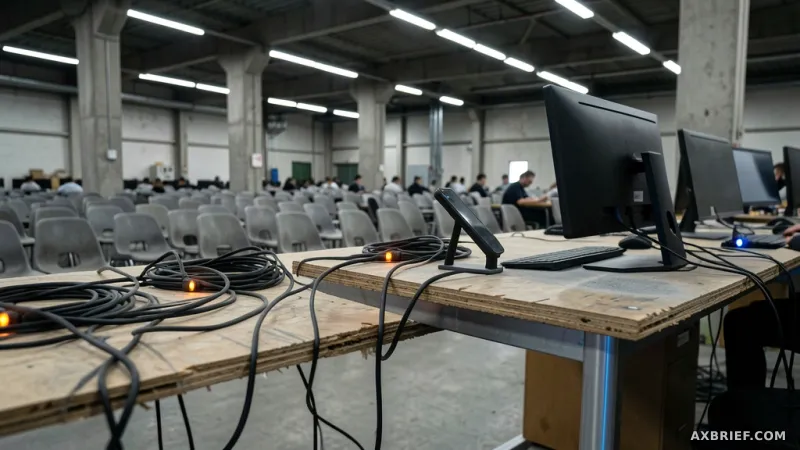
The prevailing narrative of the current technological era is one of erasure. Every week, a new headline warns that a generative AI model has rendered a specific profession obsolete or that automation is finally decoupling economic productivity from human effort. Developers, writers, and analysts alike find themselves staring at a horizon where the machine does not just assist the worker but replaces them entirely. This anxiety has become the background noise of the modern professional life, creating a collective belief that we are transitioning into a post-labor economy where the only remaining human role is to prompt the machine.
The Architecture of Fragmented Labor
In his comprehensive study, Robots Won't Come (524 pages, 32,000 KRW), digital labor researcher Antonio Casilli dismantles this myth of labor disappearance. He argues that the prophecy of the end of work is not a prediction of the future but a recurring ideological tool used since the Industrial Revolution. According to Casilli, technology does not reduce the total volume of labor required to sustain society; instead, it reorganizes that labor, breaking it into smaller, invisible fragments and pushing it to the periphery of the economic system. The perceived magic of automation is, in reality, a structural reorganization that renders the human element invisible.
This process begins with the digital platform, which functions as more than just a service provider. These platforms act as new economic engines that integrate the mundane activities of daily life into a value-production cycle. By converting user interactions into corporate assets, platform companies replace the traditional workplace with a global network of fragmented actions. The skill sets of the traditional workforce are not so much made obsolete as they are bypassed, replaced by a massive infrastructure of auxiliary labor that keeps the system running. The result is a paradox where the more a system is described as automated, the more human labor it actually requires to maintain its facade of autonomy.
The Ideology of the Invisible Worker
The critical shift occurs when we ask why this labor remains unseen. Casilli posits that the term automation serves as a linguistic veil. By labeling a process automated, companies can scrub the evidence of human intervention from their financial statements and marketing materials. This concealment is a strategic choice to maximize profit by underestimating the actual human cost of AI. When the labor is invisible, the efficiency of the technology is artificially inflated, allowing the digital capital system to build a regime where workers are unaware of their own contribution to the value chain.
This invisibility is most evident in the foundation of AI intelligence. The sophisticated reasoning of a Large Language Model is not a spontaneous emergence of code but the result of millions of micro-tasks. This is the realm of micro-work, where data labeling, image classification, and click-work are outsourced to low-wage markets across the globe. Workers log into platforms to draw boxes around pedestrians in street photos or categorize the sentiment of a sentence, creating the ground-truth datasets that AI uses to learn. Because these tasks are sliced into seconds-long units, the worker never sees the full model they are building. They exist in a state of total fragmentation, functioning as a human API for the machine.
This labor is further commodified through competitive bidding and piece-rate pay, ensuring that the cost of human intelligence remains as low as possible. The worker is stripped of a formal employment contract, agreeing instead to a set of platform terms and conditions that categorize them as independent contractors. In this ecosystem, the human is reduced to a data point, and their value is measured solely by the accuracy of the output, not the effort of the process.
Beyond paid micro-work, the system expands into the realm of unpaid labor through social media and on-demand services. Every like, post, and search performed by a user is a contribution to a massive training set. Users believe they are engaging in social connection or self-expression, but the platform views these actions as free raw material for refining AI behavior. The absence of a subscription fee is the payment for this labor; users provide their behavioral data in exchange for access, effectively becoming unpaid employees of the data economy.
This control extends to the on-demand sector, such as Uber or delivery platforms, where algorithmic management replaces the human supervisor. Rating systems and response-time metrics create a state of constant surveillance and pressure. The boundary between work and life dissolves as workers remain in a state of permanent readiness, performing unpaid waiting time that the platform does not recognize as labor. The efficiency of the app is built on the psychological tension of the worker who must be instantly available to satisfy the algorithm.
This systemic erasure has profound legal implications. Because these workers do not fit the traditional definition of an employee, they exist in a legal vacuum, devoid of minimum wage protections, health insurance, or collective bargaining rights. The technological innovation has effectively erased the legal status of the worker, leaving the platform as the sole entity with power and the worker as a disposable unit of production.
Ultimately, the competitiveness of an AI model should not be judged by the elegance of its architecture, but by the scale of the human operating costs hidden beneath its surface. The transition to an AI-driven world is not a journey toward a labor-free utopia, but a migration toward a more fragmented and obscured form of exploitation.



