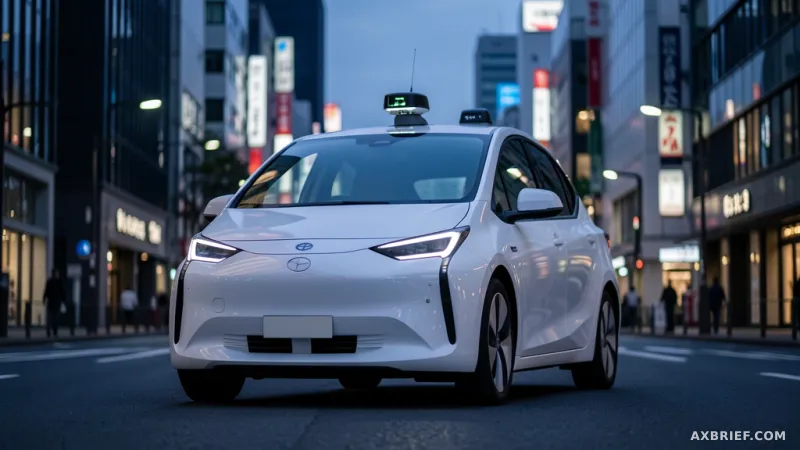
Japan is currently facing a demographic crisis that is manifesting as a logistical nightmare. In cities and rural prefectures alike, the shortage of professional drivers has moved from a corporate inconvenience to a systemic failure, leaving elderly populations stranded and transport networks fraying. This is the specific void that Autonomous a2z is moving to fill. While many autonomous vehicle companies spend years in simulated environments or gated test tracks, the Korean firm is betting on a strategy of aggressive, real-world deployment in the most challenging urban environments on earth.
The Tokyo Deployment and the ROii Blueprint
On May 20, the industry's attention shifted to the TKP Garden City Premium Shinagawa Takanawaguchi in Tokyo for the X Taxi Autonomous Driving Seminar. Organized by X Taxi, an association dedicated to the digital transformation of the Japanese taxi industry, the event gathered over 100 key stakeholders, including representatives from Japan's Ministry of Land, Infrastructure, Transport and Tourism, as well as global mobility players like Me Mobility, DiDi, and Pony.ai. Autonomous a2z took the stage to present its AV Taxi Service in Japan, focusing on the commercialization of Level 4 (L4) autonomy, where the system handles all driving functions under specific conditions without human intervention.
This was not a theoretical pitch. The presentation was anchored in empirical data gathered from a pilot operation conducted between February and March in Naruto City, Tokushima Prefecture. Unlike competitors who rely on synthetic benchmarks, Autonomous a2z showcased high satisfaction rates from both passengers and local operators on actual Japanese public roads. This tactical move was preceded by a presence at the Local Government and Public Week 2026 at Tokyo Big Sight, where the company, alongside its strategic partner Kanematsu, showcased the ROii, its proprietary L4 autonomous vehicle. By presenting the ROii not as a prototype but as a tool backed by Tokushima's operational data, the company signaled its intent to move beyond the demonstration phase and into public infrastructure integration.
This aggressive expansion is supported by a global footprint. Autonomous a2z has established operational hubs in Korea, Singapore, Japan, and the UAE. The company became the first Korean firm to secure an autonomous driving license in Singapore, a market known for its stringent regulatory hurdles. Furthermore, it has obtained export approval for its technology in the UAE, transforming its L4 capabilities from a regional experiment into a tradable product. These milestones culminated in a global ranking of 7th on the autonomous driving leaderboard published by Guidehouse, a recognition rooted in the company's accumulation of over 970,000km of real-world driving data.
The E2E Shift and the Data-Driven Control Loop
To understand why Autonomous a2z is gaining traction, one must look at the architectural shift from modular pipelines to End-to-End (E2E) neural networks. Traditional autonomous systems operate like a relay race: a perception module identifies an object, a planning module decides the path, and a control module executes the turn. This sequential process often introduces latency and information loss, as each module filters the data before passing it to the next. Autonomous a2z has moved toward an E2E architecture where raw sensor data is processed through a single, massive neural network that outputs control values directly. This allows the AI to learn optimal driving behaviors from data rather than relying on thousands of manually written if-then rules that inevitably fail in the chaos of city traffic.
This neural core is fed by a sophisticated multi-sensor fusion system. The ROii integrates high-resolution visual data from cameras, precise 3D spatial mapping from LiDAR, and relative velocity tracking from Radar. The critical innovation here is not the hardware, but the dynamic weighting of these inputs. In heavy rain or fog, where camera visibility drops, the system automatically increases the reliability weight of Radar and LiDAR data. This ensures that the perception layer remains stable even when individual sensors are compromised by environmental noise.
However, the true competitive advantage lies in how the company handles edge cases—those rare, unpredictable events that typically cause autonomous systems to freeze. When the AI encounters a scenario it cannot resolve, a remote monitoring and control system allows a human operator to intervene in real-time. This is not merely a safety net; it is a data harvesting mechanism. Every instance of remote intervention, along with all associated sensor data and control logs, is immediately captured and fed back into the E2E model for retraining. This creates a closed-loop system where every failure becomes a permanent upgrade to the model's intelligence. The 970,000km of data collected across Korea, Singapore, and Japan serves as the foundation for this loop, providing a diversity of traffic laws, road geometries, and pedestrian behaviors that simulation simply cannot replicate.
By combining this technical architecture with the local network of Kanematsu, Autonomous a2z is bypassing the typical friction of entering the Japanese market. They are not just selling a car; they are deploying a self-evolving intelligence system designed to solve a specific labor crisis. This strategy of using public road data to prove reliability to conservative government bodies is now being mirrored back in Korea, as the company was recently selected for a large-scale autonomous driving project in Gwangju. This creates a reciprocal flow of intelligence, where global edge cases encountered in Singapore or Tokyo are used to optimize the deployment of L4 vehicles in the complex urban corridors of South Korea.
This trajectory suggests that the winner of the robotaxi race will not be the company with the best simulation, but the one with the most diverse set of real-world scars.