
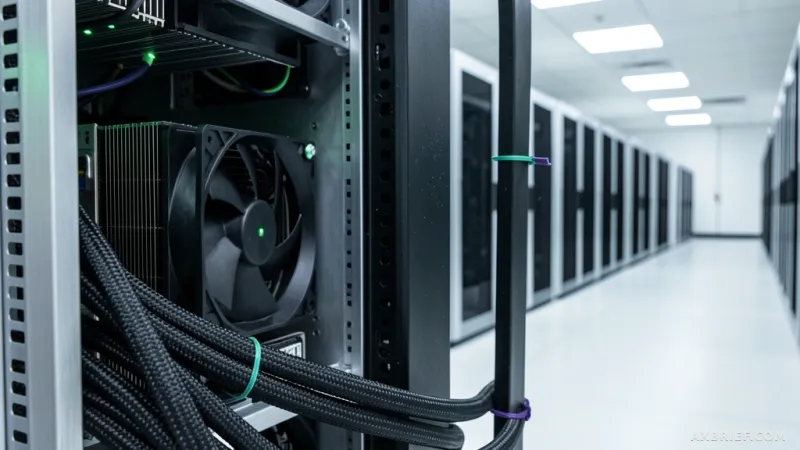
Developers often spend more time configuring their environment than writing actual logic. The ritual of updating CUDA drivers, resolving Python dependency hell, and managing API keys has become a tax on productivity. This week, a specific combination of tools is shifting that dynamic, allowing developers to deploy a fully functional, agentic coding assistant on their own hardware in under two minutes. The goal is no longer just to run a model, but to instantiate an agent that can plan, write, and test code without a single packet leaving the local network.
The Architecture of a Two-Minute Deployment
The foundation of this workflow is the Qwen3.8-27B model, a powerhouse designed for reasoning and long-horizon agentic tasks. Unlike standard chat models, this version excels at multi-step planning, making it capable of analyzing large local codebases and architecting complex project structures autonomously. To make this model accessible, the stack utilizes Ollama for model orchestration and OpenCode for the agentic interface. On a machine equipped with an NVIDIA RTX 3090, the entire process from a blank terminal to a functioning app takes less than 120 seconds.
Hardware alignment is the first critical factor. The Qwen3.8-27B model requires approximately 18GB of VRAM to be fully loaded. An RTX 3090, with its 24GB of VRAM, provides the ideal environment. By loading the entire model into GPU memory, the system eliminates data transfer bottlenecks, maximizing inference speed. The remaining 6GB of VRAM serves as a vital buffer for the context window and runtime overhead. In scenarios where VRAM is insufficient, Ollama employs an offloading mechanism that shifts parts of the model to system RAM. For this to remain viable, at least 32GB of system RAM is required, though this transition introduces a noticeable drop in generation speed due to the slower bus between the CPU and GPU.
Once the hardware is ready, the deployment follows a strict three-step command sequence. First, the user installs Ollama, which handles the binary configuration and background server management.
curl -fsSL https://ollama.com/install.sh | shWith the server running in the background, the second command pulls the Qwen3.8-27B weights and loads them into the GPU.
ollama run qwen3.8:27bThis step automates the download of the 18GB weight file and initializes the local inference engine. Finally, the user launches OpenCode, which transforms the raw model into a coding agent with file system access.
opencode --model qwen3.8:27bBy passing the `--model` flag, OpenCode connects its agentic layer to the Ollama engine. This is not a simple chat interface; it is a Text User Interface (TUI) that grants the AI permission to create, modify, and read files directly on the local disk, effectively turning the LLM into a collaborator with a keyboard and file explorer.
Simplicity Over Granularity and the Security Dividend
The decision to use Ollama and OpenCode represents a deliberate trade-off: sacrificing granular control for immediate utility. For years, the gold standard for local LLMs was llama.cpp, which offers deep optimization and precise control over quantization and hardware acceleration. However, llama.cpp requires users to build from source and manage a complex array of command-line arguments for every session. Ollama abstracts this complexity, automating the model lifecycle so that the developer focuses on the code rather than the infrastructure. While a researcher might still need llama.cpp for weight tuning, a practitioner needs a tool that works instantly.
This shift toward a TUI-based agentic workflow solves the primary friction point of modern AI coding: the copy-paste loop. In a cloud-based workflow, a developer copies code from an IDE, pastes it into a browser, receives a suggestion, and pastes it back. OpenCode eliminates this by allowing the agent to interact directly with the project folder. The agent can scan the entire directory to understand how a specific function in one file affects a module in another, maintaining a level of context that is often lost in fragmented chat sessions.
Beyond efficiency, the local nature of this setup provides a critical security dividend. For developers working on proprietary corporate codebases, cloud AI is often a forbidden tool due to data leakage risks. By running Qwen3.8-27B locally, the entire compute chain remains inside the machine. There is no need to scrub sensitive API keys or redact proprietary logic before sending a prompt to an external server. This removes the bureaucratic hurdle of security audits and allows AI integration into the most sensitive parts of a project's lifecycle.
Furthermore, the removal of network latency and API quotas changes the nature of how the model is used. Developers can run exhaustive refactoring loops or perform full-scale codebase audits without worrying about token costs or rate limits. By monitoring the Ollama server logs, users can see exactly how the model is loading into memory and responding to requests, turning the AI from a black-box API into a transparent local process. The result is a development environment where the AI is as integrated and private as the local compiler.
For those operating in restricted corporate environments, the 24GB VRAM threshold is the definitive dividing line. Without it, the offloading to system RAM makes the agent too slow for a fluid coding rhythm. But with an RTX 3090 or 4090, the latency disappears, and the agent becomes a real-time extension of the developer's thought process. The transition from manual environment configuration to a three-command deployment means that the barrier to entry for local AI is effectively gone.
The era of fighting with infrastructure to get a local model running has ended, leaving only the challenge of the code itself.



