Anthropic today released **Claude Fable 5**, its most powerful model made safe for general availability, alongside the restricted **Claude Mythos 5**—the same underlying model with select safeguards removed. Both are priced at $10 per million input tokens and $50 per million output tokens, less than half the price of Claude Mythos Preview.
Software engineering: the unit of work just changed
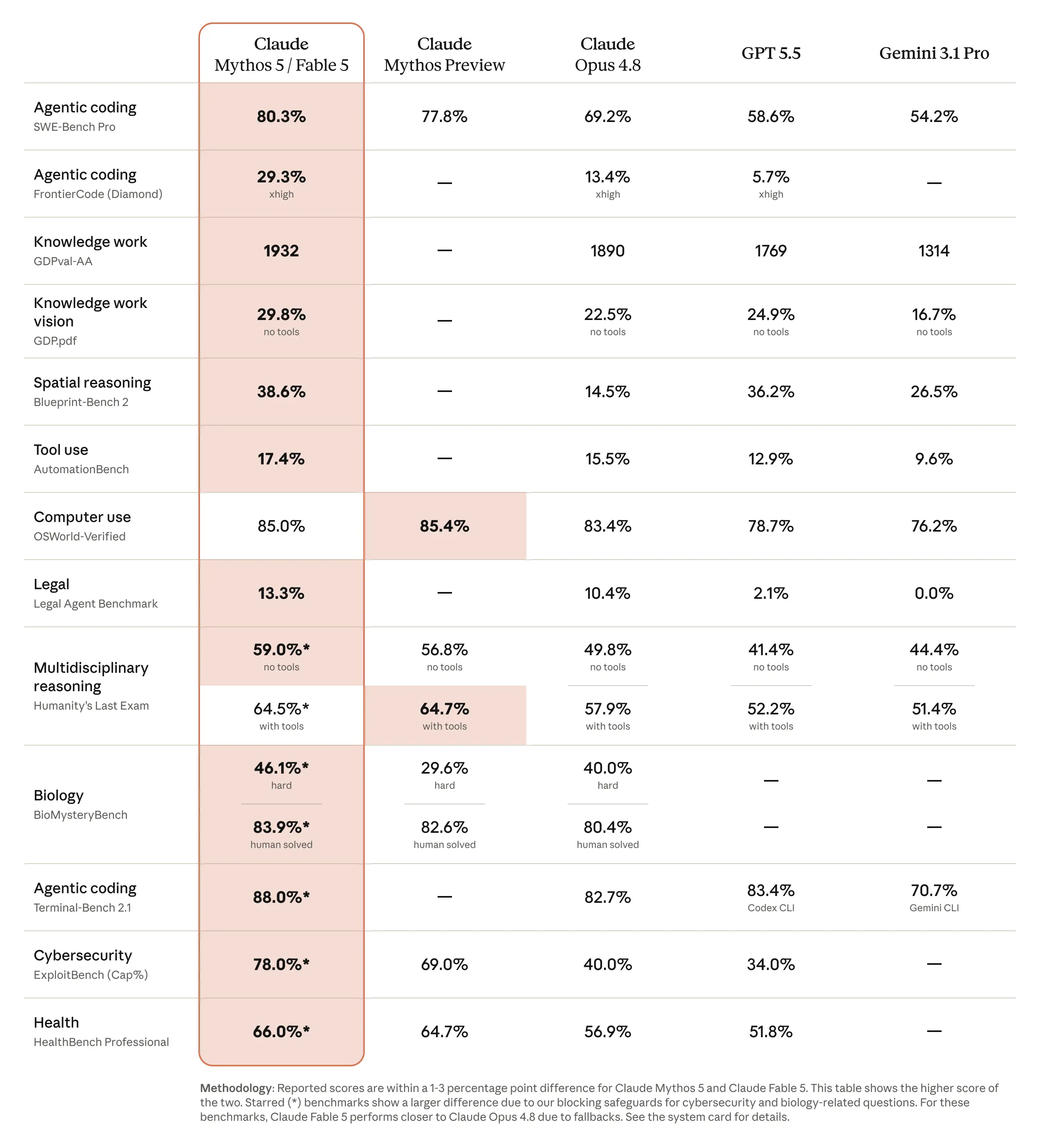
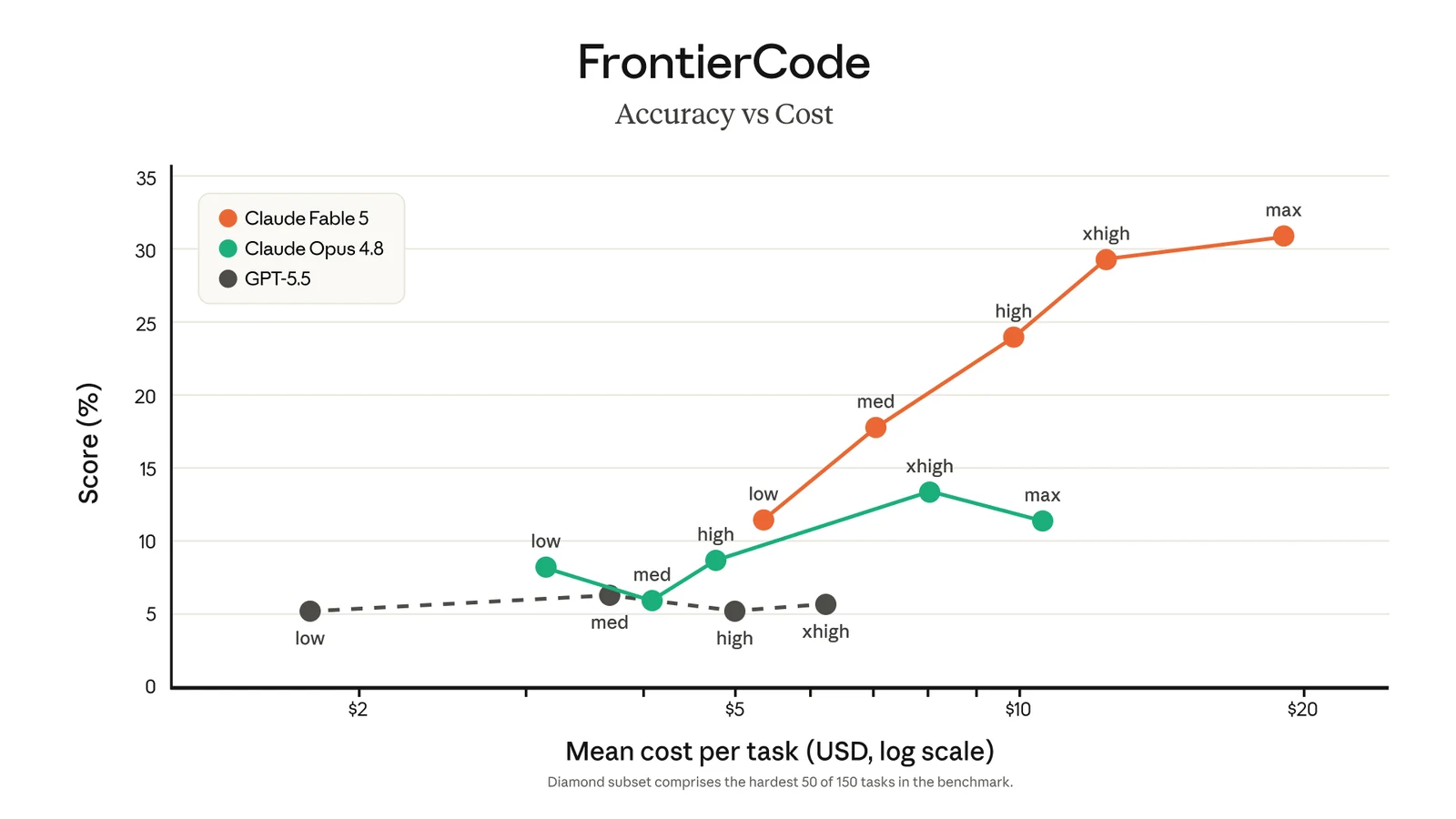
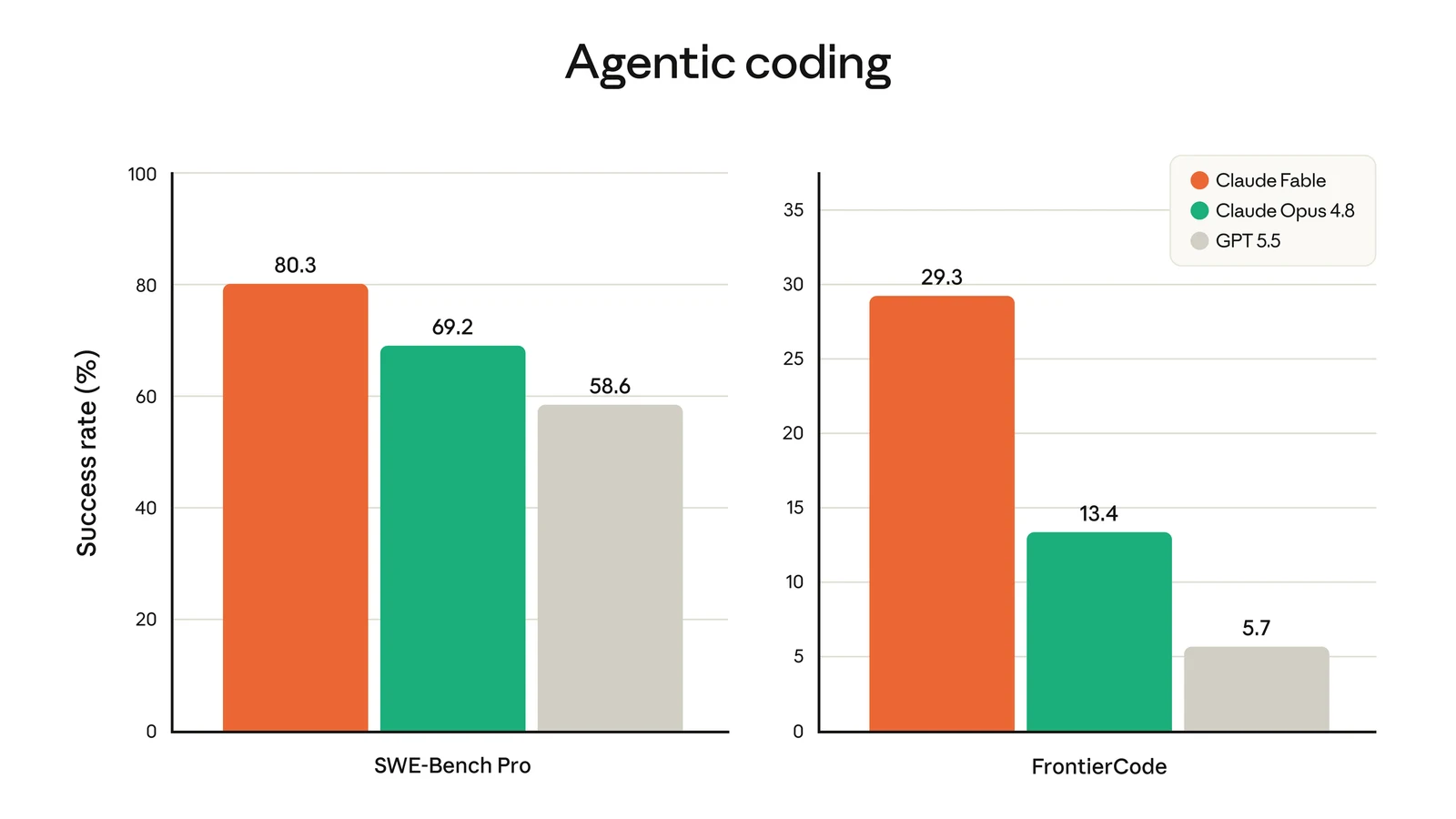
The benchmark data is unambiguous. On SWE-bench Pro, Fable 5 and Mythos 5 scored **80.3%**, against GPT-5.5's 58.6%. On Cognition's FrontierCode Diamond evaluation—which tests difficult coding tasks to production-quality standards—Fable 5 reached **29.3%**, compared with Opus 4.8's 13.4% and GPT-5.5's 5.7%.
Real-world results match the scores. Stripe completed a 50-million-line Ruby codebase migration with Fable 5 in a single day—work that would have taken a skilled team more than two months by hand. The shift is qualitative: Fable 5 is performing not as a coding assistant but as **an autonomous agent that comprehends and rewrites entire codebases**.
The stamina to hold focus across millions of tokens
Fable 5 introduces persistent file-based memory, letting it maintain context across workflows spanning millions of tokens. When Anthropic tested the model on the deck-building game *Slay the Spire*, Fable 5 with memory performed roughly **three times better** than Opus 4.8 and reached the final act three times as often.
The gap is visible in everyday tasks as well. On Anthropic's in-house spreadsheet suite, Fable 5 beat Opus 4.8 at every effort level and completed runs 25–30% faster. In legal review, its redlines matched or beat the prior model every single time.
Finance reasoning and vision: new state-of-the-art
Fable 5 claimed first place on the Hebbia Finance Benchmark's senior-level reasoning track, with substantial gains in document-based reasoning, chart interpretation, and problem solving. IMC reported that the model aced their trading-analysis evaluations nearly across the board—factual lookup, conceptual reasoning, root-cause analysis, and expected-value analysis.
Vision took a clear step up. Where previous Claude models needed additional helper tools even to play *Pokémon FireRed*, **Fable 5 completed the game using a minimal, vision-only harness**—raw screenshots, no maps, no navigation aids. The same precise visual reasoning allows it to extract exact figures from scientific plots and reconstruct a web application's source code from a single screenshot.
Drug design, molecular biology, and genomics
Mythos 5 is producing results in life-science research that Anthropic describes as qualitatively new. In protein-design work, Anthropic's internal experts reported **roughly tenfold acceleration** of key design steps; 9 of 14 protein targets—spanning immune checkpoints, neurodegenerative disease, and muscle disease—yielded strong drug candidates, all without human intervention.
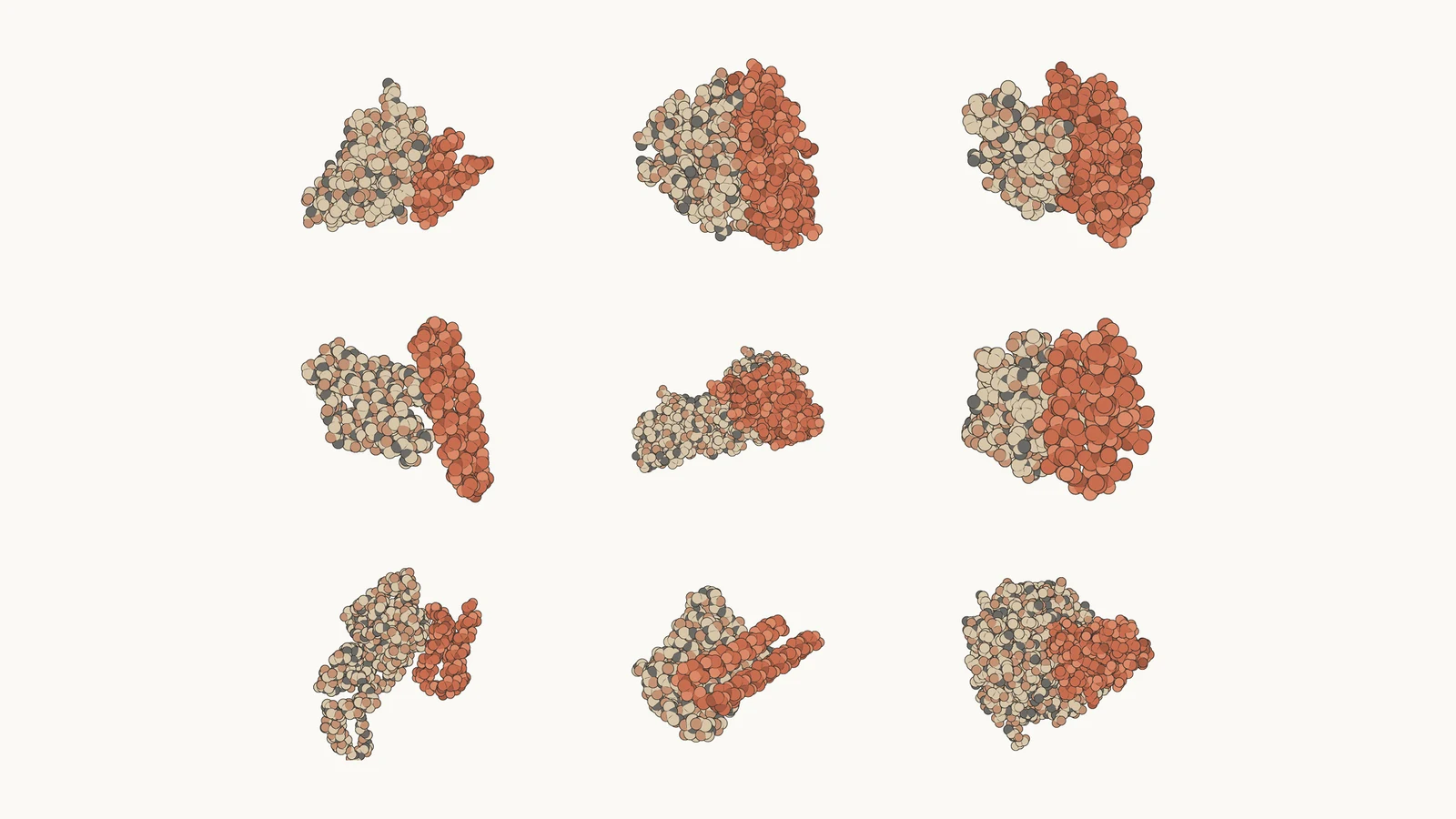
In molecular-biology hypothesis generation, Mythos 5 earned **approximately 80% blind preference** over Opus-class models in head-to-head comparisons among Anthropic scientists. One hypothesis—a novel mechanism for an *E. coli* protein—was independently corroborated by a separate laboratory's published study.
In genomics, Mythos 5 conducted over a week of largely autonomous research: assembling single-cell data for millions of cells spanning 138 animal species, then designing and training a custom machine-learning model to identify cells performing equivalent roles across distant species. The resulting model **outperformed one recently published in the journal *Science*** despite being 100 times smaller.
Three safety classifiers and how they work
Fable 5 carries three new classifier systems. When triggered, the request is automatically rerouted to **Claude Opus 4.8**, and the user is notified. More than 95% of Fable 5 sessions involve no fallback at all.
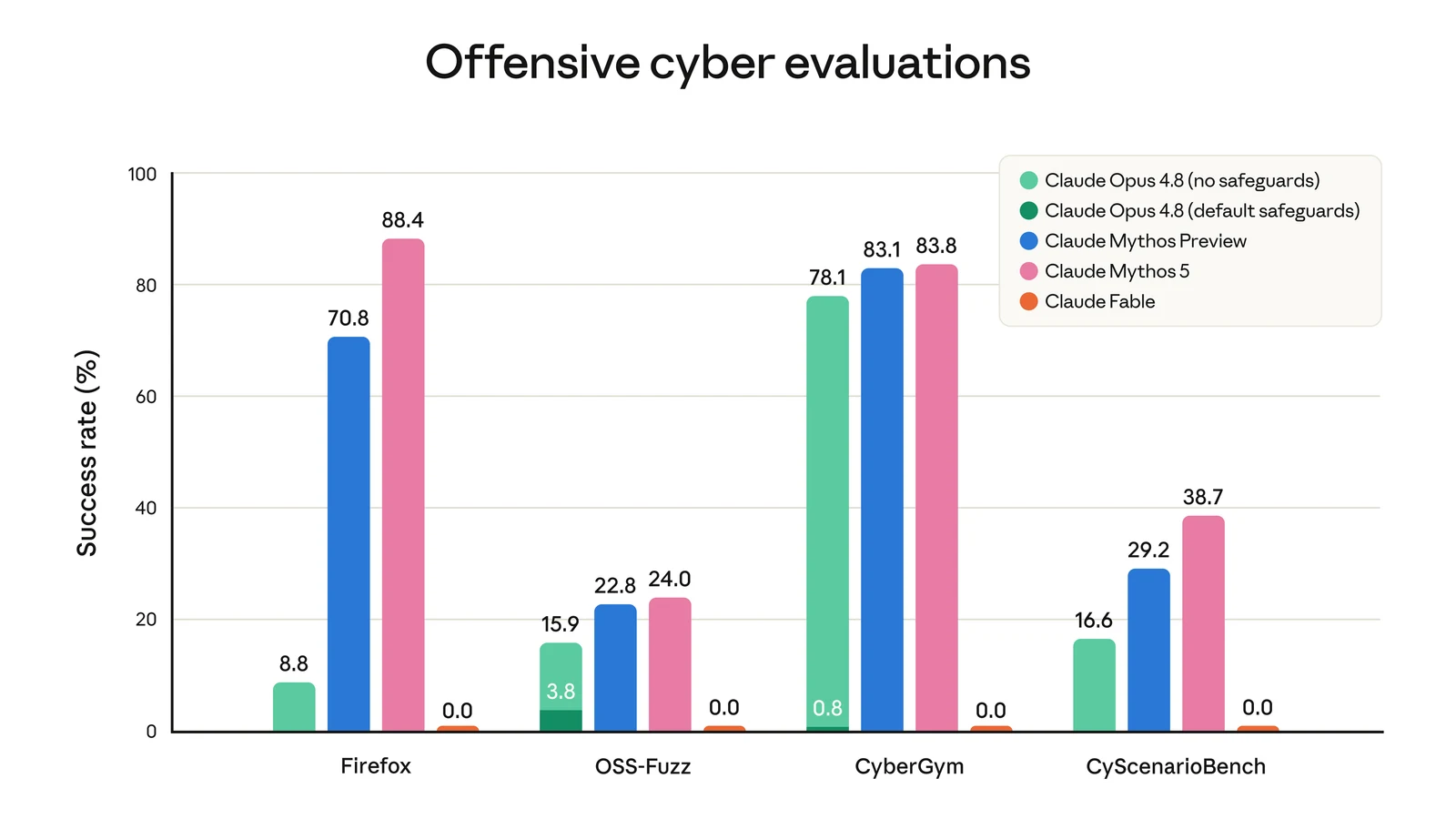
The three covered domains: **Cybersecurity**—exploitation, offensive cyber tasks, and agentic hacking. **Biology and chemistry**—dual-use high-risk biological research. **Distillation**—attempts to extract Fable 5's capabilities for training unauthorized models.
Robustness was validated externally. One red-team partner found **zero compliance** with harmful single-turn cyberattack requests across 30 public jailbreak techniques. A 1,000-hour external bug bounty produced no universal jailbreak.
30-day data retention and the Mythos 5 trusted access program
Beginning with Mythos-class models, Anthropic requires 30-day data retention for all business traffic—including customers who previously held zero-retention agreements. The data will not be used to train new models; it serves only to detect novel jailbreaks and reduce false positives.
Mythos 5 is currently limited to Project Glasswing cybersecurity partners (cyber safeguards lifted) and a small group of biology researchers (biology and chemistry safeguards lifted, cyber safeguards retained). Anthropic plans to expand access through formal trusted access programs for both cybersecurity organizations and biomedical researchers.
Fable 5 is available now on the Claude API as `claude-fable-5` and on consumption-based Enterprise plans. Subscription plan users (Pro, Max, Team) had access at no extra cost through June 22, after which usage shifts to consumption credits, with the goal of restoring Fable 5 to standard subscriptions once capacity allows.