
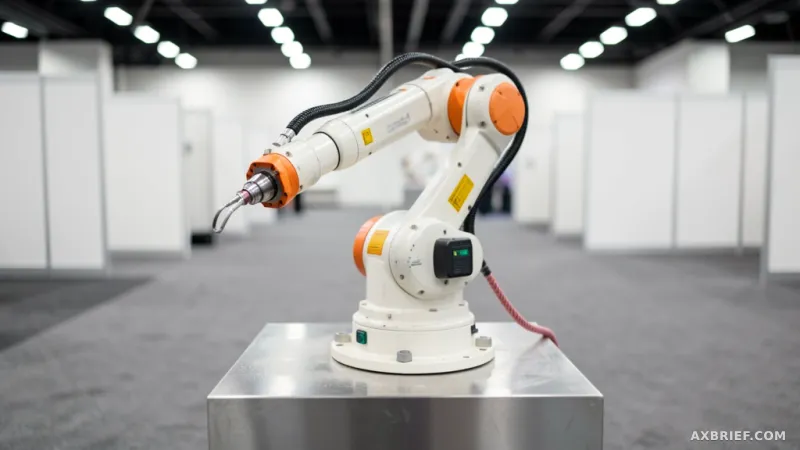
Manufacturing engineers have long fought a losing battle against the precision-speed paradox. In high-speed sorting or micro-assembly, increasing velocity almost always triggers a drop in accuracy, while tightening tolerances usually kills throughput. This friction creates a productivity ceiling that hardware alone has struggled to break, leaving many facilities trapped between the need for speed and the requirement for absolute precision.
The High-Precision Architecture for Automate 2026
DENSO is addressing this bottleneck at Automate 2026, which runs from June 22 to 25 at Chicago's McCormick Place. The company is deploying a strategic lineup of high-precision robotics designed to dismantle the trade-off between speed and stability. The showcase centers on three distinct architectures: high-speed 4-axis robots, versatile 6-axis models, and collaborative robots, commonly known as cobots.
The 4-axis robots are engineered for high-volume, simple repetitive tasks where linear efficiency is the primary goal. In contrast, the 6-axis robots provide the degrees of freedom necessary to mimic human arm movements, allowing them to navigate complex angles and tight spaces that would be inaccessible to simpler systems. Finally, the collaborative robots are designed for fence-less integration, allowing them to operate safely alongside human workers in shared environments without the need for restrictive safety barriers.
For those seeking technical specifications or deeper integration guides, DENSO maintains detailed documentation at https://www.denso.com/us-ca/en/.
Shifting the Metric from Capability to Cycle Time
The industry often treats robot acquisition as a quest for the most capable machine, but DENSO is shifting the conversation toward cycle time optimization. The real cost of automation is not the sticker price of the arm, but the time elapsed per single operation. When a facility deploys a 6-axis robot for a task that only requires 4-axis movement, they are not just overpaying for hardware; they are often introducing unnecessary complexity that can actually hinder the overall cycle time.
By demonstrating these models side-by-side, DENSO is highlighting a critical technical pivot: the alignment of axis count with task complexity. The live demos at Automate 2026 will allow engineers to verify exactly where a 4-axis robot's repeatability outperforms a 6-axis model's flexibility in terms of raw speed. For cobots, the focus shifts to the interference zone, where the goal is to determine the minimum safety distance required to maintain flow without sacrificing worker safety. This approach transforms the robot from a generic tool into a calculated variable in a productivity equation, proving that the most expensive robot is rarely the most efficient one.
The success of factory automation now depends less on the power of the machine and more on the precision of the selection process.



