
Industrial engineers have long operated in a state of calculated anxiety. When signing off on a facility investment worth millions of dollars, the decision usually rests on a series of flat, two-dimensional blueprints and static CAD layouts. These documents require the human brain to perform a complex translation, imagining how a physical worker will move through a space or how a robotic arm will interact with a conveyor belt in three dimensions. The gap between a digital drawing and a physical installation is where the most expensive mistakes in manufacturing are born.
The Architecture of Immersive Validation
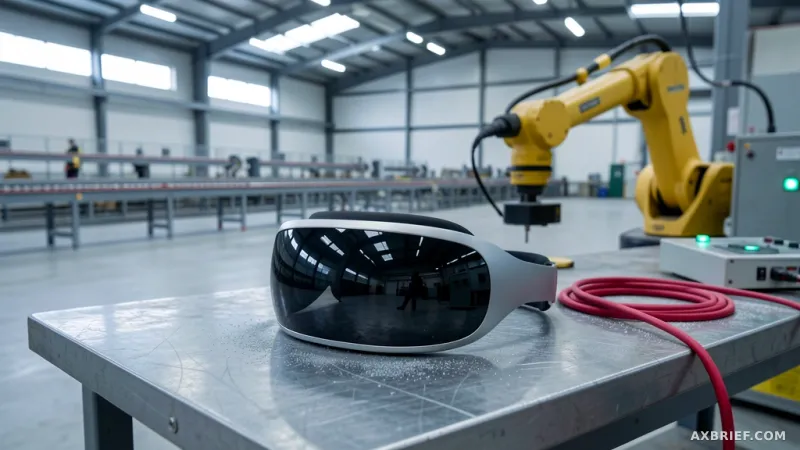
To bridge this gap, Eclipse Automation introduced Eclipse RealitySync, a simulation platform built specifically for the Apple Vision Pro. Unveiled at Automate 2026, which took place from June 22 to June 25, the platform transforms the design phase of factory automation from a viewing experience into a walking experience. Instead of analyzing a screen, users don the headset to enter a fully realized virtual version of their future plant, allowing them to navigate the production line and explore workflows in a 1:1 spatial environment.
This capability is designed for sectors where precision is non-negotiable. The platform targets high-stakes industries including life sciences, electric vehicle (EV) production, automotive manufacturing, and battery plants. It also extends to heavy equipment, consumer goods, electronics, and the rigorous demands of the aerospace and defense sectors. By simulating the environment before a single piece of hardware is bolted to the floor, companies can identify spatial conflicts and workflow bottlenecks that remain invisible on a 2D plane.
Eclipse Automation brings over 25 years of precision automation design experience to this tool, leveraging a global operational footprint that spans the United States, Canada, Hungary, and Germany. This international expertise informs the platform's ability to handle the complex requirements of diverse industrial standards.
From Static Layouts to Multidisciplinary Consensus
The true shift offered by RealitySync is not the visual fidelity, but the collapse of the communication barrier between different corporate stakeholders. Traditionally, an engineering team might spot a layout flaw, but the finance or management teams—who hold the budget—cannot visualize the problem until the equipment is already installed and failing. This often leads to costly re-work and project delays that can derail an entire production timeline.
RealitySync introduces a multidisciplinary review process. By bringing engineers, operations managers, financial officers, and executives into the same virtual space, the platform creates a shared mental model of the project. When a CFO can virtually walk the floor and see exactly why a specific equipment configuration is necessary, or when an operations manager can identify a safety hazard in a worker's path, the speed of alignment increases. The tension shifts from arguing over interpretations of a drawing to solving visible problems in a shared simulation.
This transition transforms the simulation from a mere design tool into a risk mitigation strategy. The ability to validate equipment suitability and scalability before purchase ensures that the physical deployment is a formality rather than a gamble. The platform effectively moves the failure point of a project from the construction site to the simulation phase, where the cost of correction is negligible.
The era of imagining the factory floor is ending, replaced by the ability to experience it before it exists.



