Every fifteen minutes, a full-sized humanoid robot rolls off the assembly line and enters the shipping bay. This is no longer a choreographed demonstration for a venture capital pitch or a carefully edited clip from a research lab. It is the new heartbeat of EngineAI, a Chinese robotics firm that has just transitioned the T800 humanoid from a sophisticated prototype into a mass-produced industrial product. For years, the robotics community has treated humanoids as scientific curiosities—machines that could walk or balance but could not be manufactured at scale. That paradigm shifted this week as EngineAI activated its formal mass production facility and began shipping its first commercial batches.
The 15-Minute Cycle and the 12,000 Square Meter Engine
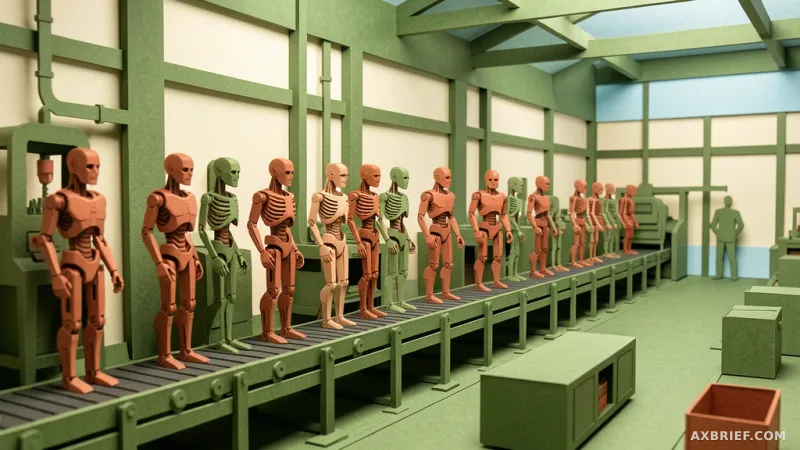
The scale of the operation is designed to shock. EngineAI has established a production base spanning 12,000 square meters, creating a vertically integrated pipeline where raw material inspection, component assembly, final testing, and shipping occur within a single contiguous flow. The central metric of this facility is its throughput: the line is now capable of delivering 10,000 units per year. To achieve this, the company has moved away from the artisanal, hand-tuned assembly methods that define most humanoid projects. Instead, they have implemented a high-efficiency process that completes one T800 every 15 minutes.
This leap in productivity is driven by the aggressive adoption of automated fastening, precision adhesive application, and laser welding equipment. By replacing manual labor with these automated systems, EngineAI reports a 40% increase in overall production efficiency. Laser welding, in particular, is critical for the T800, as it ensures the structural integrity of complex joint assemblies while drastically reducing the time required for bonding. The facility does not just assemble parts; it manages a digital lifecycle. Every component is tracked via a digital management system, ensuring that the provenance of every screw and actuator is recorded from the moment it enters the factory until the robot leaves the dock.
Quality control has been industrialized to match the speed of assembly. Every T800 must pass through 79 comprehensive quality inspections and 46 distinct simulation tests before it is cleared for shipment. EngineAI has integrated a simulation test solution specifically for integrated joints and core components, allowing the system to identify physical interference or drive efficiency gaps in a virtual environment before the physical assembly is finalized. This combination of real-time anomaly detection and simulation-based filtering is what allows the company to maintain a low defect rate despite the aggressive 15-minute cycle time.
The Death of the Lab Robot and the Rise of Hardware Standardization
While the numbers are impressive, the real story is the shift in the competitive landscape of robotics. For the last decade, the industry has been trapped in the era of the lab robot. In this phase, success was measured by a robot's ability to perform a specific task—like flipping a pancake or walking across a room—regardless of how many hundreds of man-hours were required to build that single unit. EngineAI is effectively declaring the end of that era. By proving that a full-sized general-purpose humanoid can be produced at a rate of 10,000 units per year, the conversation is shifting from whether a robot can function to how cheaply it can be deployed.
This transition triggers a inevitable collapse in hardware unit costs. When production moves from a few dozen hand-built units to ten thousand factory-made units, the economy of scale begins to favor general-purpose components over expensive, custom-engineered parts. As the hardware stack becomes standardized, the primary battlefield for AI robotics will move from the mechanical engineer's workbench to the software engineer's IDE. The focus is no longer on the physics of the gait, but on the optimization of the inference models that control it. If the hardware becomes a commodity, the winner will be whoever writes the most efficient orchestration layer.
This creates a brutal environment for smaller startups and research-heavy firms. A team that spends two years perfecting a single, high-performance prototype now finds itself competing against a factory that can iterate on ten thousand units in a year. The gap is no longer about intellectual property or a clever design; it is about the industrial capacity to execute. EngineAI's journey from the introduction of its first test equipment in 2024, through the small-scale PM01 production in 2025, to the T800 mass production in 2026, shows a compression of the development cycle that was previously unthinkable in hardware.
Vertical Integration as a Strategic Weapon
The geographical and structural layout of EngineAI's operations reveals a broader strategy of manufacturing dominance. With a global headquarters in Zhengzhou and supporting bases in Shenzhen and Henan, the company has minimized the physical distance between component suppliers and the final assembly line. This proximity, combined with the digital tracking system, allows for a rapid feedback loop. If a failure is detected during one of the 79 quality checks, the data is fed back to the supplier and the assembly line in near real-time, allowing for immediate adjustments to the production process.
This approach stands in stark contrast to the specialized robotics strategies seen in other regions. While many developers in Korea and the West have focused on domain-specific robots—machines optimized for surgery, logistics, or hazardous waste—China is pursuing a path of general-purpose mass production. By building the infrastructure for the T800 first, EngineAI is betting that the market will prefer a reasonably capable, cheap, and abundant robot over a highly specialized, expensive, and rare one. They are not just selling a robot; they are building the supply chain that will define the humanoid industry for the next decade.
For the robotics practitioner, the warning is clear: the barrier to entry is no longer the ability to make a robot move, but the ability to make a robot repeatable. The T800 is a signal that the industry has entered its industrialization phase. The era of the prototype is over, and the era of the fleet has begun.
As the T800 begins to populate warehouses and factories, the focus will inevitably shift toward the software that breathes life into this mass-produced steel. The hardware is now a solved problem; the real race begins with the intelligence that drives it.