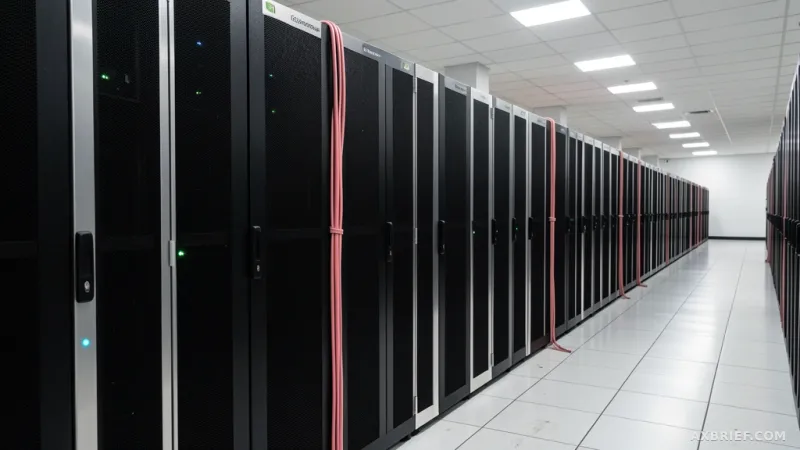
The era of hardware-induced bottlenecks in high-performance computing is effectively ending. For researchers tackling massive AI training or complex scientific simulations, the traditional wall of limited memory and sluggish processing speeds has long forced a compromise: either lower the precision of models or shrink the scope of analysis. The JUPITER supercomputer, now operational at the Forschungszentrum Jülich in Germany, removes these constraints by delivering exascale performance—the ability to perform over one quintillion floating-point operations per second—turning decades of calculation into a matter of days.
The Architecture of Exascale Production
JUPITER is built on a foundation of NVIDIA Grace Hopper Superchips and NVIDIA Quantum-X800 InfiniBand networking. The InfiniBand architecture is critical here, as it minimizes data transfer latency and maximizes bandwidth between server nodes. Unlike traditional supercomputers that struggle with data bottlenecks, JUPITER utilizes a unified memory structure that allows CPUs and GPUs to share resources efficiently. This design ensures that researchers can leverage the full weight of exascale computing without the system stalling during massive data transfers. The system currently powers four flagship projects that demonstrate a shift from theoretical research to industrial-grade production infrastructure.
Mapping the Brain with CytoNet
Mapping the human brain requires tracking trillions of neural connections, a task that has historically been impossible at the single-cell level. By utilizing JUPITER, the CytoNet foundation model has broken this barrier. The project, which aims to build a comprehensive map of cellular structures and tissue patterns, processed 6.5 petabytes of post-mortem brain data. Using 4,096 NVIDIA Grace Hopper Superchips, the team completed the training in less than five days. The system’s ability to spill over data from GPU memory to CPU memory when capacity is exceeded ensures that the training process remains uninterrupted. Detailed findings from this work are available on arXiv.
High-Resolution Climate Modeling
Climate forecasting has long relied on physical approximations—statistical estimates used because the raw physics were too complex to compute directly. The ICON (Icosahedral Nonhydrostatic) model running on JUPITER changes this by simulating the entire Earth system at a 1km resolution. By directly calculating physical interactions like ocean eddies and upper-ocean mixing, the model provides a precision previously unavailable to climate scientists. The project, which won the Gordon Bell Prize for Climate Modelling at SC25, utilized 20,480 NVIDIA Grace Hopper Superchips to process 146 days of climate data in just 24 hours. This level of granularity allows for the visualization of ecological shifts, such as plankton growth, based on actual physical laws rather than statistical guesses.
Quantum Simulation and Network Optimization
JUPITER has also set a new record by simulating a 50-qubit general-purpose quantum computer, surpassing the previous 48-qubit milestone. The JUQCS-50 simulator, accessible via JUNIQ, allows researchers to design and stress-test algorithms for future quantum hardware. Simultaneously, a collaboration with Ericsson is leveraging JUPITER to optimize 5G and 6G network architectures. By applying neuromorphic AI approaches, the team is developing models that minimize energy consumption during AI inference at the radio edge. This work confirms that JUPITER is not merely a research tool, but a production engine for the next generation of global infrastructure.
As JUPITER transitions from a experimental facility to a production-grade infrastructure, it establishes a new standard for how we approach the most complex challenges in science and industry.