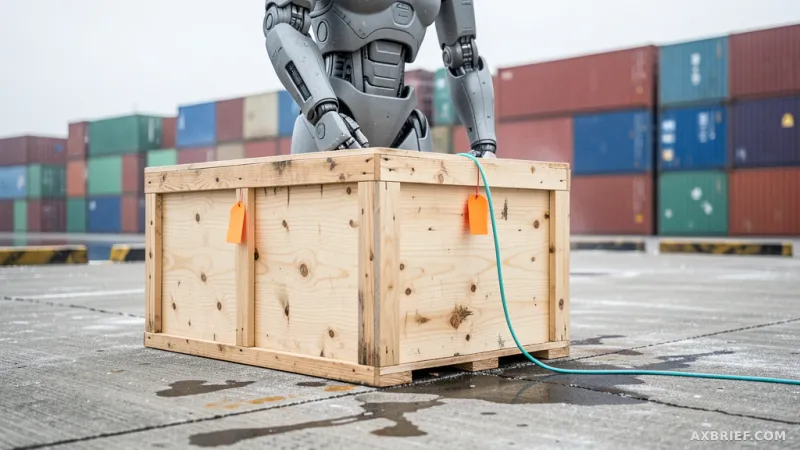
The global race for robotic supremacy has shifted from the laboratory to the customs office. For years, the developer community viewed the hardware layer as a commodity, assuming that as long as the AI brains were sophisticated, the chassis could come from anywhere. However, a sudden regulatory pivot in Washington has turned the physical supply chain into a geopolitical frontline, forcing companies to reconsider every gram of their hardware origins.
The New Border for Physical AI
On July 28, the Federal Communications Commission (FCC) implemented a sweeping restriction on the import of foreign network-connected robots weighing more than 4.4 pounds. This mandate effectively halts the equipment authorization process for a wide array of advanced machinery, specifically targeting humanoid robots, quadrupedal robots, and any mobile robotic platform exceeding the 4.4-pound threshold that relies on network connectivity. The FCC cited critical vulnerabilities in the supply chain and escalating cybersecurity risks as the primary drivers for this decision, signaling that the US government now views network-enabled robotics as potential vectors for national security breaches.
This regulatory wall extends beyond just robots. The FCC simultaneously restricted the import of foreign connected power inverters, the devices responsible for converting direct current to alternating current. It is important to note that these restrictions apply exclusively to new import authorization requests. Existing models that have already secured certification and are currently circulating in the US market remain unaffected for now. However, for any firm planning a new product launch, the barrier to entry has shifted from technical viability to geopolitical compliance. The move has already sparked international friction, with the Chinese Ministry of Commerce issuing a stern warning on July 30, promising decisive retaliation. Conversely, John Moolenaar, Chairman of the House Select Committee on the CCP, defended the measure as a necessary step to protect national security and bolster the competitiveness of the domestic robotics industry.
From Regulatory Walls to Physical Breakthroughs
While the FCC builds a digital and physical wall around the US market, the actual engineering of Physical AI is moving toward a state of fluid versatility that defies traditional categorization. The tension now lies between the restrictive nature of the supply chain and the boundary-pushing nature of the hardware. We are seeing a divergence in how robots interact with the physical world, moving away from static industrial roles toward dynamic, adaptive agents.
At Northwestern University, researchers have challenged the concept of visibility with the Phantom Twist drone. By rotating the entire chassis at a rate of up to 25 times per second, the drone exploits the limitations of the human visual system. Because the human eye cannot process individual images at that speed, the drone disappears into a visual afterimage, appearing as a ghostly blur that blends into the colors and textures of the surrounding environment. This is not a result of stealth coatings or optical camouflage, but a purely physical implementation of cloaking through rotational velocity.
Simultaneously, a joint effort between MIT and EPFL has produced a 250g amphibious robot that collapses the distinction between air and water. The engineering feat here is the use of a single set of wings to perform three distinct movements: flying, diving, and swimming. The robot achieves a speed of 6.3m/s in the air and approximately 1m/s underwater. By optimizing the wing structure to handle the drastic density difference between air and water, the team minimized the physical constraints of medium transition. The 250g weight is the critical variable here, serving as the pivot point that allows for both sufficient lift in the air and precise buoyancy control underwater.
This trend toward extreme environmental adaptation is also evident in the Super Athlete AS2-W from Unitree Robotics. Unlike robots designed for the flat floors of a warehouse, the AS2-W is built for the chaos of mountainous terrain. Through a hardware architecture that absorbs irregular shocks and rapidly shifts the center of gravity, it maintains stability in deep valleys and on sharp peaks. This represents a shift in the benchmark for mobile robots: the goal is no longer just movement, but the ability to maintain high-speed equilibrium in unmapped, rugged physical spaces.
This evolution in capability is mirrored by a philosophical war over the robot's face. At WAIC 2026, the Origin F1 showcased a hyper-realistic approach, utilizing precise anatomical replication to mimic human skin, gaze, and micro-expressions. The goal is to lower the psychological barrier between human and machine through deep emotional mimicry. However, this approach risks the Uncanny Valley, where near-perfect human likeness triggers an instinctive feeling of revulsion. In direct contrast, LG Display presented a vision at K-Display 2026 that embraces the artificial. By using a curved OLED face, LG replaces biological mimicry with a digital interface. Instead of simulating muscles and skin, the robot communicates through pixels, colors, and symbols. This strategy avoids the Uncanny Valley entirely by establishing a clear identity as a machine, thereby increasing the predictability and comfort of the interaction.
To resolve this tension between the hyper-real and the artificial, a research team at the University of Tokyo introduced a Bayesian model in July to mathematically control the Uncanny Valley. By using a Hierarchical Bayesian generative model, the team converted qualitative design guidelines into quantitative mathematical variables. Rather than relying on a designer's intuition to avoid the Uncanny Valley, engineers can now treat psychological repulsion as a parameter. By adjusting specific geometric variables within the model, they can pinpoint the exact threshold where a robot's appearance shifts from comforting to creepy, effectively turning aesthetic design into a rigorous engineering process.
The Shift Toward Functional Mastery
The ultimate trajectory of Physical AI is moving away from the superficial and toward the systemic. This is best exemplified by recent work at KAIST, where Kim Nam-kyun's team developed an auto-dressing robot based on the biomimicry of ivy. By replicating the way ivy climbs walls, the robot can pull clothing upward and onto a body without the need for manual assistance. While this seems like a niche convenience, the practical implications are massive for cleanroom environments where contamination must be zero, or emergency rescue scenes where every second spent donning protective gear is a second lost.
This transition from demo to deployment reached a milestone on July 5, 2026, at RoboCup 2026, with the first-ever 11v11 full-size humanoid soccer match. Teams like B-Human from Bremen and HTWK Robots from Leipzig demonstrated that large-scale humanoid swarm control is no longer a theoretical goal but a physical reality. Managing eleven human-sized bipedal robots in a real-time, collaborative environment requires a level of control and coordination that far exceeds the complexity of a single robot's movement.
When we synthesize these developments—the FCC's regulatory crackdown, the mathematical taming of the Uncanny Valley, and the emergence of amphibious and auto-dressing systems—a clear pattern emerges. The industry is moving past the era of the novelty humanoid. The focus has shifted from how a robot looks to how it solves the friction of the physical world. Whether it is navigating a mountain, blending into the air, or coordinating a team on a pitch, the value of Physical AI is now measured by its ability to master the constraints of the environment.
The true value of Physical AI now rests not on how closely a machine mimics a human face, but on how precisely it masters the friction of the physical world.