
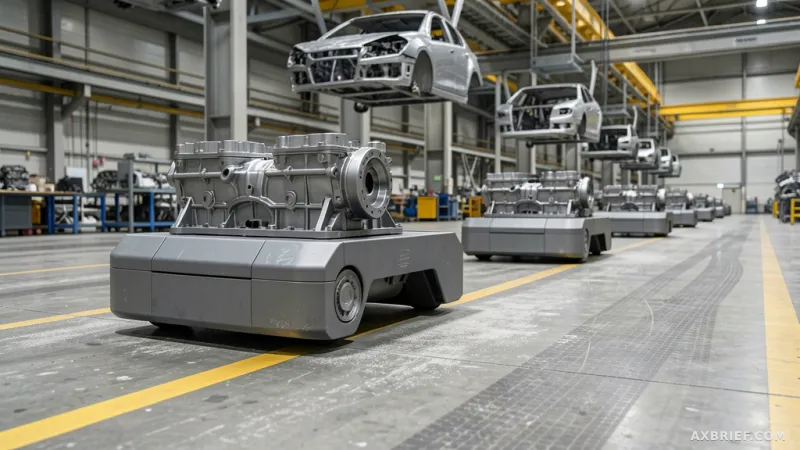
The most terrifying word in a high-volume automotive plant is downtime. For a facility producing thousands of vehicles, a scheduled stop for equipment upgrades is a calculated risk, but an unscheduled halt is a financial catastrophe. Plant managers often find themselves trapped in a paradox where they desperately need the efficiency of next-generation automation but cannot afford the operational pause required to install it. This tension creates a stagnation point where legacy factories continue to rely on outdated logistics simply because the cost of the transition is too high.
The Scale of the Dalian Deployment
ForwardX has challenged this industrial stalemate through a massive deployment at Chery Automobile's manufacturing facility in Dalian. The company integrated 484 Autonomous Mobile Robots (AMRs) into the active production environment, managing a fleet size that ranks among the largest of its kind in the automotive sector. Unlike traditional Automated Guided Vehicles (AGVs) that require magnetic tape, physical rails, or rigid floor markers to navigate, these AMRs utilize onboard sensors and intelligence to determine their own paths in real time.
This deployment was not a theoretical pilot or a controlled rollout in a vacant wing of the factory. ForwardX embedded these 484 units directly into the heart of the manufacturing process. The system has now been operational for over a year, maintaining a trajectory of continuous expansion without requiring a single moment of production stoppage. Detailed technical insights regarding these capabilities are available via ForwardX.
The Brownfield Pivot in Physical AI
To achieve this without halting the assembly line, ForwardX utilized a Brownfield strategy. In industrial engineering, a Greenfield project is a blank slate where the facility is designed from the ground up to accommodate automation. Brownfield automation, however, is the act of retrofitting existing, operational facilities that were never intended to house a robot army. Most automotive plants are designed for the singular purpose of vehicle throughput, meaning the physical layout is often a constraint rather than an asset for AI integration.
Integrating nearly 500 robots into a space designed for human-centric or fixed-line logistics creates an immense friction point. The challenge is not merely the hardware of the robot, but the orchestration of Physical AI within a rigid, legacy environment. By successfully scaling in a Brownfield setting, ForwardX has shifted the value proposition of industrial AI. The competitive edge no longer belongs to the company with the most sophisticated robot in a vacuum, but to the provider that can inject intelligence into a living, breathing factory without killing the production flow.
This transition proves that the primary barrier to the AI revolution in manufacturing is not the technology itself, but the deployment methodology. When the cost of installation is decoupled from the cost of downtime, the incentive to automate legacy plants disappears, replaced by a viable path toward modernization.
The true metric of success for Physical AI is now defined by its ability to adapt to the world as it exists, rather than demanding the world be rebuilt to suit the machine.



