The current race to build a truly functional humanoid robot often hits a physical wall at the fingertips. While companies like Tesla with Optimus or Figure AI showcase robots that can delicately handle eggs or manipulate complex tools, the underlying engineering challenge remains the same: fitting immense power into a microscopic footprint. To achieve human-like dexterity, every single joint in a robot's hand requires an actuator that is simultaneously lightweight, incredibly small, and capable of generating significant force. This tension between size and strength has long been the primary bottleneck in humanoid hardware evolution.
The Shift to PCB Winding Architecture
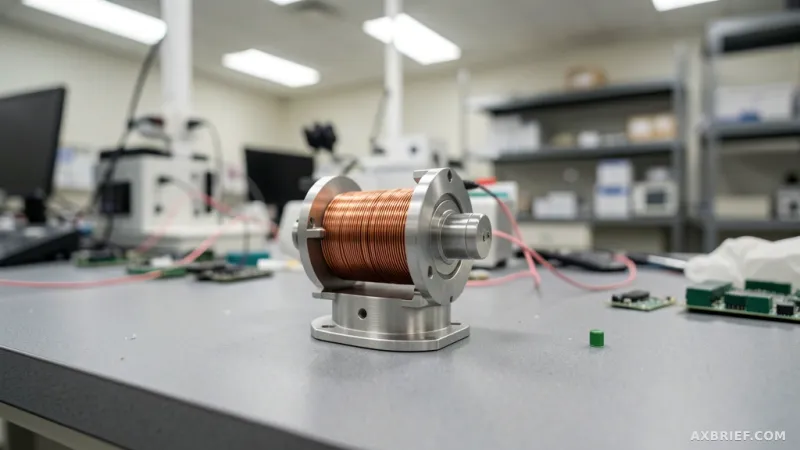
To address this hardware limitation, Gachon University has officially transferred a specialized small-scale motor technology to Higen RNM, a firm specializing in industrial and robotic motors. The agreement, signed on the 9th at Gachon Hall, centers on a breakthrough developed by Professor Won-ho Kim's research team in the Department of Electrical Engineering. The core of the innovation is a small-scale motor for humanoid robot hands that utilizes PCB winding, a method where the coils are created using the patterns of a printed circuit board rather than traditional wire winding.
The commercialization of this technology is being accelerated through strategic government backing. The Gachon University Industry-Academic Cooperation Foundation is supporting the project via the first stage of the Next-Generation Promising Seed Technology Commercialization Fast Track, funded by the National Research Foundation of Korea. Additionally, the project is pursuing IP advancement and commercialization through a dedicated program from the Korea Institute of Technology Commercialization, specifically targeting the business application of axial flux motor technology using PCB stators.
Solving the Manufacturability Paradox
The critical distinction in this technology lies in the transition from traditional winding to a circuit-based design. In standard motor construction, coils are wound manually or via complex machinery, a process that is often labor-intensive and difficult to scale while maintaining precision. By applying PCB winding to an ultra-small axial core, the research team has replaced the cumbersome winding process with a standardized circuit board design approach.
This architectural shift yields a dramatic performance increase. The PCB winding structure achieves a torque density more than two times higher than that of conventional slotless motors. Torque density refers to the amount of rotational force a motor can produce per unit of volume. In the context of a humanoid hand, where every millimeter of space is contested, doubling the torque density means engineers can either shrink the joint size further or increase the lifting and gripping capacity of the robot without increasing its bulk.
Beyond raw power, the real breakthrough is the path to mass production. Humanoid joints must be ultra-lightweight yet high-output, a combination that usually makes them prohibitively expensive to manufacture. Because PCB winding leverages existing semiconductor and circuit board fabrication infrastructure, design iterations are faster and the production process is far more scalable than traditional methods. This transforms the high-performance motor from a laboratory curiosity into a viable industrial component.
This partnership between Gachon University and Higen RNM accelerates the localization of high-output miniature motors, reducing reliance on foreign components for the next generation of humanoid robotics.