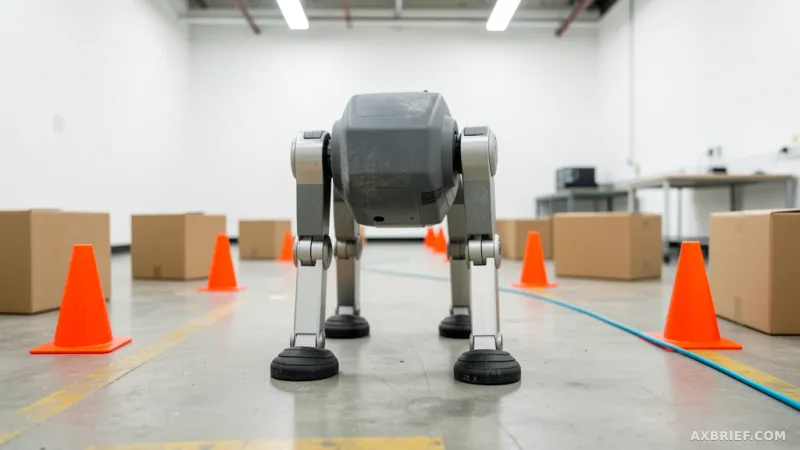
The current state of robotics is defined by a frustrating paradox. While large language models can compose symphonies or debug complex code in seconds, a physical robot often struggles with the simple act of grasping a coffee mug or navigating a cluttered living room. This clumsiness is not a failure of mechanical engineering, but a crisis of data. Robots lack the lived experience required to understand the nuances of physical interaction, and the industry has long struggled to find a scalable way to teach machines how the physical world actually behaves.
The Capital Surge and the Medal Strategy
General Intuition is attempting to bridge this gap by looking away from the physical world and toward the virtual one. The company's US entity recently secured $320 million in Series A funding, a massive injection of capital that pushes its valuation to $2.3 billion. With this latest round, the company's total cumulative investment has reached $454 million. The funding round was led by General Catalyst and saw participation from high-profile strategic investors, including Jeff Bezos and former Google CEO Eric Schmidt.
Rather than relying on the slow, expensive process of recording human movements in a lab, General Intuition is leveraging the Medal platform. Medal is a game clip sharing service that hosts billions of short videos of gamers capturing their best moments. By tapping into this vast repository, General Intuition is treating gaming history as a massive, unstructured dataset for physical intelligence. The company intends to use the new capital to aggressively expand its computing capacity and accelerate the pre-training of its next-generation models. Furthermore, General Intuition plans to broaden the availability of its Application Programming Interface (API) starting this summer, allowing for wider integration of its software protocols.
From Pixels to Causality: The Action Label Twist
To the casual observer, a video of a video game is just a sequence of changing pixels. However, the true value of the Medal dataset lies in what is hidden beneath the surface: action labels. Unlike a standard YouTube video, the data from the Medal platform often contains embedded records of exactly which buttons the player pressed and at what precise millisecond those inputs occurred. This transforms the video from a passive observation into a direct map of cause and effect.
This is where General Intuition departs from traditional AI training. Most physical AI attempts rely on textual descriptions of the world or synthetic simulations that often suffer from the sim-to-real gap, where a robot learns a behavior in a perfect digital vacuum that fails in the messy real world. By using action labels, General Intuition is training its systems on the actual decision-making process of humans. The robot does not just see a character move; it learns that the input of a specific command leads to a specific physical outcome in a complex environment.
Since 2015, the company has focused on the dual development of Action Models and World Models. The Action Model serves as the robot's decision-maker, determining which movement to execute based on the current state of the environment. The World Model acts as the robot's internal simulator, predicting the likely outcome of that action before it is even taken. When these two models work in tandem, the robot gains the ability to perceive, predict, and improvise. This architecture allows the machine to handle unexpected obstacles not by following a pre-programmed script, but by referencing a vast internal library of causal relationships learned from billions of gaming interactions.
The economic implication of this shift is profound. Collecting thousands of hours of high-fidelity real-world data is prohibitively expensive and slow. Generating synthetic data requires immense manual effort to ensure accuracy. By repurposing existing, large-scale behavioral data from the gaming community, General Intuition is fundamentally altering the cost structure of robotic intelligence. The competitive edge in physical AI is no longer about who has the most cameras, but who has the most sophisticated access to decision-making data.
The viability of the next generation of autonomous machines now depends entirely on the efficiency of their data pipelines.