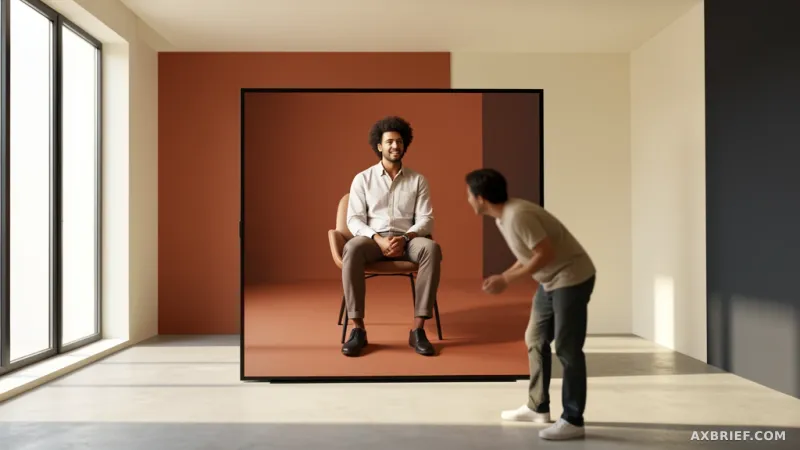
The modern corporate meeting has devolved into a digital gallery of floating rectangles. For the remote participant, the experience is less about collaboration and more about observation, as they stare at a grid of tiny faces while trying to time their interruptions perfectly. This psychological distance, often called hybrid alienation, transforms active contributors into passive spectators who struggle to read the room or catch a subtle nod of agreement. The cognitive load of translating a two-inch square of pixels into a human presence is exhausting, leaving remote workers feeling like ghosts in their own company's conversations.
The Architecture of Presence via HP Dimension
Google is attempting to dismantle this digital barrier with Google Beam, a life-size video communication platform designed to restore the physical scale of human interaction. In a recent optimization experiment, Google integrated Beam with HP Dimension, an immersive display system that moves beyond the traditional monitor. The core objective is to render every participant at their actual physical size, creating a spatial arrangement where remote attendees appear to be sitting around the same table as their in-person colleagues. This is not a simple matter of zooming in on a video feed; it is a sophisticated rendering pipeline that matches spatial coordinates with precise human proportions to maintain a realistic sense of depth and scale.
To complement the visual scale, Google has implemented Spatial Audio Anchoring. This technology ensures that sound is not emitted from a general speaker array but is instead fixed to the specific coordinates of the speaker's mouth on the screen. When a colleague sitting on the right side of the virtual table speaks, the audio originates from that exact point in space. This synchronization of sight and sound is designed to trigger the brain's natural perception of physical presence, reducing the sensory dissonance that typically plagues video calls. To ensure broad accessibility, Google has extended these capabilities through integrations with Google Workspace and Zoom, allowing users to leverage the immersive power of Beam while maintaining their existing software workflows. Detailed information on these experiments is available at beam.google.
Google's research indicates that this shift from grid-based views to life-size presence yields measurable productivity gains. The data shows that this approach strengthens social connection by 50 percent and increases the ability of remote participants to contribute to the conversation by 21 percent. By removing the psychological friction of the small box, the platform effectively lowers the barrier for remote workers to interject and engage in real-time dialogue.
From Information Transmission to Emotional Resonance
The critical insight here is the distinction between transmitting information and establishing presence. For years, the industry has focused on resolution, frame rates, and bandwidth—the technical plumbing of video calls. However, the grid view, while efficient for packing twenty people onto one screen, is an enemy of empathy. It strips away non-verbal cues, micro-expressions, and the spatial context that humans rely on to build trust and rapport. By restoring the life-size scale, Google Beam shifts the paradigm from a data-centric interface to a human-centric one, where the focus is on emotional resonance rather than just visual clarity.
Perhaps the most significant technical twist is the platform's inclusivity regarding hardware. While the HP Dimension display provides the primary immersive experience, the system is designed to render participants at life-size even if they are joining from a standard laptop or smartphone. This means the hardware burden is shifted to the meeting room rather than the individual, solving the hardware barrier through software optimization. The system automatically calculates lighting, background noise, and audio reverb in real-time to ensure that a person joining from a home office blends seamlessly into the professional environment of the boardroom.
This reduction in cognitive load is where the 21 percent increase in contribution originates. In a traditional Zoom call, a remote worker must constantly scan a grid to identify who is speaking and wait for a clear gap in the audio to speak. With spatial audio and life-size rendering, the brain processes the interaction as a physical event. The remote worker no longer feels like they are peering through a window into a room; they feel as though they are in the room. This eliminates the inclusion gap, ensuring that the most valuable ideas are not lost simply because the person suggesting them was trapped in a small blue box on the periphery of the screen.
For high-stakes collaborative work, such as architecture reviews or complex code debugging, this shift is transformative. These tasks require high-bandwidth communication where a tilt of the head or a hesitant expression can signal a problem that words might miss. By restoring these cues, Google Beam transforms the remote participant from a witness into a peer.
The era of the digital grid is giving way to a future where physical distance no longer dictates professional presence.