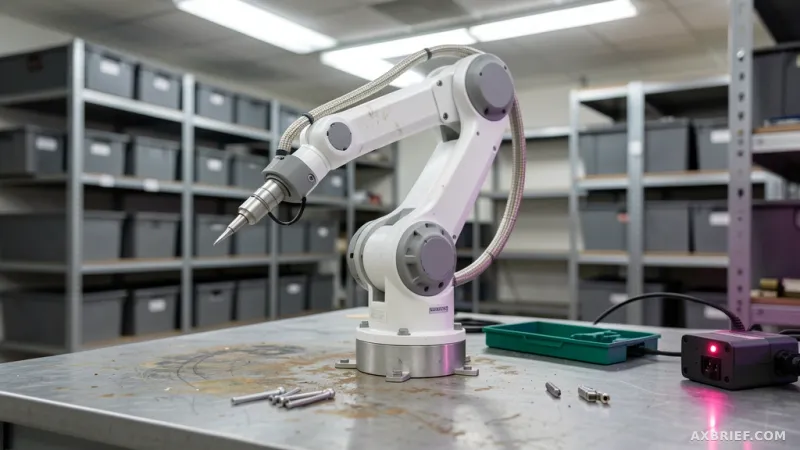
The robotics industry has long suffered from a frustrating paradox. In the controlled environment of a research lab, a robotic arm can perform a delicate task with surgical precision or a humanoid can navigate a mapped room with ease. Yet, the moment these machines enter the chaotic, unpredictable reality of a warehouse or a hospital ward, the illusion of intelligence often collapses. This gap between simulation and reality is where most robotics startups fail, exhausted by the sheer cost of building a cognitive architecture from scratch while simultaneously fighting the physics of hardware.
The Architecture of the Google DeepMind Robotics Accelerator
Google DeepMind is attempting to collapse this development cycle through the launch of the Google DeepMind Accelerator: Robotics. This intensive three-month program has selected 15 early-stage robotics startups from across Europe to integrate Google's most advanced AI capabilities directly into their hardware. The initiative, which kicked off with an event in London, is designed to move technology out of the research phase and into commercial viability by providing these companies with a level of infrastructure that would otherwise be financially impossible for a seed-stage firm to maintain.
At the center of this program are the Gemini robotics models. Rather than offering a simple API connection, Google is granting these 15 companies deep access to the Google AI stack. This allows developers to bypass the foundational struggle of building a world-understanding model and instead focus on optimizing the AI for their specific hardware constraints. The technical core of this integration relies on a tripartite system: Language, Vision, and Action models. The language model interprets natural human commands and plans the logical sequence of a task. The vision model processes real-time camera feeds to identify objects and spatial relationships. Finally, the action model translates these high-level plans and visual data into precise physical coordinates and motor control values.
Google DeepMind experts are providing direct technical mentoring to ensure these models run without latency on the limited compute resources typically found on mobile robot platforms. This includes specific guidance on inference speed optimization and hardware-software co-design to reduce sensor noise and increase control precision. By providing the product guidelines and the compute power, Google is effectively removing the primary bottlenecks that prevent a laboratory prototype from becoming a sellable product.
The Strategic Pivot Toward Embodied AI Dominance
On the surface, this looks like a philanthropic push to bolster the European tech ecosystem. However, the underlying logic is a calculated move to capture the frontier of Embodied AI. For years, AI has lived in the digital realm, processing text and images. Embodied AI is the transition of that intelligence into a physical body capable of interacting with the material world. The critical challenge here is not just the model's intelligence, but the data it consumes. While LLMs were trained on the vast expanse of the internet, Embodied AI requires high-fidelity, real-world physical data—the kind of data that can only be gathered by robots actually working in the field.
By embedding Gemini into 15 different startups across diverse domains, Google is essentially deploying a fleet of remote sensors. These robots will operate in healthcare settings, construction sites, recycling centers, and logistics hubs. As these machines encounter the friction of the real world, the data they generate—the failures, the corrections, and the successful maneuvers—flows back into the ecosystem. This creates a powerful feedback loop where the Gemini robotics models are refined by a variety of physical environments that Google could never simulate in a lab. The startups get a faster path to market, but Google gets the data necessary to build a universal robot brain.
This shift changes the competitive landscape for robotics. Previously, the primary differentiator for a robotics company was its proprietary control software or its mechanical engineering prowess. Now, the bottleneck is shifting toward the development pipeline. A company using the Google AI stack can skip years of foundational AI research and move straight to application and scaling. This creates a dependency where the startup's growth is inextricably linked to Google's infrastructure, effectively positioning Gemini as the operating system for the next generation of physical machines.
From Logistics to Healthcare: The Commercialization of Physical AI
The target sectors for this acceleration are not random. Google is prioritizing areas where the cost of human labor is high and the environment is complex, specifically healthcare, construction, and recycling. In logistics, the focus is on optimizing loading and sorting patterns. In healthcare, the goal is increasing the precision of patient assistance. In manufacturing, the integration of language and vision models allows robots to adapt to new tasks without requiring a programmer to rewrite thousands of lines of code for every new product variant.
For the developers involved, the most significant benefit is the reduction of the sim-to-real gap. The Gemini robotics models are designed to handle the noise and unpredictability of the physical world more gracefully than previous iterations. When a robot in a recycling plant encounters a piece of debris it has never seen before, the integrated vision and action models allow it to hypothesize a grip and execute it in real-time. This adaptability is what transforms a machine from a pre-programmed tool into an intelligent agent.
This strategy also serves as a warning to global competitors, including those in the Korean robotics sector. The race is no longer just about who can build the most agile robot, but who can define the standards for how those robots think and act. Google is not just providing tools; it is establishing the guidelines for responsible scaling and operational standards. If the industry adopts the Google AI stack as the default, the barriers to entry for any other model will become prohibitively high. The companies that control the development pipeline and the data feedback loops will ultimately control the market share of the physical AI era.
As these 15 European startups move toward commercialization, the success of their products will serve as the ultimate validation for Gemini's physical capabilities. The transition from digital intelligence to embodied action is the final frontier of the current AI wave, and Google is betting that by owning the brain, they will own the body of the future economy.