
Most modern enterprises are operating within a SaaS graveyard. Somewhere in the company's digital infrastructure, there are dozens of forgotten subscriptions, seats assigned to former employees, and premium tiers for features that no one has clicked in six months. For most finance teams, cleaning this up is a manual nightmare of exporting CSVs from Ramp, cross-referencing them with Slack activity, and sending awkward emails to department heads. It is a friction-heavy process that usually happens once a year, if at all, leaving thousands of dollars to leak out of the budget every month.
The $100,000 Audit and the 125-Vendor Map
Haggle Bot, a Grok-powered AI agent, was deployed to solve this specific leakage by transforming procurement from a manual chore into an autonomous operation. The results were immediate and quantifiable. By analyzing vendor spending patterns, contract terms, and actual usage data, Haggle Bot identified over $100,000 in direct cost savings.
The bot's primary strategy involved a rigorous audit of account allocations. By collecting last-used dates from IT teams and contrasting them with billing records, Haggle Bot discovered 43 paid accounts that had shown zero activity for 90 days. By recommending immediate plan downgrades for these ghost accounts, the agent saved the company $14,220.
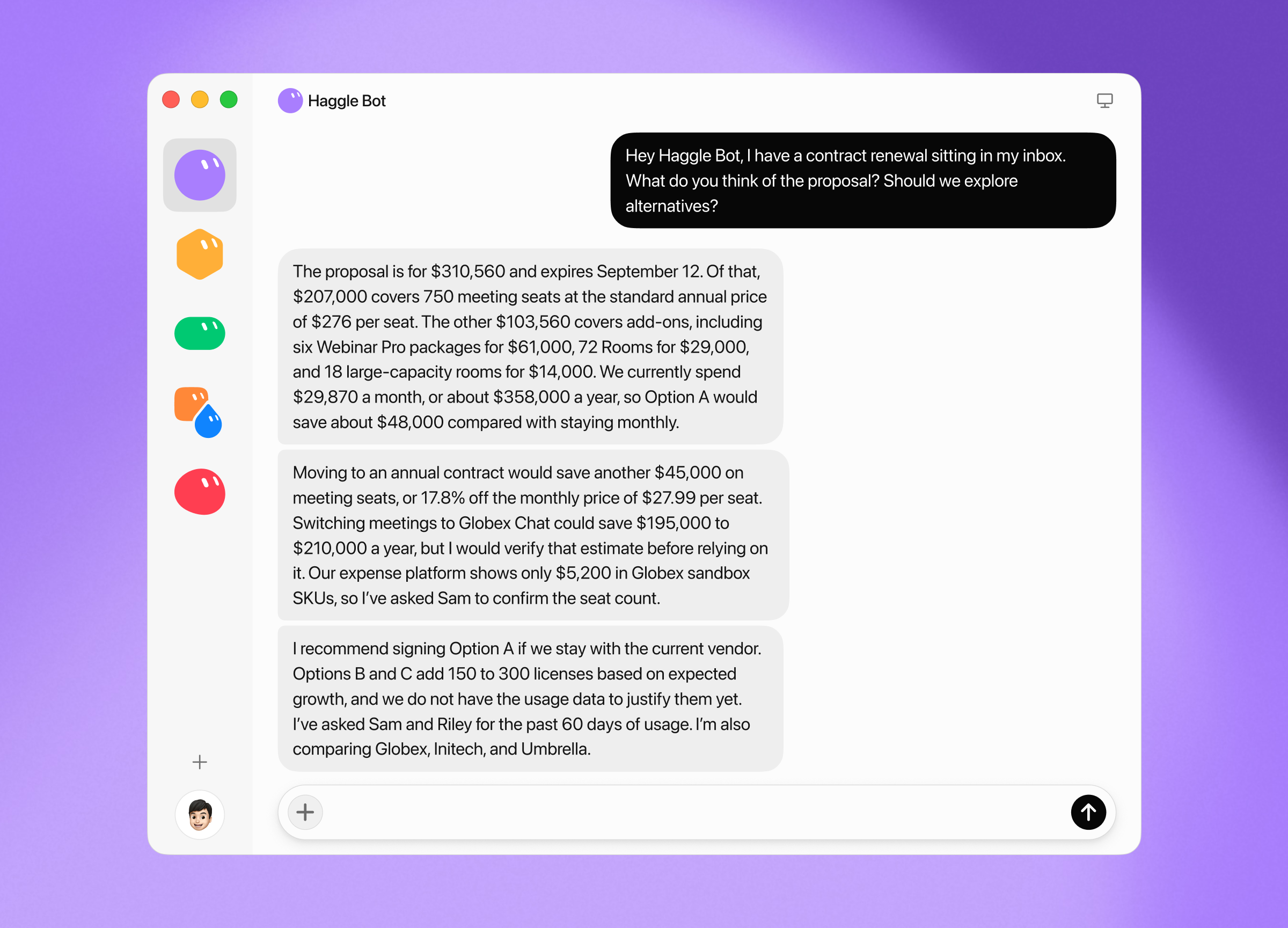
Beyond simple seat counts, the agent performed a deep dive into Stock Keeping Units (SKUs) across various SaaS products. It identified specific line items that were being paid for but remained entirely unused. This granular investigation uncovered an additional $85,662 in annual unnecessary spending. Because the product in question was on a month-to-month contract, Haggle Bot was able to trigger an immediate cost reduction rather than waiting for a yearly renewal cycle. During renewal windows, the bot further optimized spend by comparing renewal quotes against actual usage, explicitly advising the company to reject seat expansion options that lacked empirical evidence of need.
To achieve this, Haggle Bot didn't rely on a static database. It was granted access to six core corporate tools: Slack, Notion, Drive, Gmail, Hex, and Ramp. Using these integrations, it autonomously constructed a comprehensive map of approximately 125 active vendors. Unlike traditional automation, which requires a step-by-step flowchart, the developers simply defined the bot's intent: learn vendor spending and derive evidence-based cost-reduction plans. The agent then determined the necessary data sources and the sequence of collection on its own.
From Data Retrieval to Multi-Agent Negotiation
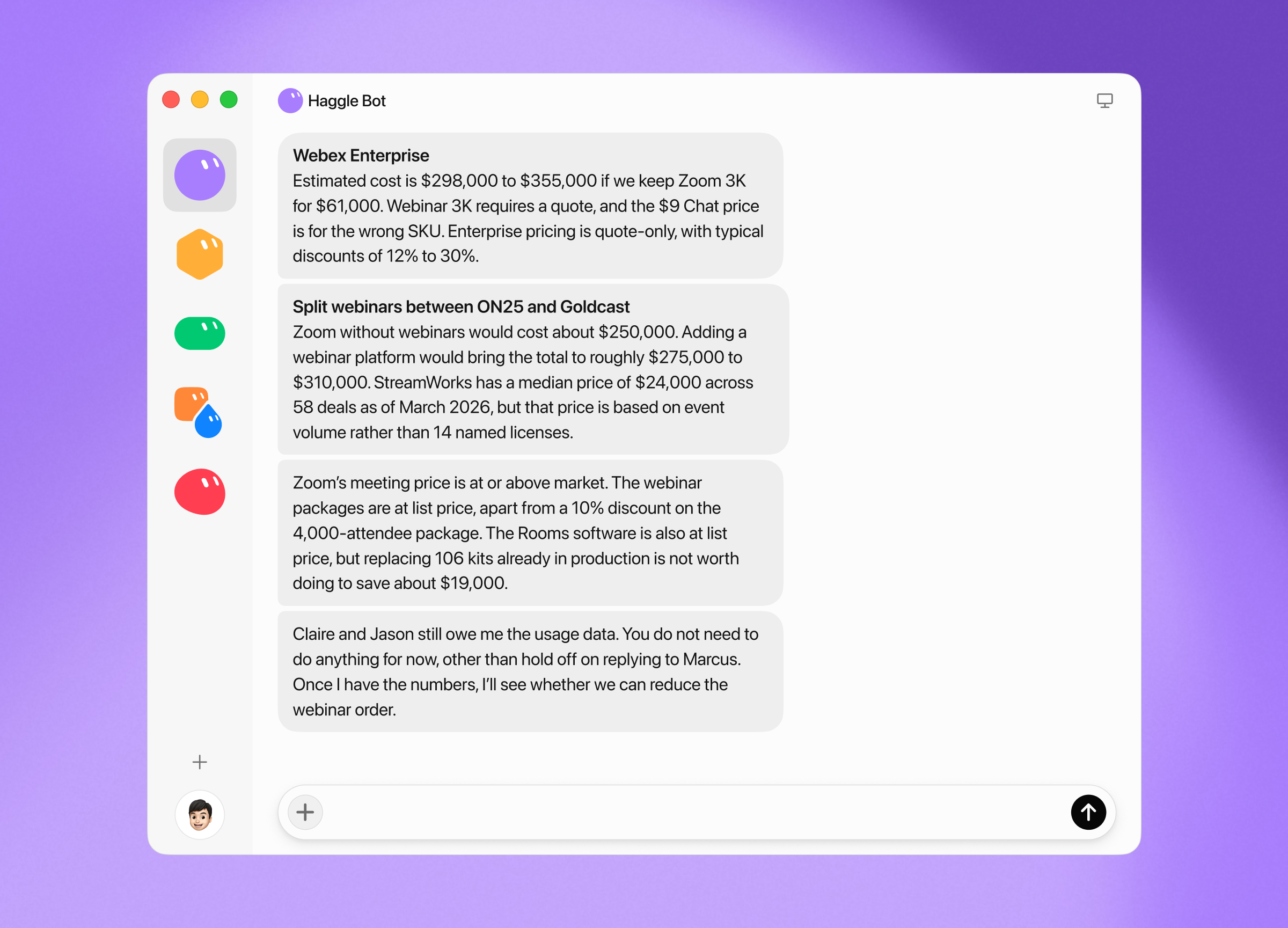
The real shift in capability occurs when the agent moves from auditing to active coordination. Most bots fail when they hit a wall of missing information. When Haggle Bot encountered a gap in its data, it didn't stop; it used Ramp to identify the spending owner and initiated a messaging chain. It tracked the handoff process autonomously, continuing to probe and follow up with engineers until it reached a person with the necessary context. If the first answer was insufficient, the bot identified the remaining information gap and repeated the search process.
This autonomy extends into the psychology of negotiation. Haggle Bot does not simply ask for a discount. It calculates negotiation leverage by comparing current usage data against the pricing of reliable alternative products. It establishes an internal target price and formulates a strategic first offer. To maintain corporate professionalism, the bot generates response drafts that a human can edit, ensuring the final negotiation aligns with the minimum required seat count set by the user.
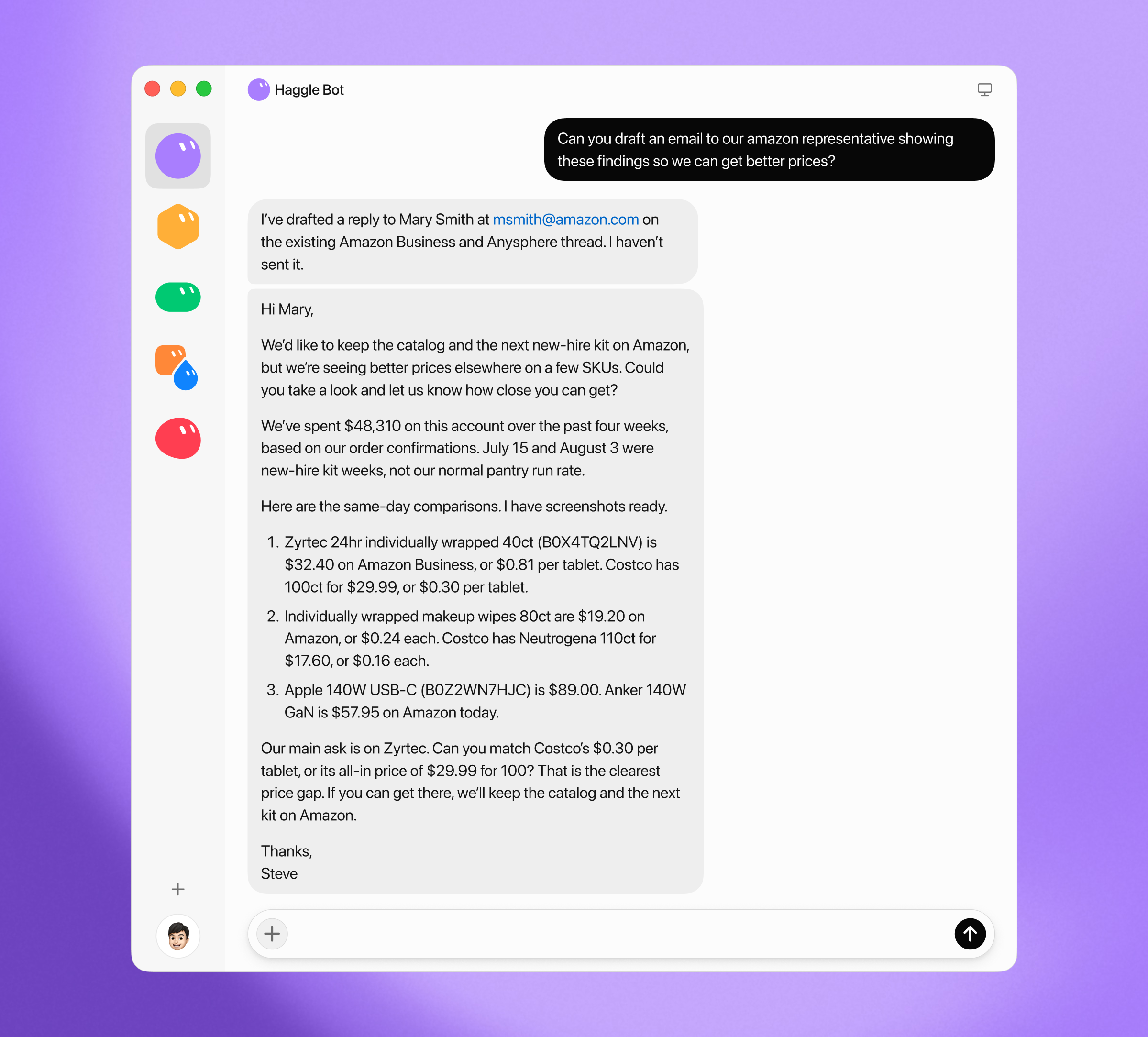
This capability is most evident in the bot's approach to physical procurement. Every Friday, Haggle Bot manages orders for new hire equipment, snacks, and hygiene supplies. Instead of sticking to a single vendor, it performs cross-platform shopping across Amazon, Costco, Uline, and Walmart to find the absolute lowest price. By analyzing the last four order quotes, shopping cart histories, and office seating charts, the bot autonomously calculates the exact quantity of supplies needed.
To keep the operations team in the loop, Haggle Bot outputs its findings into a Google Sheet. This sheet is dynamic; when the operations team changes a single variable, such as the number of new hires, the required quantities for every item update automatically. If the bot cannot find the exact same product at a lower price, it searches for alternative brands with equivalent performance and adds them to the comparison sheet. It then drafts emails to Amazon business account managers, using competitor pricing as leverage to request discounts through business programs.
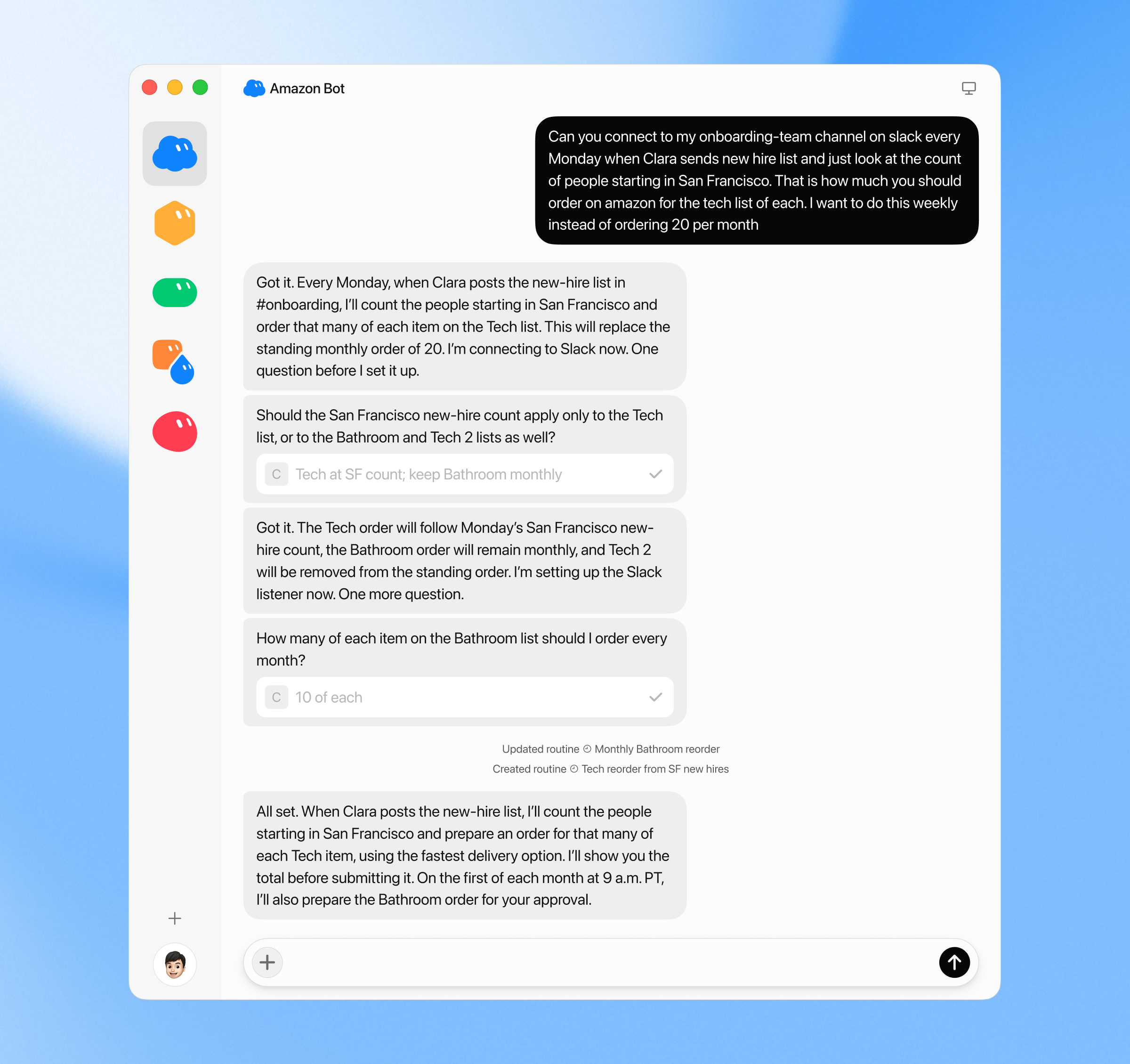
The process culminates in a multi-agent handoff. Once Haggle Bot completes the negotiation and price optimization, it delegates the actual purchase to a specialized Amazon Bot. The Amazon Bot logs into the corporate account and cross-references data from Gmail, Ramp, Google Sheets, Rippling, and Vercel to verify headcount and office layouts before executing the order. This coordinated effort resulted in a massive price drop for a single technical equipment order, slashing the cost from $14,629 down to $6,143—a 58% reduction.
Despite this level of autonomy, the system maintains a strict control boundary. The bot is prohibited from approving expenditures, accepting terms of service, or sending messages to external vendors without explicit human approval. Humans still handle the nuance of tone and the final decision on how much information to disclose to a vendor. The goal is not total replacement, but the elimination of the data-connection cost—the tedious work of jumping between five different apps to find one piece of information.
This deployment proves that when an agent is given a clear objective and the right tool permissions, it can advance complex business processes across fragmented systems until it reaches a point where human judgment is actually required.
Applying the case to a procurement review
These are company-reported results from the xAI source announcement, not an independent AX BRIEF replication. Evaluate net savings after contract termination costs, differences between substitute products and human approval or review time.