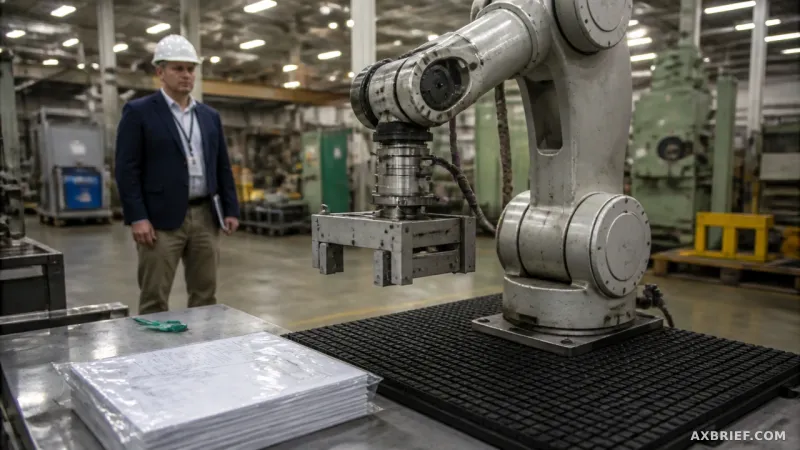
The modern robotics lab is often a battleground of bandwidth. Engineers spend as much time managing the movement of high-resolution camera frames and joint telemetry as they do refining the actual neural networks. The typical workflow is a grueling cycle: record a demonstration on a physical arm, transfer gigabytes of raw data to a GPU cluster, wait for the upload to finish, and then hope the environment configuration matches the hardware. This data tax creates a significant lag between a robot's physical experience and its digital learning, turning what should be a rapid iterative loop into a series of fragmented bottlenecks.
The Integrated Loop of Strands Robots and Storage Buckets
To solve this friction, a new integrated loop has emerged that leverages Hugging Face Storage Buckets to handle recording, streaming, and deployment within a single backend. At the heart of this architecture is Strands Robots, an open-source SDK released by AWS. Strands Robots utilizes a `Robot()` factory to abstract the complexities of various hardware configurations, such as the SO-100 or SO-101 models. This factory acts as a registry, matching names to specific robot arms, humanoids, mobile bases, or grippers. By abstracting the hardware, developers can validate their code in a simulation environment and transition to physical hardware using the same interface, eliminating the need for device-specific configuration tweaks during deployment.
The storage layer for this pipeline is Hugging Face Storage Buckets, introduced in March 2026. Unlike traditional version-controlled repositories, these buckets are Xet-based object stores that are mutable and do not perform versioning. This mutability is critical for robotics; it allows the system to modify specific parts of a dataset without rewriting the entire object. This infrastructure is paired with the LeRobot data format, a standard already adopted by over 8,000 publishers across more than 90,000 datasets and models within Project Pulse. Because Strands Robots records data directly into the LeRobot format, the resulting files are immediately compatible with any tool in the LeRobot ecosystem without requiring a separate conversion step.
The operational flow is streamlined: data is recorded via natural language prompts, synchronized to the bucket, and then read back frame-by-frame without requiring a local copy. The same `Robot()` object used for recording is used to stream data and eventually deploy the trained checkpoints. This creates a closed-loop system where physical demonstrations flow into the bucket, feed the training process, and return to the hardware as updated policies. The full implementation details are available in the `examples/notebooks/05_streaming_data_loop.ipynb` notebook.
Using Buckets as a High-Velocity Working Layer
Robot datasets, which combine high-frequency joint states with heavy video frames, grow exponentially as more episodes are recorded. In a traditional setup, every single training iteration requires copying the entire dataset to a GPU server, meaning the same bytes are transferred repeatedly. To bypass this, the architecture treats the mutable Storage Bucket as a working layer. Data is recorded and synced to the bucket first, and only once the results are validated are they moved to a version-controlled repository using the `push_to_hub()` function.
Dataset validation and transmission are handled by the `sync_dataset_to_bucket` function, which operates independently of the recording cycle. This function takes the local dataset root path, the target bucket, and a specific `run_id` as arguments, utilizing the hf CLI to manage the transfer.
sync_dataset_to_bucket(root, bucket, run_id=...)For those preferring the command line, the `hf sync` command allows for the direct transfer of local recording folders to a bucket path, wrapping the Python logic into a simple shell operation.
hf sync ./recordings hf://buckets/my-org/robot-fave/run-021In environments where an open recorder is running, the `DatasetRecorder.sync_to_bucket` method is used. To ensure data is pushed immediately upon stopping a session, the `stop_recording` function can be passed a bucket argument to force synchronization. The data is then stored in a structured path following the `hf://buckets/{bucket}/{run_id}` convention, allowing the subsequent streaming phase to identify the specific run via the `run_id`.
The Xet Advantage: Reducing Transfer by 4x
The most significant technical breakthrough in this pipeline is the use of Xet deduplication, which reduces the total data transfer across the Hugging Face Hub by approximately 4x. Traditional version-controlled stores suffer from a structural limitation: if a single byte in a large file changes, the system often requires the entire file to be re-uploaded. This wastes network bandwidth and increases latency in the learning loop.
Xet solves this through content-defined chunking. In a standard fixed-length chunking system, inserting a few bytes at the beginning of a file shifts the position of every subsequent byte, causing the system to perceive the entire file as new. Content-defined chunking instead analyzes the actual content of the data to determine boundaries. When a change occurs, only the specific chunk containing the modified bytes is altered; the boundaries for the rest of the data remain intact. This allows the system to identify and transmit only the bytes that have actually changed.
This efficiency is evident in real-world benchmarks. When a 500MB file is uploaded and then re-uploaded after a 1% modification, the actual data transmitted over the network is only 5.5MB. This represents a 100-fold reduction in transfer volume compared to traditional methods. This optimization extends to the financial model for enterprise users, where billing is based on the deduplicated footprint—the actual space the data occupies after deduplication—rather than the total volume of data transferred. For robotics teams running constant training loops, this byte-level deduplication drastically lowers infrastructure overhead.
Streaming Training and Zero-Config Deployment
To eliminate the wait time associated with downloading tens of gigabytes of data, the `stream_dataset(...)` function reads data directly from the Hub on a frame-by-frame basis. This approach removes the need for local disk storage and bypasses the I/O bottlenecks typically associated with large-scale video data. By using on-the-fly decoding, video frames are decrypted in memory and fed directly into the training model, allowing researchers to scale their datasets without being limited by local disk capacity.
Deploying the resulting model back to the physical robot is reduced to a single argument change. By initializing the `Robot()` object with `mode="real"`, the code transitions from simulation to hardware control instantly.
robot = Robot("so100", mode="real")Because the hardware abstraction layer remains consistent, logic validated in simulation can be deployed to the physical arm without modification, reducing the risk of hardware damage caused by configuration errors. To move from a test phase to a functional one, the `create_policy` function replaces the mock policy—which only generates joint movements—with a trained checkpoint capable of actual grasping.
policy = create_policy("hf://datasets/my-robot-policy")Even after the policy is swapped, the prompts, data formats, and synchronization methods remain identical. This allows developers to iterate on model weights and immediately verify performance gains on the hardware. This loop provides the foundation for agents to decide which episodes to retain, when to re-record based on scene changes, and which checkpoints should supersede previous models.
For robotics practitioners, this infrastructure removes the need for complex IAM settings or CORS rules. By utilizing existing account permissions, small research labs can build professional-grade data pipelines without needing a dedicated cloud engineer. In environments where cameras are fixed and backgrounds remain static, the deduplication of redundant pixels across thousands of episodes becomes a critical cost-saver. The combination of byte-level deduplication and direct streaming transforms the robot learning process from a series of heavy uploads into a fluid, real-time conversation between the hardware and the model.
This architecture effectively collapses the distance between physical action and digital optimization, accelerating the pace of hardware refinement.