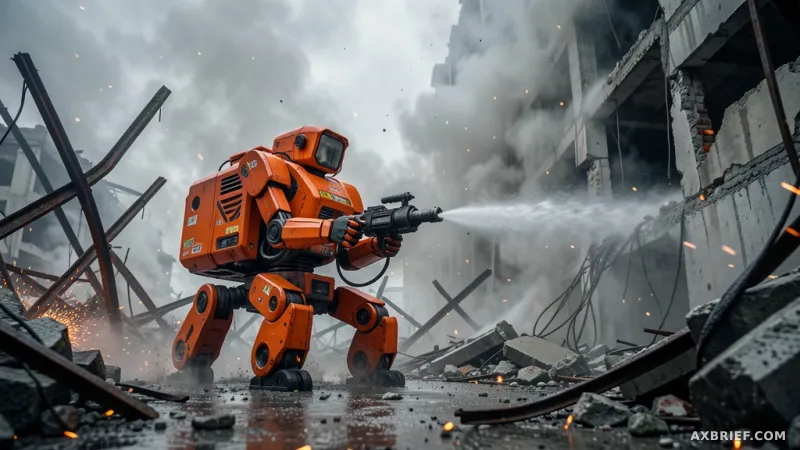
The air at a disaster site is usually thick with a suffocating mixture of concrete dust and acrid smoke, where every step a first responder takes could be their last. For decades, the protocol for building collapses has remained stubbornly human-centric, relying on the raw courage of firefighters to enter unstable structures and scout for survivors. But this week, the scene shifted from a test of human endurance to a demonstration of machine precision. The tension of the moment was not about whether a human would survive the entry, but whether a set of algorithms and treads could navigate the chaos of a simulated catastrophe.
The Operational Record of the 2026 Safety Korea Drill
On May 21, 2026, the Hyundai Motor Group Namyang R&D Center in Hwaseong, Gyeonggi-do, became the staging ground for the 2026 Safety Korea Drill. This was not a mere corporate demonstration but a large-scale joint operation conducted under Article 34 of the Framework Act on the Management of Disasters and Safety. The exercise was spearheaded by the Ministry of the Interior and Safety and involved a coalition of 11 public and private organizations, including Hwaseong City Hall, the Hwaseong Fire Station, and the Hwaseong Western Police Station. Approximately 150 personnel were deployed to manage a complex disaster scenario involving a massive earthquake that triggered building collapses, an electric bus fire, and the leakage of hazardous materials.
At the center of this operation was the unmanned firefighting robot, a piece of advanced hardware that Hyundai Motor Group had donated to the National Fire Agency in February. The primary objective was to test the robot's ability to penetrate a structure where structural integrity had been compromised—a zone deemed too dangerous for human entry. The robot was tasked with navigating through piles of debris, locating the seat of the fire, and executing suppression maneuvers while simultaneously acting as a mobile reconnaissance unit. Throughout the exercise, the robot successfully transmitted high-definition, real-time situational data back to the command center, proving that it could function as the primary eyes and ears of the rescue operation in lethal environments.
Technical observers at the site focused heavily on the robot's control stability and communication reliability. Disaster zones are notorious for signal interference and physical obstructions that typically cripple remote-operated vehicles. However, the Hyundai robot maintained a seamless data stream and precise control over its firefighting apparatus. This performance indicates that the software algorithms governing the robot's movement and environmental perception have moved beyond laboratory simulations and are now capable of handling the unpredictable variables of a real-world disaster site.
The Shift from Remote Tool to Intelligent Collaborator
To understand why this success matters, one must look at the fundamental change in how the robot interacts with its environment. In previous iterations of disaster robotics, machines were treated as simple remote-controlled tools—essentially cameras on wheels that required constant, minute adjustments from a human operator. The robot deployed in the Hwaseong drill operates on a different paradigm. It utilizes a sophisticated sensor fusion system that allows it to analyze thermal data and structural stability in real-time, enabling it to suggest or execute path corrections autonomously as it navigates rubble.
This creates a critical reversal in the disaster response workflow. Traditionally, a firefighter would enter a building to gather data, and that data would then inform the strategy. Now, the robot enters first to establish a data-driven map of the danger zone. By the time a human responder is called in, the robot has already suppressed the initial flames and identified the safest entry points. The robot is no longer just a piece of equipment; it has become a strategic collaborator that absorbs the highest level of physical risk.
This transition is particularly evident in the robot's ability to handle complex tasks like fire suppression within a collapsed zone. The integration of thermal imaging sensors allows the machine to pinpoint heat signatures through thick smoke, a task that often blinds human rescuers. The ability to operate firefighting equipment without a human operator standing in the line of fire changes the calculus of risk management. It moves the human element from the position of the vanguard to the position of the strategist, where they can make informed decisions based on a stream of telemetry rather than intuition and guesswork.
Redefining the Public Safety Infrastructure
The success of the Hyundai robot in the 2026 Safety Korea Drill signals a broader evolution in the national disaster response framework. The collaboration between 11 different agencies demonstrated that the hardware is only one part of the equation; the real victory was the integration of the robot's data into a multi-agency command structure. When the robot transmits a thermal map of a collapsed floor, that information is instantly available to the police for perimeter control and to the fire department for tactical planning. This creates a unified operational picture that was previously impossible to achieve in the early minutes of a crisis.
From a technical development perspective, the drill provided an invaluable dataset on how unmanned systems handle the variables of a complex disaster. The ability to maintain a stable connection while moving through reinforced concrete and steel debris is a significant milestone for the robotics community. It proves that the latency and interference issues that once plagued field robotics are being solved through more robust communication protocols and edge computing. The robot's capacity to process environmental data locally and only send critical updates to the command center reduces the bandwidth burden and increases the speed of response.
Furthermore, the donation model used by Hyundai Motor Group suggests a new blueprint for public-private partnerships in safety technology. By placing high-end R&D assets directly into the hands of the National Fire Agency, the cycle of feedback between the engineers who build the robots and the firefighters who use them is shortened. This ensures that future iterations of the robot will be designed around the actual needs of the field rather than theoretical requirements. The robot is evolving into a standardized piece of safety infrastructure, much like the fire truck or the ambulance, but for the specific niche of high-risk, unmanned entry.
The Future of the Korean Disaster Response Ecosystem
As the 2026 Safety Korea Drill concludes, the implications for the future of urban safety are clear. The ability of a robot to successfully navigate a collapsed building and suppress a fire is the first step toward a fully integrated, intelligent disaster response ecosystem. In the densely packed urban environments of South Korea, where a single building collapse can lead to catastrophic cascading failures, the deployment of such robots is no longer a luxury but a necessity. The shift toward a model where robots handle the initial, most dangerous phase of an operation allows for a more surgical and safe approach to human rescue.
Looking ahead, the focus will likely shift toward optimizing autonomous pathfinding and enhancing the efficiency of thermal sensor data processing. The goal is to move from remote control to a level of autonomy where the robot can be assigned a sector and tasked with a goal—such as find and extinguish all heat sources—without needing a human to steer every turn. This would allow a single operator to manage a fleet of robots, exponentially increasing the area that can be scouted and secured in the golden hour following a disaster.
Ultimately, the events at the Namyang R&D Center prove that the era of relying solely on human bravery to face the unthinkable is ending. By combining the strategic judgment of human commanders with the physical resilience and sensory precision of unmanned robots, the disaster response system is becoming a hybrid entity. This synergy does not replace the firefighter; it protects them, ensuring that when they finally step into the ruins, the path has already been cleared and the danger has already been mapped.