
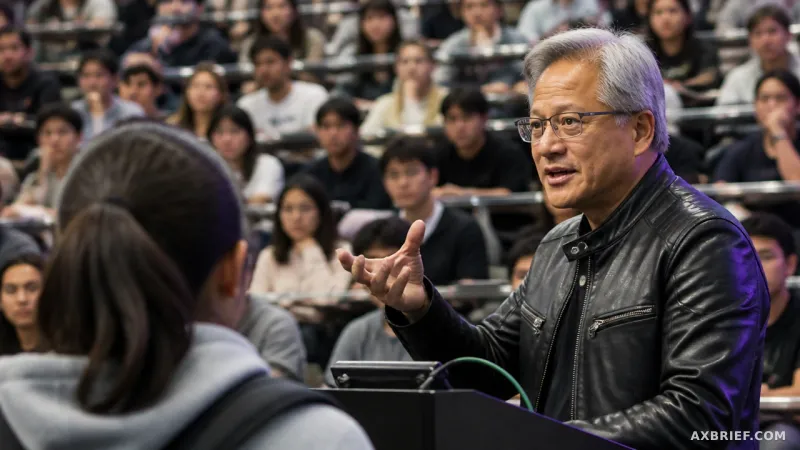
The current era of artificial intelligence is often defined by staggering market caps and the frantic pace of GPU shipments, but for the engineers and architects inside these firms, the experience is usually far more volatile. Across the valley, the narrative of the last few years has been one of correction, massive layoffs, and a growing disconnect between the C-suite's vision and the reality of the cubicle. Yet, amidst this turbulence, one company has managed to align its astronomical financial success with an almost unprecedented level of internal devotion. This is not merely a result of stock options or high salaries, but a reflection of a leadership style that has become a statistical anomaly in the modern corporate landscape.
The Metrics of a Leadership Peak
According to the latest data from Glassdoor, the professional review and recruitment platform, Jensen Huang has been named the top CEO for 2026. The most striking figure in the report is the 99% approval rating from NVIDIA employees, a number that places Huang at the absolute summit of leadership evaluations. This ranking is particularly significant because it is derived directly from the people who observe his decision-making and management style daily, shifting the criteria for corporate success from external shareholder value to internal talent retention.
This level of support is not a sudden spike but part of a sustained trend of organizational health. NVIDIA previously secured the top spot on Glassdoor's 2025 Best-Led Companies list, proving that the trust employees place in the company's direction is consistent and measurable. Furthermore, in January of this year, the company was ranked number one in the Best Places to Work in Technology and AI category. These overlapping accolades suggest that the technical achievements of the firm are being mirrored by a psychological satisfaction within the workforce.
To understand these numbers, one must look at the rigorous data collection process Glassdoor employed. The platform reintroduced its Best CEOs list after a five-year hiatus, intentionally pivoting away from the Best-Led Companies metric to focus specifically on the individual influence of the CEO and senior management. The data was gathered over a precise one-year window, from May 16, 2025, to May 15, 2026. The scope was limited strictly to employees based in the United States who submitted reviews during this period, ensuring the results reflected the specific dynamics of the U.S. labor market.
Glassdoor's methodology combined quantitative ratings with qualitative, anonymous feedback. Employees were asked to rate the performance of the CEO and senior leadership separately from their general feelings about the company. By synthesizing these numerical scores with descriptive text, the platform was able to analyze how a leader's specific actions translate into the daily lived experience of the staff. The evaluation did not just look at Huang in isolation but considered the collective leadership of the senior executive team, operating on the premise that a shared leadership philosophy has a deeper impact on culture than the charisma of a single individual.
The Great Leadership Divide
When viewed against the broader economic backdrop, NVIDIA's internal harmony reveals a startling contrast. While Jensen Huang enjoys near-total approval, the general state of corporate leadership is in a period of decay. Daniel Zhao, the Chief Economist at Glassdoor, noted in a statement that senior leadership ratings have hit their lowest point in a decade. We are witnessing a paradox where employees require stable, visionary leadership more than ever due to economic uncertainty, yet the trust they place in their executives is evaporating.
In this environment of systemic distrust, the technology sector has emerged as a surprising stronghold. Tech leaders claimed nine of the top 50 spots on the Best CEOs list, the highest representation of any industry. This suggests that while the general workforce is disillusioned, those within the AI and tech vanguard are finding a different kind of resonance with their leaders. The data further proves that leadership quality is the primary driver of workplace satisfaction; 28 of the top 50 CEOs also led companies that appeared on the Best Places to Work list.
Beyond NVIDIA, the top five list includes Jason Johnson of Quick Quack Car Wash, Kevin A. Lobo of Stryker, Alan D. Schnitzer of Travelers, and Chris Janaki of Keller Williams. Despite coming from vastly different industries, these leaders share a common thread: a commitment to clear communication and a relentless focus on the company's core mission. While other executives have retreated into opaque corporate speak or focused solely on cost-cutting, these five have maintained a transparent emotional bond with their teams.
For the AI industry specifically, this shift highlights a new requirement for leadership. In a field where the technical landscape changes every few weeks, the role of the CEO has evolved from a traditional manager to a provider of psychological safety. The high approval ratings at NVIDIA suggest that when a leader can connect a company's overarching mission to an individual's personal growth, the resulting loyalty outweighs the typical frictions of a high-pressure environment. The market cap growth of NVIDIA is essentially being converted into a leadership brand that acts as a non-financial incentive, creating a competitive advantage in the war for elite engineering talent.
This evolution points toward a future where empowerment replaces control. The top-rated CEOs are those who delegate decision-making power to their practitioners, allowing high-skill workers to solve complex problems without the bottleneck of traditional hierarchy. In the context of AI, where the most valuable assets are the minds of the researchers and developers, this autonomy is the most effective retention tool available. The 99% approval rating is not just a compliment to Jensen Huang; it is a signal that the traditional command-and-control model of management is failing, and a mission-driven, empowering approach is the only way to lead the next industrial revolution.



