
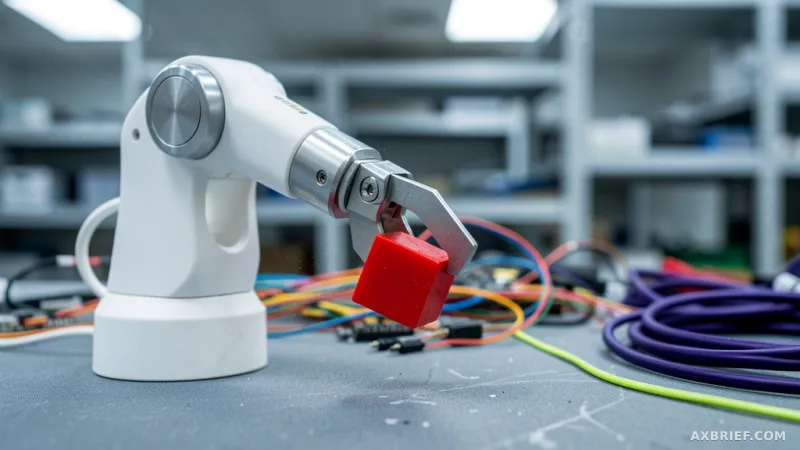
For years, the divide between large language models and physical robotics has been a matter of embodiment. While an AI can describe how to fold a shirt with perfect linguistic precision, translating that knowledge into the precise voltage changes of a robotic joint remains a monumental challenge. Developers have spent countless hours manually syncing vision encoders with action heads, often fighting with fragmented dependencies and incompatible data formats. This week, the release of LeRobot v0.6.0 signals a shift toward a more unified ecosystem where the ability to imagine future states is baked directly into the control policy.
The Unified VLA and Reward Ecosystem
LeRobot v0.6.0 transforms the framework into a comprehensive hub for Vision-Language-Action (VLA) models, integrating six new architectures: GR00T N1.7, MolmoAct2, EO-1, EVO1, and Multitask DiT. These models serve as the bridge between high-level textual instructions and low-level joint angles, allowing users to deploy a variety of model sizes depending on the complexity of the task and the available hardware. By consolidating these models, the framework removes the friction of custom implementation, allowing researchers to swap VLA backbones as easily as they would swap a tokenizer in a text-based LLM.
Beyond action, the update introduces a critical layer of self-evaluation through the `lerobot.rewards` API. In robotics, the hardest part of learning is often defining what success looks like without writing thousands of lines of manual reward functions. LeRobot now provides Robometer and TOPReward to automate this process. Robometer, built on the Qwen3-VL-4B model, has been trained on over 1 million robot trajectories. It can quantify task progress and success rates using only the original video and the language instruction, eliminating the need for task-specific fine-tuning.
Complementing this is TOPReward, which utilizes a zero-shot VLM-based reward function. Instead of training new weights, TOPReward leverages existing Vision-Language Models to analyze trajectory videos and calculate the probability of a success token appearing. This allows developers to turn any high-performing VLM into a reward function instantly, providing an objective metric to optimize data pipelines without the overhead of traditional reinforcement learning reward shaping.
The Architecture of Robotic Imagination
The most significant technical leap in v0.6.0 is the introduction of world model policies: VLA-JEPA, FastWAM, and LingBot-VA. The core tension in robotic AI is the trade-off between predictive accuracy and inference latency. A robot that spends too much time simulating the future will be too slow to react to a slipping object in the real world. LeRobot addresses this by implementing three distinct philosophies of future prediction.
VLA-JEPA, based on Qwen3-VL-2B, operates within a latent space. During training, the JEPA world model learns to predict the next frame of a sequence in a compressed mathematical representation. The twist occurs during the inference phase: the world model is entirely discarded, leaving only the action control component. This means the robot benefits from the sophisticated supervision of a world model during its learning phase but incurs zero additional computational cost when actually moving.
LingBot-VA takes a different approach using an autoregressive video-action model. It predicts future video frames and robot actions in chunks, continuously feeding real-world observations back into the model to close the gap between imagination and reality. For developers wanting to peek into the robot's mind, the framework now supports the `--policy.save_predicted_video=true` option, which saves the internally predicted video for direct comparison with the actual execution. This model is more computationally demanding, requiring a single GPU with 24 to 32GB of memory for inference.
FastWAM balances these two extremes by combining a 5B parameter video generation expert with a small action expert in a single network. While it dreams through continuous rollouts during training, it bypasses the generative process during inference. Instead, it uses a denoising process to output immediate action values. Users can leverage the `lerobot/fastwam_base` checkpoint to fine-tune the model for specific environments, choosing between the zero-cost inference of JEPA or the high-fidelity feedback of LingBot-VA based on their GPU budget.
Hardware Constraints and Data Throughput
For the engineer working with limited VRAM, the diversity of model scales in v0.6.0 is a practical necessity. EVO1, featuring 0.77B parameters and an InternVL3-1B backbone, utilizes flow matching and real-time chunking to enable execution on low-end GPUs. Even smaller is the Multitask DiT at 450M parameters, which uses a CLIP vision and language embedding conditional diffusion transformer. This allows individual users to train a single model capable of multiple natural language tasks on consumer-grade hardware.
Memory efficiency is further highlighted by MolmoAct2. Using bf16 precision, it requires approximately 12GB of GPU memory for inference, while LoRA fine-tuning can be accomplished on a single 24GB GPU. In contrast, high-precision models like EO-1, which uses a Qwen2.5-VL-3B backbone and interleaved data pre-training, demand higher memory bandwidth but offer superior generalization for complex, multi-step instructions.
However, the bottleneck in robotics is rarely just the model size; it is the data pipeline. LeRobot v0.6.0 doubles data loading speeds by implementing parallel decoding of multi-camera frames and using `uint8` frame transfers between dataloader workers, which reduces memory consumption by 4x. The most dramatic improvement is seen in partial loading for large datasets, where the time to access specific episodes has dropped from 275 seconds to 0.06 seconds. This allows for a rapid experimental cycle where developers can verify small slices of data without waiting for massive files to load.
Physical awareness is also enhanced through native depth map support. By connecting Intel RealSense devices and enabling the `use_depth` setting, the system records millimeter-accurate distance information as 12-bit compressed video streams. This is compatible across platforms including SO-100, SO-101, Koch, OpenArm, reBot, and Unitree G1. To further accelerate the pipeline, the framework now supports hardware-accelerated encoding via NVENC or VideoToolbox through the `--dataset.rgb_encoder.*` setting, with `vcodec=auto` automatically selecting the fastest available hardware encoder.
Scaling Annotation and Validation
Data quality in robotics depends on the richness of the annotations. Moving beyond a single text description per episode, v0.6.0 now supports timestamped sub-tasks, plans, memories, and camera-specific VQA pairs. To automate this, the `lerobot-annotate` CLI allows a VLM to watch episode videos and generate these annotations automatically:
lerobot-annotate --dataset_id <dataset_id>These annotations are then converted into chat-style messages via a YAML recipe layer, providing the necessary structure for robots to learn long-horizon tasks or interactive human-robot collaboration. When scaled via HF Jobs, this pipeline can automate the annotation of tens of thousands of episodes, drastically lowering the cost of dataset curation.
Finally, the framework addresses the nightmare of simulator dependencies. The `lerobot-eval` CLI now integrates nine benchmark families, including LIBERO, Meta-World, and NVIDIA IsaacLab-Arena. To avoid the common library conflicts associated with these simulators, LeRobot provides dedicated Docker images for each benchmark. This ensures that the evaluation environment remains isolated and reproducible, allowing developers to cross-validate VLA models without corrupting their local development environment. With the addition of FSDP (Fully Sharded Data Parallel) support, the framework is now ready to scale these workloads across multiple GPUs.
LeRobot v0.6.0 effectively moves the industry closer to a world where robotic intelligence is as modular and accessible as the transformer models that preceded it.



