
The human hand is a masterpiece of biological engineering, operating through a complex coordination of 34 muscles, 27 joints, and over 100 tendons and ligaments. Every time a person scrolls through a smartphone or picks up a needle, they are executing a high-precision sequence of movements that remains incredibly difficult to replicate in digital or mechanical systems. For years, the robotics and virtual reality communities have struggled with a fundamental gap: the inability to capture the full nuance of human dexterity without encumbering the user or relying on restrictive external hardware. This week, the focus has shifted toward Physical AI, where the goal is no longer just to simulate movement, but to translate the internal biological signals of the human body into seamless robotic action.
The Architecture of Ultrasound-Based Motion Tracking
MIT researchers have addressed this dexterity gap by developing a wearable ultrasound system that transforms the wrist into a high-fidelity data hub. The core of the hardware consists of miniaturized ultrasound stickers, scaled down from traditional medical transducers to the size of a smartwatch. These stickers are integrated into a wearable band and utilize a specialized hydrogel material to maintain a secure, moisture-rich contact with the skin. This interface allows the device to continuously capture high-resolution images of the muscles, tendons, and ligaments residing beneath the wrist's surface.
To process this data, the band incorporates an onboard electronic control center roughly the size of a smartphone. This unit handles the raw ultrasound imagery and transmits the processed signals wirelessly to a receiving system. The technical objective is the tracking of 22 degrees of freedom (DoF), which refers to the specific axes of rotation and movement available to the fingers and thumb. By treating the tendons in the wrist like the strings of a marionette, the system captures the physical shifts in tissue patterns whenever a finger moves. These shifts are recorded as grayscale image patterns, creating a direct physical-to-digital interface that monitors the internal state of the hand in real-time.
To bridge the gap between a grayscale image and a robotic command, the team implemented a sophisticated AI labeling pipeline. During the training phase, participants performed various hand gestures while surrounded by a multi-camera array that recorded the exact spatial coordinates of their fingers. Simultaneously, the ultrasound band captured the corresponding internal tissue images. By aligning these two data streams, the researchers could identify exactly which region of the ultrasound image shifted when a specific joint rotated or a finger extended. An image-pattern recognition AI was then trained on this dataset, allowing it to predict the current gesture and joint angles of a new user based solely on the ultrasound feed. This pipeline converts raw physical deformation into precise digital coordinates without perceptible latency.
Overcoming the Occlusion and Bulk of Traditional Tracking
When analyzing why this approach is a breakthrough, it becomes clear that it solves the three primary failures of existing tracking modalities: occlusion, bulk, and signal noise. Most current high-end tracking relies on computer vision. However, camera-based systems suffer from the occlusion problem, where one finger hides another from the lens, or an object in the environment blocks the line of sight, causing the data stream to snap or drift. Because the MIT system looks inside the wrist, it is entirely indifferent to the external environment. The tracking remains constant whether the hand is under a table, inside a pocket, or gripping a solid object.
Sensor gloves offer another alternative, but they introduce a physical trade-off. The weight and thickness of sensors attached to every knuckle restrict natural movement and, more importantly, dampen the user's sense of touch. By moving the entire sensing apparatus to the wrist, the MIT band leaves the palm and fingers completely exposed, preserving the tactile feedback essential for complex tasks. This shift in form factor transforms the device from a restrictive garment into a transparent interface.
Finally, the system outperforms electromyography (EMG), which measures the electrical activity of muscles. EMG is notoriously susceptible to electrical noise from the environment and often struggles with precision, frequently providing binary data—such as whether a finger is open or closed—rather than the continuous, fluid trajectory of a movement. Ultrasound, by contrast, provides a visual map of physical displacement. It does not guess based on electrical spikes; it sees the actual movement of the tendon. This allows for a level of granularity in the 22 degrees of freedom that electrical sensors simply cannot match.
Validating Physical AI Through Real-World Dexterity
To test the versatility of the system, the research team conducted trials with eight participants of varying wrist and hand sizes. The primary benchmark was the implementation of the American Sign Language (ASL) alphabet. The system successfully recognized all 26 letters, proving that the AI could distinguish between highly similar hand shapes across different biological structures. The team further validated the system by tracking the grasping of diverse objects, including tennis balls, plastic bottles, scissors, and pencils, demonstrating that the internal tissue patterns remain legible regardless of the object being held.
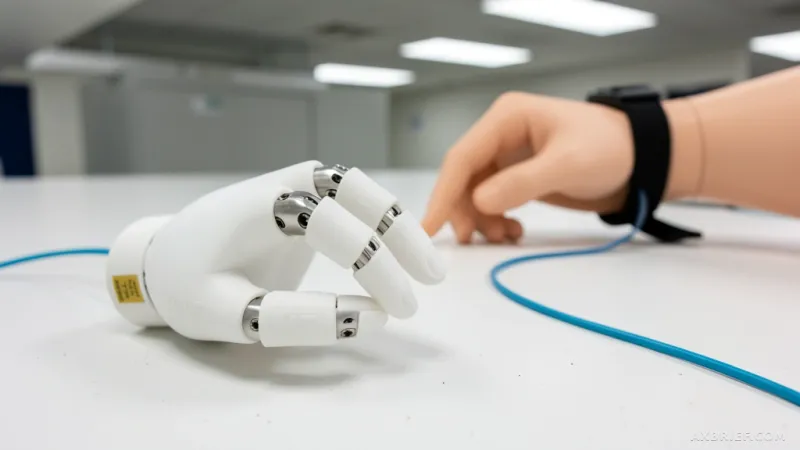
In practical demonstrations, the system drove a wirelessly connected robotic hand to mimic the user's movements with startling accuracy. The robot was able to play a simple melody on a piano and successfully shoot a small basketball into a desktop hoop. In virtual environments, the system enabled precision interactions, such as using a pinch gesture to zoom in on digital objects. These results suggest that the system is not merely a novelty for VR, but a viable pathway for training humanoid robots in high-stakes environments. By building a comprehensive dataset of human hand movements, the researchers are creating a learning pipeline for robotic dexterity that could eventually be applied to millimeter-precise tasks, such as remote robotic surgery, where the cost of a tracking error is absolute.



