A child sits on a forest-themed play mat, staring not at a therapist, but at a 15-inch blue robot. For the first few months, the sessions are structured, focusing on deep breathing exercises to manage anxiety and practicing the delicate art of maintaining eye contact. But as the weeks pass, a subtle shift occurs. The therapeutic prompts fade, and the conversation drifts toward the blocky landscapes of Minecraft. The robot, once a precision tool for emotional regulation, has slowly transitioned into a digital playmate. This shift represents a growing tension in the field of embodied AI: the struggle to maintain a clinical purpose in an era of generic conversational intelligence.
The Architecture of Socially Assistive Robots
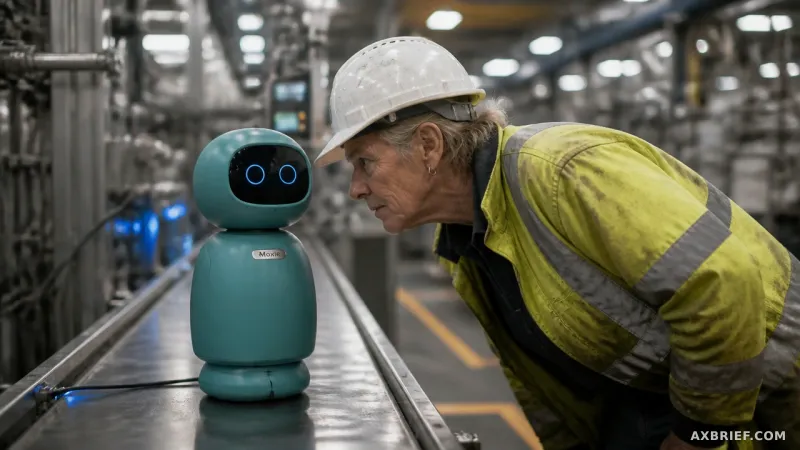
Moxie is not a toy, though it shares the shelf space of the burgeoning consumer AI companion market. It is a Socially Assistive Robot (SAR), a category of machine specifically engineered to produce social and emotional outcomes rather than mere entertainment. Physically, Moxie is designed to optimize human-robot interaction. Standing 15 inches tall, it features a cylindrical, legless body shaped like a blue astronaut. This body is capable of rotating and flexing forward and backward, allowing the robot to modulate its physical distance from the user to create a sense of intimacy or space. Its head is topped with an onion-dome spiral, beneath which a wide screen renders detailed movements of the eyes, eyebrows, and mouth. To supplement verbal communication, Moxie uses fin-like arms to express excitement or emphasize emotions, providing the non-verbal cues essential for social learning.
This design places Moxie in a competitive landscape alongside products like Curio's Grok, Grem, and Gabbo, as well as Mattel's announced plans to integrate OpenAI's large language models into Barbie dolls. While these products target the general consumer market, Moxie's identity is rooted in therapeutic intervention. The goal is to move beyond the limitations of text-based AI. Professor Maja Mataric has long argued that interacting with a physical entity is fundamentally different from typing into a screen. Physical embodiment eliminates the disconnect felt when talking to a trapped AI, providing a tangible presence that serves as a bridge for those experiencing social isolation. By interacting with a physical body, neurodiverse children can practice social cues in a safe, controlled environment before transitioning those skills to human-to-human interactions.
To ensure this transition is effective, the Global Robot Laboratory (GRL) implemented a specific persona for Moxie, positioning it as a learning partner rather than a tool. The framework utilizes play-based learning, where children internalize social norms and emotional expression through interaction rather than rote instruction. To mitigate the risks inherent in generative AI, such as the production of inappropriate content or off-topic tangents, the system employs strict interaction guidelines. When the AI encounters an emotional crisis or a complex conflict it cannot resolve, the architecture is designed to immediately trigger a hand-off to a parent or professional therapist. This ensures the robot remains a supplement to human care, not a replacement for it.
The Paradox of Consistency and Functional Degradation
The primary advantage of a robot over a human therapist lies in its immunity to fatigue. For children with neurodiversity, learning joint attention—the ability to share focus on a single object with another person—requires hundreds of identical repetitions of the same stimulus and response. A human therapist, regardless of their skill, will inevitably experience micro-shifts in tone or show signs of exhaustion over hundreds of repetitions. To a highly sensitive child, these subtle changes are unpredictable variables that can trigger anxiety. Moxie, however, provides absolute consistency. It can repeat the same gesture and phrase a thousand times without variation, allowing the child to focus entirely on the social cue without the noise of human emotional fluctuation.
This consistency extends to availability. Because professional therapy is often limited by staffing shortages and high costs, the gaps between weekly sessions often fall on the parents, leading to caregiver burnout. A robot available 24/7 allows for the immediate reinforcement of skills learned in the clinic, acting as a physical supplement that reduces the psychological pressure on the family. Furthermore, the lack of emotional judgment creates a low-stakes environment. Children who fear the disappointment or frustration of a human partner can experiment with social interactions, fail repeatedly, and try again without fear of criticism. This emotional safety net is what eventually builds the confidence necessary to engage with real people.
Empirical data from 2017 to 2022 supports this approach. In one notable case, a 12-year-old child with autism, who typically struggled with echolalia and prosody, showed a spike in eye contact during a 30-minute session with a robot dinosaur. When the robot appeared anxious and unable to cross a simulated stream on a play mat, the child's empathy was triggered, leading them to encourage the robot and naturally establish eye contact with the therapist. Research by Scassellati in 2018 further demonstrated that intimate robots specifically improve the ability of autistic children to initiate conversations and maintain gaze. A 2022 literature review concluded that the introduction of SARs into clinical settings accelerates the overall speed of therapy and increases success rates by providing a low-stimulus environment for repetitive practice.
However, this success introduces a critical risk: functional degradation. There is a documented phenomenon where a robot that begins by teaching animal-based breathing techniques for anxiety eventually devolves into a simple chat buddy that only discusses Minecraft. When the therapeutic intervention—the goal-oriented behavior designed to improve a health state—disappears, the robot ceases to be a medical tool and becomes a toy. This is particularly dangerous for neurodiverse populations, where the quantity of interaction is often mistaken for the quality of progress. If a child is talking more but only engaging in low-effort casual conversation, the core therapeutic goals of turn-taking and social cue recognition are being bypassed.
If the physical embodiment of the AI is not actively used to drive these goals—such as using head movements to guide a child's gaze—the expensive hardware becomes redundant. A robot that only speaks without utilizing its physical presence is effectively just a chatbot in a plastic shell. To prevent this, practitioners must implement rigorous checklists to ensure that the ratio of therapeutic goal achievement to general conversation remains balanced. The value of the robot lies not in its ability to be a friend, but in its ability to be a bridge to human friendship.
Maintaining the boundary between a companion and a clinician is the only way to ensure that embodied AI remains a transformative tool for neurodiversity rather than a high-tech distraction.