
For years, the global AI landscape has been defined by a stark divide between the architects of intelligence and the consumers of it. Most nations have found themselves in a position of digital tenancy, renting compute power and API access from a handful of Silicon Valley giants. This dependency creates a precarious vulnerability where a country's intellectual growth is tethered to foreign pricing models and external corporate roadmaps. This week, Indonesia is attempting to break that cycle by shifting from a consumer mindset to a creator mindset, treating AI not as a service to be imported, but as a national utility to be owned.
The Architecture of National Intelligence
At the heart of this shift is the establishment of the UGM Indosat NVIDIA AI Technology Center, known as NVAITC. Located in Yogyakarta, this center represents the first university-based AI technology hub in Indonesia. The initiative is a strategic convergence of four distinct powers: the Indonesian Ministry of Communication and Digital (Komdigi), the telecommunications giant Indosat Ooredoo Hutchison, NVIDIA, and Gadjah Mada University (UGM). Together, they are building a framework where researchers and students can develop models using national computing resources rather than relying on overseas infrastructure.
This center is the flagship of the Indonesia AI Center of Excellence initiative. The primary objective is the realization of AI Sovereignty, a strategy designed to ensure that Indonesia can solve its own urgent national priorities without technological dependency. By combining government policy, corporate infrastructure, and academic research, the NVAITC aims to move beyond the mere adoption of global AI tools. Instead, it seeks to build a self-sustaining ecosystem where Indonesian innovators contribute original breakthroughs to the global community.
Minister Meutya Hafid of the Ministry of Communication and Digital has positioned this initiative as a primary engine for economic growth and national competitiveness. To support this, NVIDIA is providing more than just hardware; Marc Hamilton, Vice President at NVIDIA, has emphasized the role of technical expertise in transforming raw compute into actual solutions for healthcare, agriculture, and disaster preparedness. This ensures that the gap between academic theory and real-world deployment is bridged by a structured pipeline of technical mentorship.
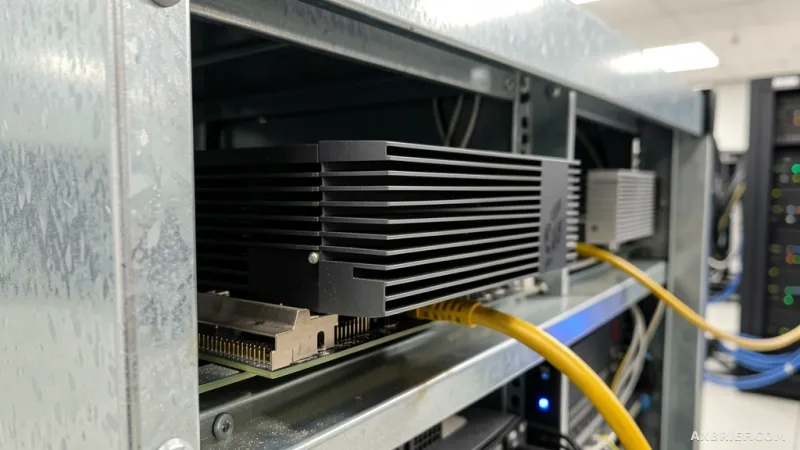
Technically, the environment is powered by the integration of NVIDIA's full-stack AI platform and Indosat's sovereign GPU-as-a-service (GPUaaS) platform, branded as GPU Merdeka. This GPUaaS model allows researchers to access enterprise-grade accelerated computing on demand, removing the prohibitive cost of purchasing and maintaining high-end hardware. By providing a full-stack environment that includes software, open-source frameworks, and development tools, the NVAITC minimizes the time spent on infrastructure configuration and maximizes the time spent on model architecture.
Crucially, the center provides access to pretrained models and open-source resources, specifically the NVIDIA Nemotron open models. By utilizing Nemotron, researchers can peer into the internal structures of the models and optimize them for specific local contexts. This access to accelerated computing frameworks allows for faster processing of massive datasets and shorter training cycles, enabling a higher frequency of experimentation and iteration.
This infrastructure is paired with a global expert network. By connecting local researchers with international AI specialists, the NVAITC solves the historical problem of isolation that many Indonesian developers faced. This network optimizes the entire workflow from model design to deployment, ensuring that theoretical research is rapidly converted into functional services.
The Pivot from General AI to Domain Sovereignty
While the world is currently obsessed with general-purpose LLMs that can write poetry or code, Indonesia is taking a different path by focusing on high-impact, domain-specific applications. The NVAITC is prioritizing three critical projects that demonstrate the practical utility of sovereign AI. The first is eNose-TB, an AI-driven electronic screening technology designed to combat tuberculosis. With over one million new TB cases annually, Indonesia faces a crisis where rural areas lack the specialized equipment and personnel for early diagnosis. eNose-TB analyzes breath samples using AI to identify patients quickly and cheaply, providing a lifeline to remote clinics where traditional laboratory infrastructure is non-existent.
In the agricultural sector, the SmartAgri project is implementing precision farming through multimodal AI. By fusing satellite imagery, sensor data, and local agricultural knowledge, the system can analyze crop conditions in real-time. The use of edge computing is critical here, as it allows data to be processed locally on the farm even when network connectivity is unstable. This creates a precision control loop where farmers receive immediate, data-driven recommendations on irrigation and cultivation, directly increasing yields through a workflow optimized for the field rather than the lab.
For disaster management, the Tech4Disaster project leverages NVIDIA's accelerated computing to power a geospatial AI platform. This system processes massive streams of data from satellites and sensors to detect early signs of natural disasters. In a country as geographically volatile as Indonesia, the ability to eliminate data bottlenecks and reduce processing time is not just a technical achievement; it is a means of securing the golden hour for life-saving rescue operations.
This strategy reveals a deeper insight into how emerging economies can compete in the AI era. Indonesia is leveraging its position as the world's fourth most populous nation, treating its massive volume of local data as a strategic asset. By recognizing that model performance scales with data volume, the government is vertically integrating the entire pipeline: from the collection of indigenous data to the operation of sovereign compute and the training of local talent. This prevents the leakage of national data to foreign entities and ensures that the resulting models are optimized for the specific linguistic, cultural, and environmental nuances of the region.
Furthermore, the NVAITC model solves the traditional bottleneck between the university and the market. When a researcher at Gadjah Mada University defines a problem, the GPU Merdeka infrastructure provides the immediate compute to test it, and the government provides the regulatory framework to deploy it. By focusing GPU resources on sectors where a large portion of the population is employed—such as agriculture—Indonesia is proving that AI's greatest value lies not in general intelligence, but in domain-specific utility.
This blueprint suggests that the most efficient path to AI sovereignty is not to build a general-purpose competitor to GPT-4, but to build a specialized, vertically integrated stack that solves national survival problems. By combining GPU-as-a-Service with university research and domain-specific data, Indonesia is creating a scalable benchmark for how nations can secure their digital future.
The transition from renting intelligence to owning the means of production marks the beginning of a new era of national digital autonomy.



