For the modern AI engineer, the most daunting constraint is no longer just the availability of H100s or the quality of the training set. It is the power wall. In the current era of AI factories, electricity is not merely an operational expense; it is the absolute ceiling of scalability. Every watt consumed that does not contribute to a generated token is a direct hit to the profitability of the service. The industry has reached a point where the ability to scale is determined not by how many GPUs a company can buy, but by how many tokens they can squeeze out of a fixed power budget. This is the specific tension NVIDIA addresses with the GB300 NVL72, which claims a massive 25x increase in performance per watt compared to the previous Hopper architecture.
The Architecture of Rack-Scale Efficiency
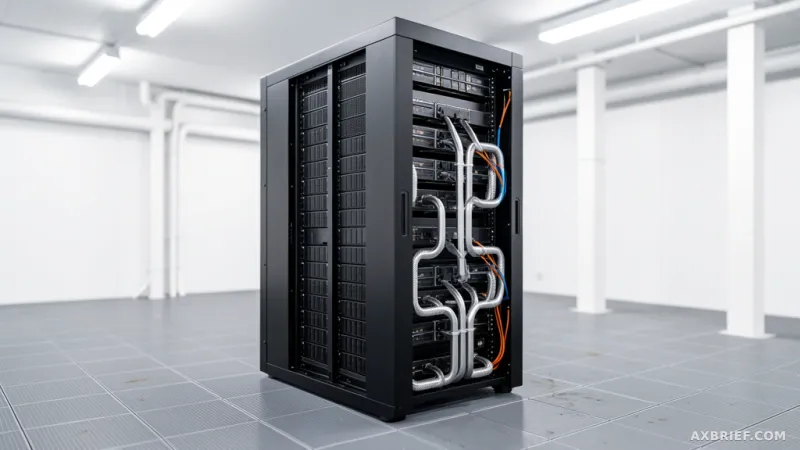
NVIDIA has shifted its focus from the individual GPU to the rack-scale platform. The Blackwell NVL72 is not simply a collection of chips in a box; it is a unified system designed through a process called codesign, where silicon, networking, and software are developed in tandem to maximize inference throughput. This approach allows the system to treat an entire rack of GPUs as a single, massive logical GPU, drastically reducing the overhead typically associated with node-to-node communication. Major AI labs, including OpenAI and Anthropic, have already begun deploying Blackwell NVL72 systems to handle their most demanding inference workloads.
The core of this efficiency gain lies in the integration of the 6th generation NVLink Switch. Unlike general-purpose networking gear, this switch is purpose-built for GPU domain expansion. It utilizes SHARP, or Scalable Hierarchical Aggregation and Reduction Protocol, which enables in-network computing. By performing aggregation operations directly within the switch rather than forcing the GPUs to handle the communication overhead, the system ensures that the compute units spend more time calculating and less time waiting for data. This structural shift is what allows the GB300 NVL72 to hit that 25x performance-per-watt milestone, turning the rack into a streamlined engine for token generation.
The Software Ceiling and the Pareto Frontier
Hardware provides the theoretical floor for performance, but the actual realized efficiency is determined by the software stack. The synergy between NVIDIA Dynamo, TensorRT LLM, and inference frameworks like SGLang and vLLM creates a layer of optimization that maps the logical model to the physical hardware. This stack employs NVFP4 quantization, which reduces data precision to accelerate computation and lower memory footprints, allowing more operations to occur within the same power envelope. To further push the limits, the system implements separated serving for computation and memory management, large-scale expert parallelism for MoE models, KV-aware routing, and KV cache offloading. These techniques ensure that the path from memory to compute is as short and energy-efficient as possible.
However, the real insight for infrastructure operators is that there is no single performance number. Instead, there is a Pareto curve—a trade-off between latency, throughput, and cost. Depending on the use case, an operator might prioritize the lowest possible latency for a real-time chat experience or the highest possible throughput for batch processing. To navigate this without wasting expensive GPU-hours on trial and error, NVIDIA provides DynoSim. This simulation tool allows teams to calculate the Pareto frontier and identify the optimal operating point before a single chip is powered on. The impact of this software-centric optimization is staggering; in the case of the DeepSeek V4 model, software optimizations alone improved performance per watt by up to 5x within a single month, proving that the hardware's potential can be unlocked iteratively through the software layer.
Eliminating Power Leakage with DSX MaxLPS
Even with efficient chips, the physics of the data center introduce significant waste. In a typical AI factory, only about 60% of the electricity drawn from the grid actually reaches the AI computation. The remaining 40% is lost to cooling systems and power delivery inefficiencies. NVIDIA addresses this leakage through DSX MaxLPS, a power-efficiency software suite that manages energy distribution at the rack level. By utilizing power steering, the system can dynamically shift power to GPUs under heavy load while cutting losses from idle components. When paired with warm water liquid cooling—which reduces the energy required to maintain operating temperatures compared to traditional chilled water or air cooling—the results are tangible.
By eliminating these inefficiencies, DSX MaxLPS allows operators to increase their GPU deployment density by up to 40% within the same power budget. This is a critical advantage in regions where power grid upgrades are slow or impossible. This infrastructure efficiency is already being leveraged by industry leaders. CoreWeave has deployed the Kimi K2.6 model on GB300 NVL72 systems, combining NVFP4 quantization with EAGLE3 speculative decoding to accelerate generation. Perplexity is running Qwen3 235B and Qwen3.5-397B-A17B on GB200 NVL72 to power its agentic AI platform, while Fireworks AI uses the Blackwell platform to serve GLM 5.2 to enterprise clients like Cursor and Factory AI. These companies are not just buying faster chips; they are optimizing the cost per token.
The Economics of MoE and the Power Constraint
As the industry moves toward Mixture-of-Experts (MoE) architectures, the relationship between power and performance becomes even more complex. MoE models improve efficiency by activating only a fraction of their total parameters for any given input, but this creates a massive data routing challenge. If the hardware's data paths are not perfectly aligned with the model's expert parallelism, the theoretical efficiency of MoE is wiped out by network bottlenecks. This is why the codesign philosophy of the Blackwell platform is essential; it ensures that the physical interconnects match the logical flow of the MoE routing, minimizing the distance data must travel and the energy required to move it.
For AI practitioners, especially those operating in power-constrained environments, the metric of success has shifted from TFLOPS to tokens per watt. In a landscape where electricity costs are rising and power density is capped, the ability to deploy 40% more GPUs without increasing the power draw is the difference between a scalable product and a financial liability. The infrastructure economics of the Blackwell era dictate that the winner will not be the one with the most GPUs, but the one who can generate the most intelligence per watt of electricity consumed.