
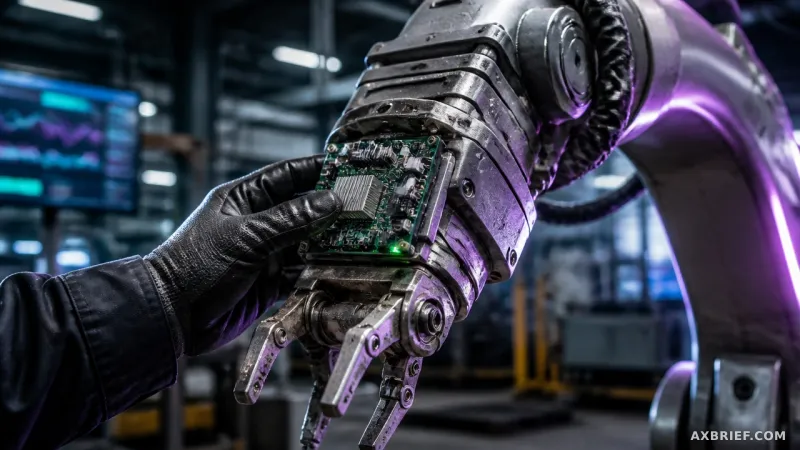
The transition of agentic AI from high-powered data centers to the physical constraints of the factory floor has long been stalled by a persistent bottleneck: the trade-off between memory availability and inference performance. Developers building industrial robots or autonomous systems have historically struggled to port server-grade AI models to edge hardware without facing significant latency or system instability. NVIDIA’s latest release, JetPack 7.2, alongside support for its NemoClaw agentic AI framework, aims to bridge this gap by shifting the optimization burden from hardware upgrades to the software stack.
Hardware Efficiency and Computational Scaling
The most immediate impact of the JetPack 7.2 update is the optimization of existing hardware resources. The Jetson AGX Orin 32GB module sees a 20% performance increase, reaching 241 TOPS (trillion operations per second) for AI workloads. This allows developers to run more complex inference models on the same hardware footprint. Furthermore, the integration of NVIDIA CUDA 13 ensures that the latest parallel computing libraries are fully accessible on edge devices, minimizing the friction between development and deployment environments.
Flexibility at the operating system level is a core component of this release. By introducing support for the Yocto Project, NVIDIA enables developers to build lightweight, customized Linux environments. This allows for the removal of unnecessary libraries, which is critical for maintaining system stability in memory-constrained edge environments. For next-generation platforms like Jetson Thor, the update introduces support for Multi-Instance GPU (MIG) technology. This allows for the physical partitioning of GPU resources, ensuring that deterministic workloads—such as real-time robot perception systems—are isolated from general AI inference tasks, preventing resource contention.
Three-Tiered Software Architecture
To address the complexity of edge development, NVIDIA has introduced a three-tiered software architecture designed to streamline the path from prototype to production. The base layer, JetPack 7.2, provides the foundation for deterministic performance and OS-level control. By leveraging the Yocto Project, industrial users can strip away bloat, while CUDA 13 provides the necessary compute stack. On Jetson Thor, the MIG implementation ensures that critical tasks receive dedicated GPU instances, guaranteeing predictable response times even under heavy load.
The middle layer focuses on Agent Skills, which automate repetitive development tasks. Processes that previously required weeks of manual labor—such as Linux kernel customization, memory optimization, and model benchmarking—are now handled by agentic units. By utilizing NVIDIA’s design guides, development teams can automate these optimization steps, effectively reducing development cycles from weeks to days.
At the top of the stack sits NemoClaw, the agentic AI framework. This layer allows for the deployment of agentic AI to edge devices via a single command. By porting server-grade agentic technology directly to the production-ready Jetson stack, developers can enable real-time situational analysis and decision-making on the device itself. This hierarchical structure reduces the Total Cost of Ownership (TCO) by enabling high-performance AI on lower-cost hardware.
Real-World Performance and TCO Reduction
Moving agentic AI to the edge is not merely a technical challenge; it is a financial one. Companies like SandStar have demonstrated the efficiency of this new stack by migrating from 16GB to 8GB memory devices while maintaining performance. By utilizing NemoClaw, they achieved a 40% reduction in memory usage, proving that software-level optimization can negate the need for more expensive hardware. Similarly, NoTraffic optimized its intelligent traffic management systems by using static compilation and target kernel pruning within the CUDA library, resulting in a 29% reduction in memory footprint.
These gains are made possible by the ability to isolate deterministic workloads. In industrial automation, where a millisecond of latency can lead to system failure, the ability to partition GPU resources via MIG is a game-changer. This ensures that the robot’s perception system remains responsive regardless of other background AI tasks. As these capabilities mature, edge devices are evolving from simple data processors into independent compute nodes capable of executing complex agentic workflows.
Industry Adoption and Future Deployment
Leading industrial players are already integrating these tools into their workflows. Solomon has unified robot perception, reasoning, and manipulation into a single workflow using NemoClaw, enabling robots to autonomously calculate optimal grasping positions in dynamic environments. Advantech has implemented an agentic AI factory operating system using Nemotron 3 and Jetson Thor to automate robot orchestration and defect detection. Meanwhile, Zipline utilizes Jetson Orin NX for real-time sensor fusion and safety navigation in its autonomous delivery drones, relying on Yocto-based OS optimizations to maintain high-performance AI within strict power and memory envelopes. Developers looking to implement these solutions can find detailed documentation and tools at the NVIDIA Jetson software portal.
The success of edge AI now depends less on raw hardware power and more on the ability to optimize agentic inference skills within constrained environments to drive down TCO.



