The image of a high-performance AI stack usually involves rows of humming server racks in a climate-controlled data center or a bulky workstation tethered to a high-speed fiber connection. However, the boundary between massive compute and portable hardware just shifted. Sarah Guo, founder of Conviction, recently demonstrated this shift by slipping an NVIDIA Jetson Orin Nano Super into a Jacquemus Mini handbag. It was a calculated piece of theater that signaled a broader technical reality: the ability to run desktop-class generative AI is no longer anchored to a desk. We are entering an era where the intelligence required to navigate the physical world can fit inside a small accessory, moving the brain of the AI from the cloud directly into the chassis of the machine.
The Hardware Blueprint for Physical AI
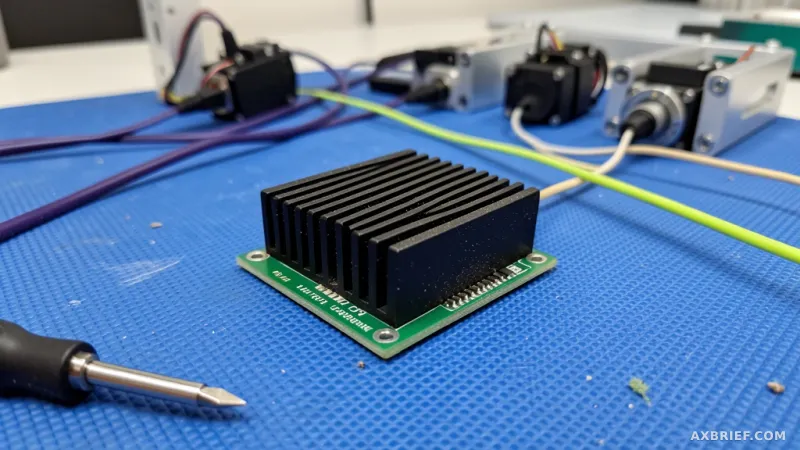
At the center of this transition is the NVIDIA Jetson Orin Nano Super, a compact module designed to deliver 67 TOPS (Trillion Operations Per Second) of AI performance. This specific compute ceiling is not an arbitrary number; it represents the threshold required to move beyond simple pattern recognition and into the realm of autonomous agency. The Orin Nano Super sits as the entry point in a tiered ecosystem that scales upward to the Jetson AGX Orin and the powerhouse Jetson AGX Thor. This hierarchy allows developers to match their computational budget to the complexity of their task, whether they are building a simple classroom project or a complex industrial autonomous vehicle.
These modules are designed for deployment in makerspaces, research laboratories, and active field environments. By providing a developer kit that fits into the palm of a hand, NVIDIA is encouraging a move away from the fixed workstation. The goal is to allow engineers to prototype in the actual environment where the AI will operate, rather than simulating a physical space in a digital twin and hoping the model translates to the real world. This hardware provides a practical pathway for developers to learn computer vision and prototype edge AI agents while maintaining rigorous security and safety standards. By embedding frontier open models directly onto the device, the system eliminates the need for constant external communication, which inherently reduces the risk of data leakage and removes the fragility associated with network connectivity.
Breaking the Dependency on the Cloud
For years, the primary bottleneck for edge AI has been the cloud umbilical cord. Most AI agents rely on API keys and constant internet access to send data to a remote server, wait for a response, and then execute an action. This architecture introduces latency that is unacceptable for real-time physical interactions. The Jetson Orin Nano Super solves this by providing a fully local GPU acceleration environment. When the inference happens on the local silicon, the network packet travel time drops to zero, enabling the kind of instantaneous reaction speeds required for robotics.
This shift is made possible by the rise of open-weight models. For example, the developer known as Coding with Lewis utilized the Mistral model on the Jetson Orin Nano Super to build a robot from the ground up. Because open-weight models allow developers to download the trained parameters directly to the hardware, the robot does not need to call a proprietary API to think. This removes the recurring cost of API tokens and ensures that the robot remains intelligent even in a dead zone with no internet access. To streamline this process, NVIDIA provides Jetson Device Skills and Jetson BSP (Board Support Package) Skills. These tools allow developers to use coding AI agents to handle the tedious low-level hardware configurations, freeing the human engineer to focus on optimizing inference efficiency and model behavior.
The true breakthrough, however, lies in the implementation of Vision Language Models (VLM) and Vision-Language-Action (VLA) models. A VLM allows a device to see a camera feed and understand it in linguistic terms, such as recognizing that a red object is a stop sign. A VLA model takes this a step further by translating that linguistic understanding into a physical command, such as adjusting a servo motor to turn a wheel. Processing both of these high-load operations locally is what transforms a machine from a passive observer into an active agent.
Practical applications are already emerging. The SidewalkPilot AI model, powered by the Jetson Orin Nano Super, successfully navigated a toy electric car, executing real-time left and right turns based on visual input. Similarly, the Reachy Mini Lite uses the module to power an on-device voice and vision assistant. By processing multimodal inputs locally, the robot can interact with humans at a natural pace, avoiding the awkward pauses typical of cloud-based voice assistants. This proves that the 67 TOPS threshold is sufficient to bridge the gap between perception and action in real-time.
NVIDIA is supporting this transition through a structured learning path delivered via live stream series. The curriculum guides developers from the basics of running generative AI to building Claw agents, and finally to deploying VLM and VLA models in physical applications. This approach moves the development cycle out of the simulation and into the field, drastically shortening the time between a conceptual model and a working physical prototype.
In the previous generation of edge computing, running a VLA model required a massive GPU server and a flawless network connection. Now, the ability to control physical motion in real-time is a local capability. For any developer aiming to build an AI agent that operates without the latency of the cloud or the cost of an API, 67 TOPS of local performance has become the new baseline for hardware selection.