
The modern AI developer is no longer just building chatbots that return text; they are building agents that act. These autonomous systems write their own code, execute it in sandboxed environments, query databases, and iterate on their own errors until a goal is met. However, a frustrating paradox has emerged in the data center. While H100s and B200s can process tokens at blistering speeds, the entire pipeline often grinds to a halt because the CPU responsible for executing the agent's tools is too slow. The most expensive silicon in the world sits idle, waiting for a legacy CPU to finish a simple Python script or a SQL query. This is the bottleneck that NVIDIA is now attacking head-on.
The Architecture of the Agent-First Processor
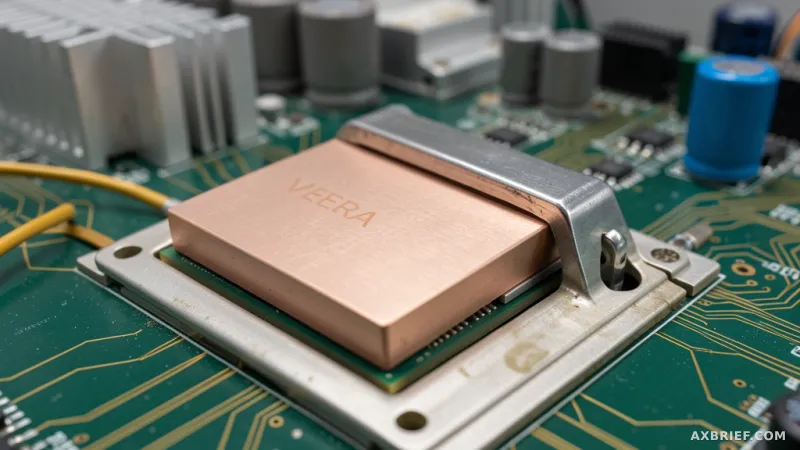
NVIDIA has introduced the Vera CPU, a processor specifically engineered for the Max single-threaded CPU at scale category. Unlike general-purpose server chips designed for massive multi-tenancy, Vera is optimized for the sequential nature of AI agent workloads. In real-world agent execution, Vera provides 1.8x higher sustained single-core performance compared to traditional x86 server CPUs. This performance jump is not a marginal gain but a strategic move to ensure that the GPU remains the primary engine of the AI factory, rather than a passenger waiting on the CPU.
The hardware is built around 88 cores designed to handle the heavy lifting of tool calls, code execution, and data analysis. Beyond simple execution, Vera is integrated into the critical path of LLM inference by managing the Key-Value (KV) cache, which stores previous computation values to accelerate subsequent token generation. The fundamental logic behind Vera is the agent loop: the model reasons, the CPU executes a tool, the result is fed back to the model, and the model decides the next step. Because this process is inherently sequential, the total time to completion is dictated by the speed of a single core rather than the total number of cores available.
To achieve this, NVIDIA developed the Olympus core. This custom CPU core delivers a 50% increase in Instructions Per Cycle (IPC) over the previous NVIDIA Grace architecture. By increasing the amount of work a core can do in a single clock cycle, NVIDIA physically reduces the latency of each turn in the agent loop. Supporting this compute power is a memory system utilizing LPDDR5X, providing a massive bandwidth of up to 1.2TB/s while keeping power consumption under 40W. This ensures that the high-performance cores are never starved for data, eliminating the memory-wall bottlenecks that often plague high-core-count processors.
Perhaps the most significant physical departure from industry norms is the use of a Monolithic Compute Die. While most modern data center CPUs have moved toward chiplet-based designs to save costs, NVIDIA has implemented all circuits on a single piece of silicon. This architectural choice allows Vera to achieve an inter-core bandwidth of 3.4TB/s, which is three times higher than that of typical data center CPUs. By removing the interconnect delays inherent in chiplet designs, all 88 cores can operate at peak performance without interference, slashing the time it takes for an agent to transition from one step of a task to the next.
Breaking the Chiplet Tax and the Core Count Myth
For the last decade, the data center CPU market has been driven by a specific economic incentive: maximizing the number of rentable cores. Cloud providers prioritize total core counts to increase the number of virtual machines they can sell per rack. This led manufacturers to shrink the area dedicated to instruction processing and memory fabrics for each individual core, effectively sacrificing the peak speed of a single thread to fit more threads on the die. This trend culminated in the widespread adoption of chiplet architectures, which introduced what is known as the chiplet tax—a performance penalty caused by the latency of moving data between separate silicon dies.
In a traditional cloud environment, this trade-off is acceptable because workloads are often embarrassingly parallel. However, AI agents operate differently. An agent might be running a complex chain of thought where step B cannot begin until step A is fully completed. Adding more cores to this process does not make step A finish faster; it only allows you to run more agents simultaneously. If the individual core is slow, the agent is slow, and the GPU remains underutilized.
NVIDIA Vera represents a fundamental pivot in design philosophy. Instead of chasing throughput via core density, Vera prioritizes the completion speed of individual tasks. By eliminating the chiplet tax and focusing on single-core IPC, Vera ensures that each agent can sprint through its sequential chain of logic. This removes the resource competition that occurs when too many cores fight for limited memory bandwidth, allowing each core to utilize the full power of the memory system independently. The result is a drastic reduction in GPU idle time, which directly translates to higher profitability and efficiency for the AI factory.
Real-World Gains in Coding and Data Analysis
The theoretical advantages of the Vera architecture have been validated through rigorous testing with industry leaders. Perplexity tested Vera using actual agentic coding workflows, which involve cloning repositories and running test suites within sandboxed environments. The results showed that Vera reduced the total time to complete these tasks by approximately 1.5x compared to x86 server CPUs. When scaling to multiple simultaneous sandboxes, the startup speed improved by up to 1.9x, proving that the monolithic design handles bursty, agent-heavy workloads far more efficiently than traditional architectures.
Data processing, another critical component of the agent loop, saw even more dramatic improvements. Agents frequently perform CPU-bound tasks such as querying, extracting, and filtering data before passing it back to the LLM. In tests conducted by Starburst, large-scale SQL analysis speeds increased by 3x over x86 benchmarks. Furthermore, in Redpanda environments, data transmission latency was reduced by up to 6x. These numbers indicate that the bottleneck in AI agent response times is often not the model's reasoning speed, but the time it takes to fetch and process the data the model asks for.
From an operational standpoint, Vera simplifies the AI factory. Previously, engineers had to maintain different CPU configurations for different tasks—one for tool calling, one for sandbox execution, and another for data processing. Vera provides a single, unified architecture capable of handling all these workloads at peak efficiency. By accelerating the rotation of the agent loop, Vera ensures that the massive compute power of the GPU is never wasted, maximizing the return on investment for the entire hardware stack.
The Unified Roadmap: From Vera Rubin to Rosa
NVIDIA is not treating Vera as a standalone product but as a foundational building block for a unified infrastructure. The company has integrated the same CPU design into the NVIDIA Vera Rubin GPU host CPU and the NVIDIA BlueField-4 STX storage processor. This convergence eliminates heterogeneity across the AI factory. When the GPU host and the storage processor share the same CPU architecture, they share the same instruction set and optimization paths.
This unification provides a massive advantage for infrastructure engineers. Instead of writing and maintaining separate optimization code for different CPU models across the pipeline, teams can use a single toolchain. This standardization reduces operational overhead and ensures that data moves from storage to the GPU with minimal friction, as every step of the journey is optimized for the same architectural logic.
Looking ahead, NVIDIA has already mapped out the next evolution with the Rosa CPU. The upcoming Rosa line will feature the Rigel core, based on the Arm v9.2 architecture. The Rigel core is designed to fit within the same silicon footprint as the Olympus core while further increasing per-core processing power. By optimizing instruction delivery, expanding L2 cache capacity, and improving memory handling, the Rigel core aims to further erode the latency of the agent loop.
This roadmap confirms NVIDIA's conviction that the future of AI is agentic. As AI evolves from a system that provides answers to a system that executes workflows, the metric for success shifts from total throughput to single-thread latency. The transition from Olympus to Rigel suggests a long-term commitment to solving the sequential bottleneck, ensuring that as models become more capable of taking action, the hardware beneath them is fast enough to keep up.
As AI agents move from experimental prototypes to production-grade tools, the industry must stop measuring CPU value by core count and start measuring it by the speed of the loop. With 1.8x the performance of x86 and a staggering 3.4TB/s of bandwidth, NVIDIA Vera is the first processor designed to ensure the CPU is no longer the weakest link in the AI chain.



