
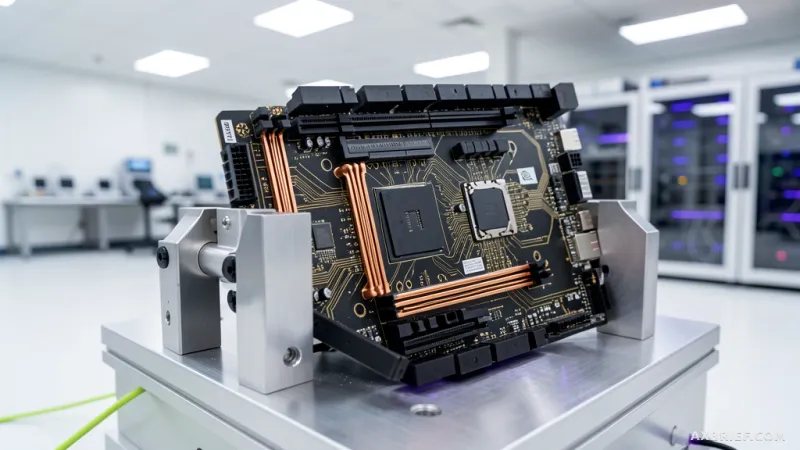
Modern AI infrastructure is currently facing a silent crisis of idling. As the industry shifts toward autonomous AI agents capable of generating thousands of concurrent tasks, the bottleneck has migrated from the compute core to the data path. Developers are finding that while their H100s or B200s can process tokens at blistering speeds, these GPUs often sit dormant, waiting for the storage layer to deliver the next batch of training data or context. This I/O wait is the primary friction point in the quest for real-time AI agency, where the latency of a single data fetch can derail the fluidity of a multi-turn conversation.
The Architecture of Direct Data Access
To dismantle this bottleneck, NVIDIA has introduced the Vera CPU, integrated into the NVIDIA Vera BlueField-4 STX. The core objective is to transform the storage layer from a passive warehouse into an active, accelerated data path. In traditional x86-based architectures, the CPU acts as a mandatory middleman, handling data services such as encryption, compression, validation, and the reconstruction of distributed data. When tens of thousands of GPU threads request data simultaneously, the x86 CPU becomes a choke point, unable to keep pace with the GPU's appetite for information.
Benchmark data reveals a stark performance gap. In a demanding two-stage pipeline environment requiring both data compression and encryption, the NVIDIA Vera CPU achieves up to 3.21x higher throughput compared to standard x86 CPUs. This leap in processing power allows storage platforms to absorb the explosion of AI data without requiring a proportional increase in the physical footprint of the server farm. By offloading these critical data services to a dedicated processor, the system ensures that the GPU is fed a constant stream of ready-to-use data.
Complementing this hardware is the NVIDIA DOCA (Data Center Accelerated Computing Architecture) security stack. Rather than treating security as a separate, slow layer, DOCA integrates security policies directly into the data path. This allows enterprises to enforce strict access controls and encryption protocols at the infrastructure level without sacrificing the throughput gains provided by the Vera CPU. The result is a system where high-speed data movement and rigorous security are no longer mutually exclusive.
Parallel to the hardware rollout, NVIDIA has taken the strategic step of open-sourcing cuFile. As the central component of GPUDirect Storage, cuFile is the API that allows a GPU to read and write data directly to storage, completely bypassing the CPU's memory and processing cycles. By removing the CPU from the critical path, cuFile reduces data access times to the microsecond level. This is made possible by leveraging the massive parallelism of GPU threads and high-bandwidth memory (HBM), which widen the data highway and eliminate the serialization delays inherent in CPU-centric designs.
This open-source transition is not a solo effort. Google, Intel, NVIDIA, and Meta have joined as initial maintainers to establish a global technical standard. By basing the storage stack on Linux best practices, these industry giants are ensuring interoperability between different GPU architectures and storage devices. This move signals a shift away from proprietary, closed ecosystems toward a common foundation where developers can optimize storage access based on their specific hardware configurations without vendor lock-in.
From Block Storage to Selective Extraction
The real shift in perspective comes when analyzing how data is actually moved. For decades, storage was about moving large blocks of files from a disk to memory. However, the SCADA (Scaled, Accelerated Data Access) framework changes this paradigm by implementing parallel data extraction. Instead of transferring an entire file or a massive block, SCADA allows thousands of GPU threads to selectively extract only the specific fragments of data required for a particular operation. This precision eliminates the waste of memory bandwidth and physically removes the latency associated with transferring unnecessary data.
To prevent this direct access from becoming a security liability, SCADA employs a strict separation of concerns. The architecture splits the process into two distinct roles: the user application and the privileged component. The user application resides in a trusted computing environment and can only send data requests through a limited interface. The privileged component, meanwhile, manages the actual physical paths to the storage and controls access rights. This ensures that an external application cannot interfere with storage settings or access unauthorized data regions, maintaining system integrity while operating at maximum speed.
This framework is already being integrated into the DDN Infinia platform, an AI-native data intelligence system. By embedding SCADA's parallel extraction and security separation at the platform level, DDN allows users to deploy high-speed, secure data paths without the need for complex manual tuning. This integration proves that the theoretical gains of GPUDirect Storage are now becoming a deployable reality in production data centers.
However, the challenge extends beyond just the speed of the path; it involves the capacity of the destination. The size of an AI's context window—the amount of information it can remember at once—is physically limited by system memory. To solve this, NVIDIA introduced the Vera BlueField-4 STX, a modular rack-scale foundation. By combining the Vera Rubin platform, BlueField-4 storage processors, and Spectrum-X Ethernet networking, NVIDIA is treating the entire rack as a single resource pool. This breaks the memory limit of individual servers, allowing the infrastructure to scale its throughput and capacity dynamically.
Sitting atop this is the NVIDIA CMX (Context Memory Storage), an AI-native context layer designed specifically for long-context, multi-turn reasoning. CMX acts as an intermediate storage tier that maintains vast amounts of state information without requiring everything to be loaded into the expensive and limited GPU memory. In a multi-turn conversation, CMX allows the AI to rapidly restore previous context, ensuring that response speeds remain consistent even as the conversation history grows. This hardware-level solution to the memory wall is what enables AI agents to reference external knowledge in real-time without stuttering.
This evolution is part of the broader Storage-Next initiative, a consortium of over 40 storage and flash vendors, including DDN, KIOXIA, and Micron. The goal of Storage-Next is to synchronize how GPU-based storage operates across the industry. By involving controller vendors, thermal engineers, and standards bodies, NVIDIA is pushing for an open industrial standard where hardware and software work in harmony. The industry is moving away from measuring data access in minutes or seconds and is now optimizing for microseconds.
Ultimately, the productivity of an AI factory is no longer measured by the number of servers in a rack, but by how efficiently those resources are utilized. When the direct path between the GPU and storage is optimized, the time spent waiting for data vanishes, directly increasing the return on investment for expensive compute clusters. The new gold standard for AI infrastructure is not raw capacity, but the elimination of the gap between storage and compute.



