
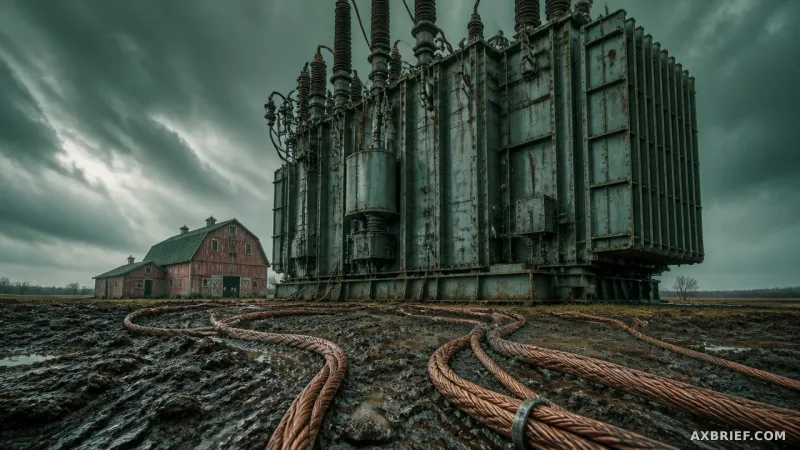
The AI industry has spent the last few years obsessed with the invisible: weights, tokens, and latent space. But in the boardrooms of San Francisco and the halls of government in the Midwest, the conversation has shifted to something far more tangible: megawatts and acreage. The era of optimizing algorithms to fit existing hardware is ending; the era of building the world to fit the algorithms has begun. This week, the shift became physical.
The 1GW Blueprint for The Barn
OpenAI has officially broken ground on The Barn, a massive 1GW data center campus located in Saline, Michigan. This project represents a departure from the traditional reliance on third-party cloud providers, signaling a move toward total control over the physical layer of intelligence. To execute a build of this magnitude, OpenAI has assembled a consortium of industrial heavyweights. Oracle provides the cloud infrastructure expertise, Blackstone handles the massive capital requirements, and Walbridge and Related Digital manage the construction and digital design processes. The groundbreaking ceremony, attended by Michigan Governor Gretchen Whitmer and local labor leaders, underscored the project's scale not just as a tech venture, but as a regional economic engine.
A 1GW power capacity is an outlier even by modern hyperscale standards. For context, this level of energy is required to sustain the constant, high-intensity training and inference cycles of next-generation frontier models. By securing this capacity, OpenAI is addressing the primary bottleneck of the current AI era: the power grid. The strategy here is to move beyond software-level efficiency and secure the physical resources—land and electricity—that will define the winners of the next decade. The Barn is not merely a server farm; it is a dedicated fortress for computation designed to ensure that hardware limitations never again throttle the pace of model evolution.
This expansion into Michigan is a calculated move to leverage the state's deep engineering heritage and construction culture. By partnering directly with the state government and local labor unions, OpenAI is streamlining the administrative and permitting hurdles that often plague massive infrastructure projects. The goal is to accelerate the deployment of power infrastructure, ensuring that the physical site is ready the moment the next generation of chips arrives. In this new landscape, the ability to secure a gigawatt of power is as critical a benchmark as any HumanEval or MMLU score.
Vertical Integration and the Stargate Strategy
This move is the physical manifestation of the Stargate program, launched in January 2025. For years, OpenAI operated in a linear progression: first Research, then Products. Now, the company has entered the third and most aggressive phase: Infrastructure. This shift toward vertical integration means OpenAI is no longer content to be a tenant in someone else's cloud. By controlling the entire stack—from the physical power grid and cooling systems to the networking and the model weights—the company can directly manage service availability, latency, and reliability.
When a company controls its own infrastructure, the economics of AI change. Increased computing power leads to higher model intelligence, while increased infrastructure efficiency lowers the cost of delivery. OpenAI is investing in the entire pipeline to remove data bottlenecks and optimize power efficiency, effectively lowering the barrier to deploying high-performance AI at scale. This is a structural redesign of the AI business model, moving from a software-as-a-service (SaaS) approach to something closer to a utility provider.
One of the most significant technical hurdles in 1GW-scale computing is thermal management. To solve this, OpenAI has implemented a closed-loop cooling system. Unlike traditional data centers that consume vast amounts of water through evaporation, a closed-loop system circulates coolant through a sealed path. This allows The Barn to maintain a water footprint comparable to a standard office building despite its massive energy draw. By solving the water-energy tension through engineering, OpenAI is mitigating the environmental and regulatory risks that typically trigger community backlash against data centers.
This strategy extends into the social and educational fabric of Michigan. The project is projected to generate 1 billion dollars in tax revenue over the lease term, providing a direct windfall for local schools and public services. The employment impact is equally precise: 2,500+ union construction jobs, 450 permanent operational roles, 1,500 county-level jobs, and 1,000 indirect positions, totaling 5,450 jobs. To further embed itself in the community, OpenAI, Oracle, and Related are donating 10 million dollars to improve the Saline Recreation Center, transforming a closed-off industrial site into a catalyst for public utility.
Perhaps the most sophisticated part of the plan is the human capital strategy. OpenAI is allocating up to 45 million dollars in Codex credits for over 400,000 students aged 18 and older across Michigan's universities, community colleges, and vocational schools for the 2026-2027 academic years. Students can participate via the Codex for Michigan College Students page. This is a classic lock-in strategy. By providing the tools of the trade to the next generation of developers, OpenAI ensures that the future workforce is natively fluent in its specific interfaces and workflows.
This educational push is paired with a partnership with the Michigan Department of Labor and Economic Opportunity to create AI literacy and workforce training programs. The goal is to transition local labor into AI operations and management roles, ensuring that the hardware does not sit idle for lack of skilled personnel. In the global AI race, the final bottleneck is not the chip, but the human capable of operating it. By synchronizing infrastructure build-out with human capital development, OpenAI is creating a self-sustaining ecosystem.
The battle for AI supremacy is no longer being fought in the code, but in the power grid.



