The modern AI developer is currently locked in a silent war with the GPU tax. Every new agentic workflow, every complex reasoning chain, and every attempt to scale a production-grade LLM hits the same wall: the brutal trade-off between intelligence and inference cost. For years, the industry has accepted this as a fixed law of physics, assuming that higher reasoning capabilities inevitably require an exponential increase in compute and a corresponding spike in the monthly cloud bill. The tension is no longer about whether a model can solve a problem, but whether it can solve it without bankrupting the operation.
The Silicon Shift and the Jalapeño Benchmark
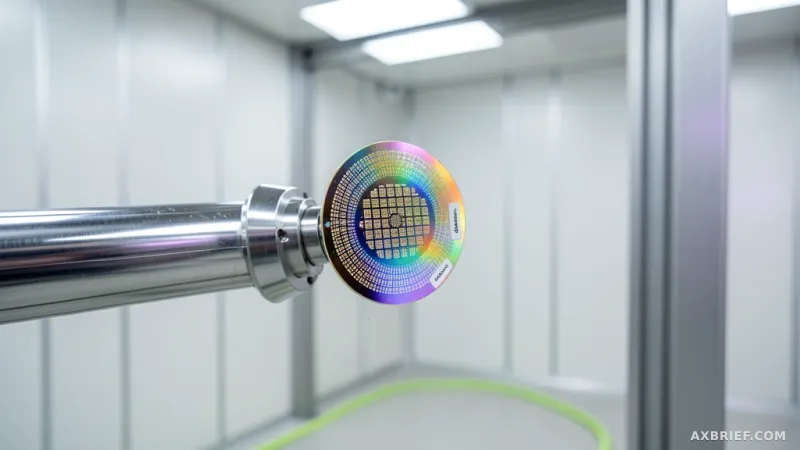
OpenAI has moved to break this deadlock by unveiling Jalapeño, its first proprietary inference chip. This is not merely a hardware iteration but a strategic pivot toward vertical integration. To prove the chip's viability, OpenAI released performance metrics using the InferenceX public benchmark with the GPT-OSS 120B model. The results indicate that Jalapeño achieves a higher peak throughput per kilowatt and significantly lower token latency compared to existing commercial systems. This efficiency is not limited to a single architecture; the chip demonstrated strong performance across diverse models, including DeepSeek R1 and Kimi K2, proving that Jalapeño is designed for general-purpose efficiency rather than narrow optimization.
By securing its own silicon, OpenAI has effectively seized control over the economics of its service delivery. The company is no longer solely dependent on external hardware roadmaps to determine how its models are served. While OpenAI continues to utilize partner accelerators, the introduction of Jalapeño allows the company to match specific workloads to the most economical hardware available. This capability reduces the volatility of inference costs and expands the total supply of compute available for its users. Furthermore, the company has already transitioned beyond these initial models and entered the development phase for the next generation of chips, signaling that Jalapeño is the first step in a long-term hardware roadmap.
The Full-Stack Co-Design and the Pareto Frontier
The real disruption, however, is not the chip itself but the philosophy of co-design. OpenAI is moving away from the traditional siloed approach where models are built by researchers and then deployed on generic hardware. Instead, they are implementing a strategy that integrates the model, serving software, silicon, memory, and networking into a single, unified system. In this framework, the software is designed to maximize the productivity of the hardware, and the hardware is tailored to eliminate the specific bottlenecks of the software. This creates a compounding effect where improvements in one layer accelerate gains in all others, removing the friction that typically occurs when data moves from a high-level model request to a physical transistor.
This systemic approach extends to the physical world through Project Camellia, a new data center initiative in Georgia. Project Camellia is designed around the specific characteristics of AI workloads rather than general-purpose cloud computing. To mitigate the environmental impact of massive compute clusters, the facility employs a closed-loop water cooling system to prevent resource waste. OpenAI has also integrated local economic support and energy cost management into the facility's core design, committing to annual independent public audits to ensure transparency and accountability. By optimizing the energy supply and cooling efficiency at the site level, OpenAI is maximizing the amount of useful intelligence produced per unit of computing resource.
To maintain this edge, OpenAI is diversifying its partner portfolio to avoid vendor lock-in and manage supply chain risks. While Microsoft and Nvidia remain central, the company has expanded its ecosystem to include AWS, AMD, Broadcom, Cerebras, CoreWeave, Oracle, SB Energy, and SoftBank. This allows OpenAI to operate on a Pareto frontier, where they can prioritize different metrics based on the specific workload. For frontier model training or high-stakes reasoning, they deploy premium, high-performance systems. For massive-scale inference or always-on agents, they shift to efficiency-optimized systems. This diversification ensures that they can always route demand to the system with the best performance-to-cost ratio.
This economic shift is most evident in the performance of GPT-5.6 Sol. According to the Artificial Analysis Coding Agent Index, GPT-5.6 Sol reaches top-tier performance scores while using 54% fewer output tokens in its maximum reasoning mode compared to leading competitors. This reduction is a direct result of increased intelligence; the model requires fewer attempts and less redundant reasoning to reach the correct answer. When combined with smart routing and optimized context management, the total cost to complete a complex workflow drops significantly.
This creates a phenomenon known as the Jevons paradox, where an increase in efficiency actually leads to an increase in total consumption. As the cost per unit of useful intelligence drops, tasks that were previously too expensive—such as real-time financial scenario modeling or the exhaustive review of tens of thousands of legal contracts—become economically viable. The growth generated by this efficiency is then reinvested into further R&D and safety infrastructure, creating a virtuous cycle of expansion.
For the AI practitioner, the metric of success has shifted. The industry is moving past the era of chasing raw benchmark scores and entering the era of useful intelligence per dollar. The goal is no longer just to find the smartest model, but to construct an infrastructure that hits the Pareto optimal point between performance and cost.