
Modern electronic warfare has turned the sky into a battlefield of invisible signals. In recent conflicts, such as the Spider Web operations in Ukraine and Rising Lion operations in Israel, GPS jamming and spoofing have become standard tactics to neutralize unmanned aerial vehicles. When the satellite link vanishes, most drones lose their orientation and drift, rendering them useless or easy targets. This vulnerability has created an urgent demand for drones that can think and navigate without relying on an external signal from space.
The Convergence of Additive Manufacturing and Autonomous Flight
QuantumAero has entered a strategic partnership with Konyang University to solve this critical failure point. Through a recently signed agreement for defense industry development and joint technical research, the two entities are focusing on autonomous flight technology specifically designed for GPS-denied environments. This initiative aligns with Konyang University's vision as a leading K-Defense industry university under the Glocal University 30 project.
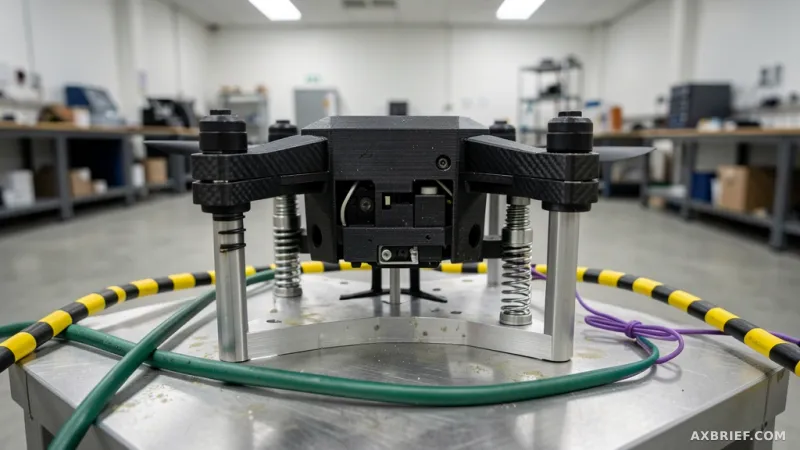
The core of the research addresses a specific hardware-software conflict. QuantumAero utilizes 3D printing for drone airframes to enable rapid production and field deployment. However, additive manufacturing often introduces structural characteristics that cause specific vibration patterns. These vibrations create significant noise in the Inertial Measurement Unit (IMU), the sensor responsible for measuring acceleration and angular velocity. When the IMU is flooded with noise, the drone's internal sense of balance and position degrades, making precise autonomous flight nearly impossible without GPS correction.
QuantumAero brings a proven track record to this collaboration. The company recently launched the QA Strike 101, a dedicated defense FPV drone, and secured a spot in the top 11 of the attack team during a drone and anti-drone competition hosted by the Ministry of National Defense. This technical foundation provides the baseline for integrating advanced AI-driven navigation into 3D-printed platforms.
Solving Hardware Limitations Through Software Compensation
The breakthrough in this project lies in the shift from trying to eliminate physical vibration to compensating for it via software. Rather than pursuing an impossibly rigid 3D-printed frame, the team is implementing a combination of Visual SLAM (Simultaneous Localization and Mapping) and VIO (Visual-Inertial Odometry).
Visual SLAM allows the drone to use its onboard cameras to map the surrounding environment in real-time, identifying landmarks to determine its position. VIO enhances this by fusing camera data with IMU readings to track the drone's trajectory with high precision. The innovation here is the development of a vibration compensation algorithm specifically tuned for the noise profiles of additive manufacturing. By analyzing the specific frequency of vibrations produced by 3D-printed components, the software can filter out the noise and extract the true motion data.
Konyang University provides the industrial additive manufacturing infrastructure necessary to produce prototypes and collect raw vibration data. This data is then fed back into the algorithm to refine the compensation logic. This loop ensures that the resulting autonomous flight technology is not just a theoretical model but a practical solution tailored to the physical realities of 3D-printed hardware. Beyond the technical development, the partnership includes the establishment of R&D and R&BD (Business Development) frameworks, including specialized contract departments to train the next generation of defense AI engineers.
By treating the physical limitations of 3D printing as a data problem rather than a manufacturing flaw, QuantumAero and Konyang University are redefining the viability of field-produced drones. The ability to print a drone on-site and have it fly autonomously through a jammed environment shifts the advantage back to the operator.



