
The robotics industry has a pervasive demo problem. For years, the public has consumed polished, highly edited videos of humanoids performing seamless tasks, only to find that the actual deployment is fraught with instability and failure. In the controlled environment of a laboratory, a robot can be programmed for a specific path, but the chaos of a football pitch offers no such luxury. This week, the RoboCup 2026 Humanoid League serves as the ultimate antidote to the demo trap, forcing developers to move their theories out of simulation and into a high-stakes physical arena where the only metric that matters is the score on the board.
The Global Scale of Physical AI Competition
The RoboCup 2026 Humanoid League has evolved into a massive geopolitical and technical showcase, drawing teams from 17 different countries. The geographic diversity is striking, with participants arriving from Colombia in South America, Malaysia in Southeast Asia, Germany in Europe, and Australia in Oceania. This variety in origin brings a corresponding variety in engineering philosophies, as each team approaches the problem of bipedal locomotion and ball handling from different cultural and academic perspectives. Among these, China has emerged as the dominant force in terms of sheer volume, fielding 15 teams. This massive presence is not concentrated in a single category but is spread across all three divisions, reflecting a broad national investment in humanoid research across various universities and institutes.
To maintain fairness and safety, the league operates under a strict three-tier division system: Small, Middle, and Large. Because the physical interaction between a 5kg robot and a 50kg robot would be catastrophic, these divisions ensure that robots compete against peers with similar mass and scale. This structure shifts the competition from a battle of raw hardware power to a battle of software optimization. Before a robot even touches the grass, it must pass a rigorous qualification process. Teams are required to submit detailed manuals, software specifications, and qualification videos that prove the robot can perform basic movements. This prevents the danger of unstable machines entering the field and causing systemic failures.
Safety is further enforced through a real-time disciplinary system. Referees issue yellow cards for unsafe challenges, which are defined as movements that risk damaging other robots or the field infrastructure, often caused by a failure in balance control. If a robot accumulates two yellow cards, it receives a red card and is immediately removed from the match. This is not merely a sporting penalty but a technical necessity. In the world of Physical AI, a minor calculation error in a control loop can lead to a permanent hardware crash. The red card system acts as a fail-safe, isolating unstable systems to preserve the integrity of the overall competition.
The Hardware Gap and the Shift to Standardized Platforms
The most jarring aspect of the league is the extreme disparity in physical specifications. At one end of the spectrum is the ALICE 4 robot from the HERoEHS team, which stands as the heaviest and tallest competitor at 160cm and 48kg. This robot possesses a physical profile similar to an adult human, granting it a massive advantage in terms of stride length and the ability to apply significant force to the ball. Following closely is the Z4 bipedal humanoid from the BigHeroX team, weighing in at 37kg. These heavyweights rely on high-torque actuators to manage their own inertia, as the energy required to stop a 48kg mass in motion is exponentially higher than that of a smaller bot.
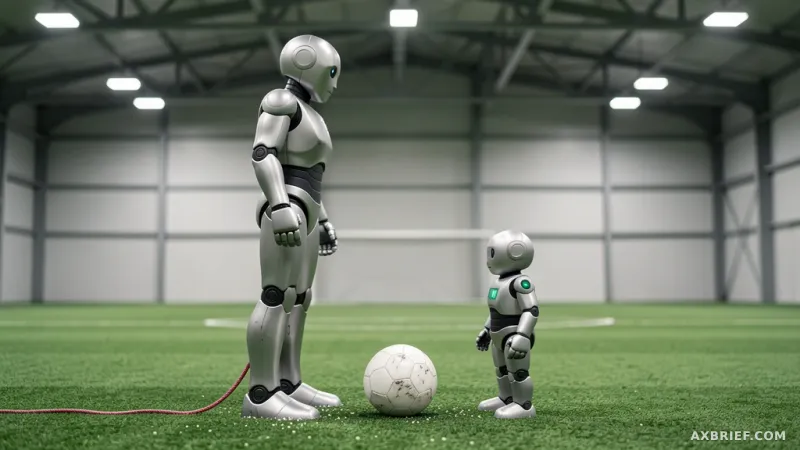
In stark contrast, the Chape robot from the ITAndroids team represents the opposite extreme, weighing only 3.8kg and standing 53cm tall. The weight difference between ALICE 4 and Chape is approximately 12.6 times, while the height difference is roughly 3 times. While Chape is vulnerable to being knocked over by larger opponents, its low center of gravity allows for rapid changes in direction and acceleration that the larger robots cannot replicate. This creates a fascinating technical tension: the 48kg robot must fight its own momentum to stay precise, while the 3.8kg robot must fight external perturbations to stay upright.
Interestingly, a trend toward hardware standardization is emerging. Many teams have adopted the Unitree G1 platform, a 35kg humanoid that has become a common baseline for the competition. By utilizing a pre-verified hardware platform, engineers are bypassing the tedious process of kinematic design and focusing their efforts entirely on the control algorithms. This shift indicates that the industry is moving away from the era of bespoke hardware and into the era of Physical AI optimization. When multiple teams use the same Unitree G1 chassis, the winner is no longer the one with the best motor, but the one with the most efficient neural network or control loop.
This technical reality is reflected in the seeding round results. In the Small Division, CAU Mountain&Sea has dominated the field with 4 wins in 4 matches, securing 12 points and conceding only a single goal. In the Middle Division, the B-Human team has displayed an overwhelming offensive capability, recording 4 wins and a staggering goal difference of +35. Meanwhile, in the Large Division, Tsinghua Hephaestus stands as the only undefeated team with 3 wins and 9 points. These numbers provide a cold, hard truth that no demo video can simulate: the ability to maintain balance, track a ball, and execute a kick in a dynamic environment is the only true measure of a robot's intelligence.
The transition from a polished video to a live match is where the fragility of current AI is exposed. A robot that looks graceful in a 30-second clip may be a liability on the field, earning red cards for instability. The real victory in RoboCup 2026 is not found in the aesthetics of the movement, but in the robustness of the system's recovery from failure. As these robots clash, the league proves that the future of humanoid AI will not be decided by who can create the best simulation, but by who can survive the physical world.



