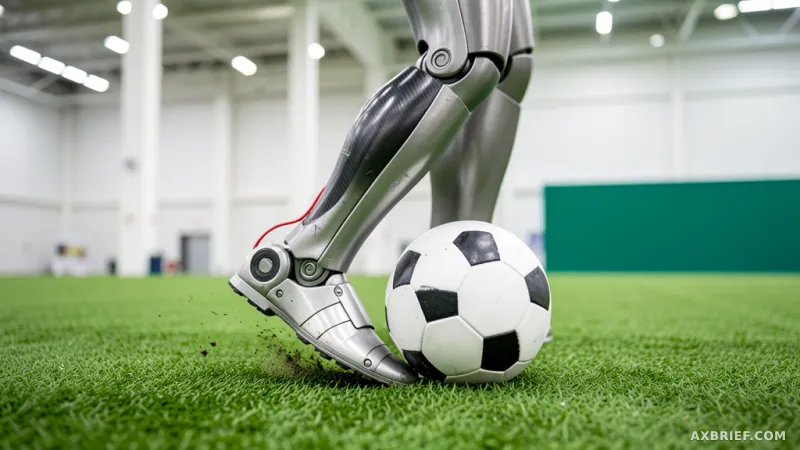
The tech world is accustomed to the polished choreography of AI demonstration videos. We see robots navigating complex mazes or scoring goals with surgical precision, but these clips are often the result of a thousand failed attempts and careful editing. In the vacuum of a controlled demo, the environment is a constant. In the real world, the environment is an adversary. This fundamental tension between simulated success and physical reality is exactly why the global robotics community converged on the Incheon Songdo Convention Center from July 2 to 6, 2026, for RoboCup 2026. This was not merely a competition, but a rigorous stress test for Physical AI—artificial intelligence that must operate within the messy, unpredictable constraints of the material world.
The Infrastructure of Real-World Validation
RoboCup 2026 served as a massive laboratory, drawing approximately 3,000 participants from 40 different countries. The event was structured around three primary pillars: competitive matches to test peak performance, dedicated training sessions to refine behavioral patterns, and a technical symposium where researchers shared the theoretical frameworks behind their builds. Unlike a software hackathon, the stakes here were physical. Every line of code had to translate into a mechanical action that could withstand the friction of a turf floor, the instability of a battery discharge, and the chaos of an opponent's collision.
To ensure the event functioned as an open-source learning opportunity, organizers maintained a transparent flow of information. Detailed schedules and guidelines were hosted on the official information page https://t.co/T5mjdVMhH3, while the actual execution of the robots was broadcast in real-time via the @RoboCup YouTube channel and the robocupofficial Twitch account. This streaming strategy transformed the venue into a global classroom, allowing developers who could not travel to Incheon to analyze the failure modes and success patterns of their peers in real-time.
The concentration of so many teams in one location highlights the unique difficulty of Embodied AI. An AI model can achieve a perfect score in a virtual simulation, but once it is ported to a physical chassis, it encounters the sim-to-real gap. This gap consists of sensor noise, motor backlash, and unpredictable power fluctuations. RoboCup 2026 sought to standardize these variables through a strict set of rules, effectively creating a benchmark for how AI handles the physical world's inherent instability.
The Shift from Software Elegance to Hardware Pragmatism
When observing the robots at RoboCup 2026, the most striking insight was that software optimization often reaches a ceiling that only hardware can break. A prime example was the Booster T1 model operated by Raghav Arora. The robot faced a classic problem in indoor navigation: precise localization in an environment without a pre-existing map. While many teams attempted to solve this through more complex SLAM (Simultaneous Localization and Mapping) algorithms, Arora took a pragmatic hardware approach.
The Booster T1 was equipped with an external Lidar sensor, which emits laser pulses to measure distances to surrounding objects with millimeter precision. To integrate this, the team designed and attached a physical backpack to the robot. This backpack was not an aesthetic choice but a functional necessity, providing the structural support and power delivery required to elevate the Lidar sensor. By increasing the sensor's height, the team effectively eliminated blind spots that would have plagued a lower-mounted sensor, regardless of how advanced the software was.
This approach reveals a critical truth about Physical AI: the most efficient path to reliability is often a physical modification rather than a code update. By using the Lidar backpack to provide high-fidelity spatial data, the Booster T1 could minimize localization errors and generate optimal paths to its destination with far greater certainty than robots relying on standard onboard sensors. It was a victory of hardware pragmatism over algorithmic idealism.
This trend toward standardization continued with the adoption of open platforms. High Torque Robotics, which managed the Mini Pi plus teams, abandoned closed, proprietary systems in favor of ROS2 (Robot Operating System 2). In the past, adding a new sensor to a robot required writing custom drivers and defining new communication protocols from scratch. If a manufacturer stopped supporting a part, the entire system risked obsolescence. ROS2 changes this by providing a standardized communication layer that allows different hardware components to talk to each other using a common language.
By leveraging ROS2, High Torque Robotics shifted its engineering focus. Instead of spending weeks on low-level hardware integration, their engineers spent that time refining the AI's decision-making logic and game strategy. The result was a dominant performance, with four of their teams breaking into the Top 8 of the Mini Pi plus league. This success demonstrates that the acceleration of Physical AI depends less on secret, proprietary code and more on the adoption of shared, open-source standards that allow developers to build upon a stable foundation.
Resilience as the Ultimate Benchmark
The results of the competition further underscored the divide between theoretical capability and physical execution. Tsinghua University maintained its dominance in the Humanoid League, defending its title by mastering the precarious balance required for a bipedal robot to play soccer. Their victory was a testament to the integration of complex joint-control algorithms and real-time strategic processing, proving that they had solved the most difficult aspect of humanoid robotics: maintaining equilibrium while executing a goal.
In the Mini Pi plus league, the Hamburg Bit-Bots took the top spot. The fact that multiple teams using the same hardware platform—specifically those from High Torque Robotics—placed in the top tier suggests that hardware has reached a level of commoditization. The competitive edge has shifted entirely to software optimization and the efficiency of control logic. The battle is no longer about who has the best motor, but who can extract the most performance from the available hardware.
However, the most educational moments of the event were the failures. The Booster K1 provided a sobering example of the fragility of Physical AI. During a match, the robot lost its balance and tipped over. While it attempted to right itself by manipulating its legs, it ultimately failed to recover and remained stranded. This failure highlighted a gap that no amount of soccer strategy can fix: resilience. A robot that can score a goal but cannot survive a fall is fundamentally less capable than a robot that can recover from any position.
For the AI practitioners in attendance, the lesson was clear. The maturity of a Physical AI system is not measured by its peak performance in a perfect scenario, but by its recovery rate in a worst-case scenario. The ability to perceive a failure state—such as being overturned—and execute a recovery sequence is the true hallmark of an advanced embodied agent.
RoboCup 2026 proved that the future of robotics will not be won by the most powerful model, but by the most resilient system. The transition from the screen to the stadium reveals that stability, standardization, and physical adaptability are the only metrics that truly matter when AI leaves the cloud and enters the world.